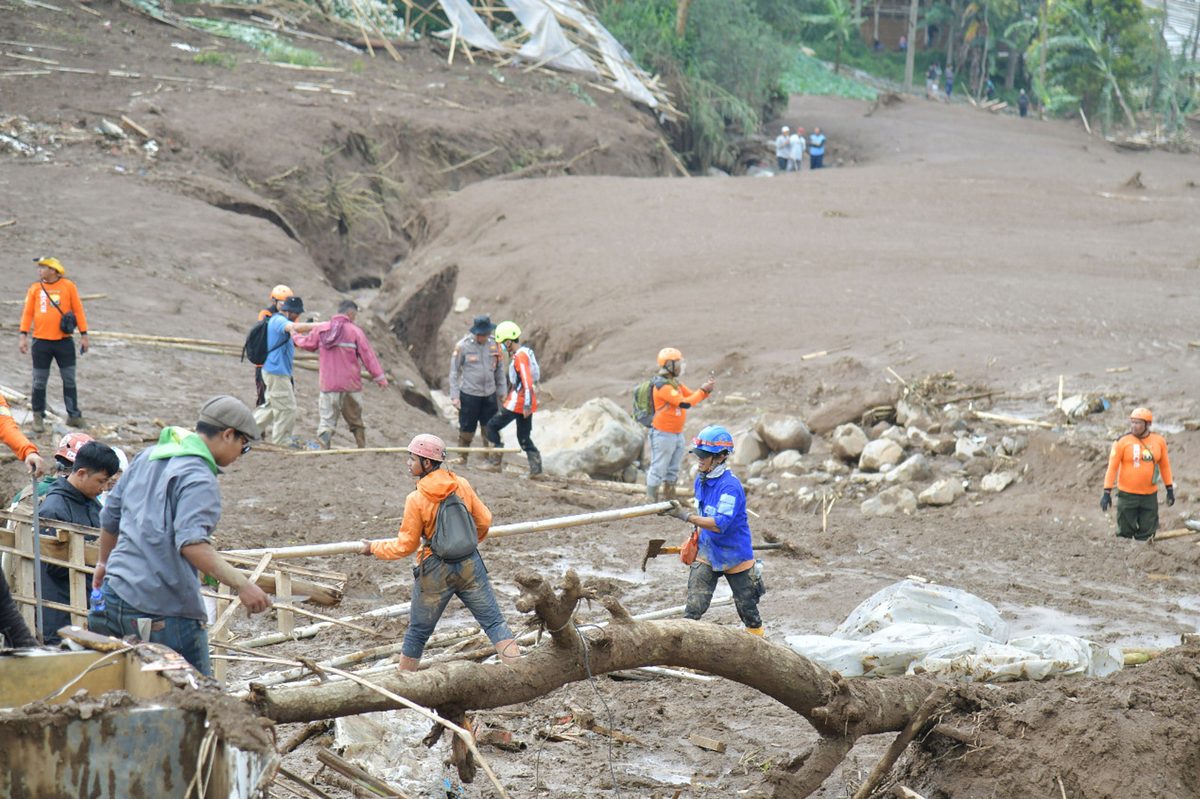
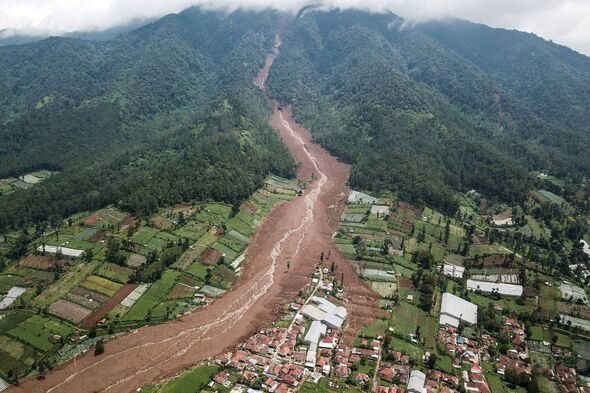
A predawn landslide hit Pasir Langu village on Mount Burangrang at 2 a.m. on January 24, 2026, burying 34-48 houses and a marine training camp under up to 8 meters of mud while residents slept. At least 85 people died, including 23 members of Indonesia's elite marine force conducting border patrol training.[1][2][7]
Search teams are now in their 12th day manually excavating a 2-kilometer debris field. Over 3,675 personnel, tracker dogs, drones, and heavy equipment are deployed despite unstable terrain. Basarnas extended the emergency response beyond February 6, with 564 people from 164 families displaced to shelters.
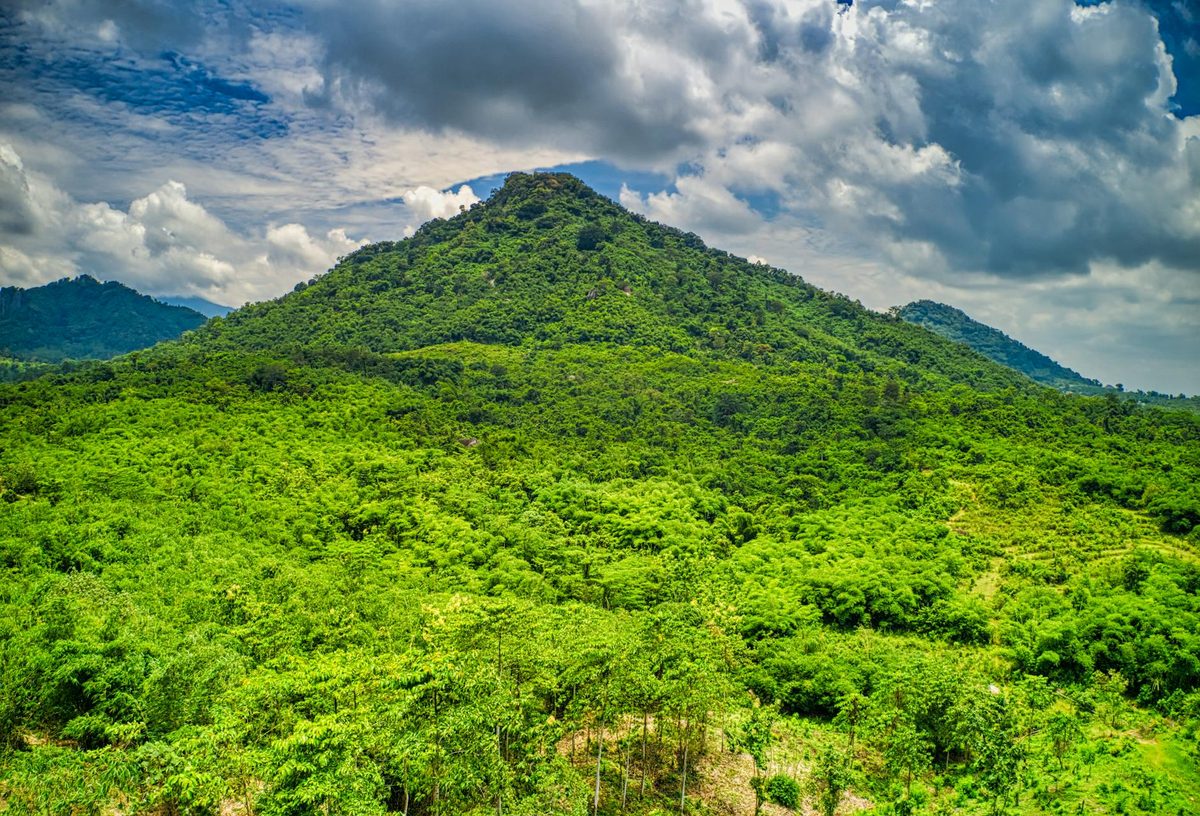
Environmental groups attribute the landslide to years of illegal land conversion in the 38,543-hectare North Bandung Area conservation zone. A similar cause was cited in the Sumatra floods that killed over 1,100 people in late 2025.[2][3]
Questions about this story
Free account needed to ask — your question is kept and asked for you right after sign-up. Answers are public.
No questions yet — be the first to ask.
Key Indicators
85
Confirmed dead
Death toll risen to 85 as of February 4; includes at least 23 Indonesian marines on training exercise
10+
Still missing
At least 10 unaccounted for as search enters 12th day; hampered by unstable ground and terrain
75
Rescued alive
Survivors pulled from debris by search teams
3,675
Search personnel
Expanded operation using tracker dogs, drones, excavators, and heavy equipment across 2km debris field
564
Displaced
564 people from 164 families relocated after 48+ houses damaged; housed in government shelters
18 events
Latest: February 4th, 2026 · 8 months ago
Showing 8 of 18
JK to step
Tap a bar to jump to that date
Jump to
February 2026
Death toll climbs to 85 as search enters 12th day
LatestRescue Operations
Authorities recover additional bodies in West Bandung, raising confirmed fatalities to 85. Search continues for at least 10 still missing amid challenging terrain; operations extended beyond February 6 deadline.
Death toll reaches 80; all bodies evacuated from site
Rescue Operations
Bandung Search and Rescue Office reports 80 recovered bodies evacuated. Disaster affected 158 people, displacing 564 from 164 families and damaging 48 homes.
Death toll reaches 53 as search continues for 10 missing
Rescue Operations
Consolidated casualty count shows 53 confirmed dead and 10 still missing on the ninth day of operations. Search efforts continue as emergency response period approaches February 6 deadline.
January 2026
Death toll reaches 49-64 as emergency response extended
Rescue Operations
Basarnas reports death toll at 49 with 15 missing, though some sources report 64 dead with 16 missing. Emergency response period extended to February 6. Search operation now involves 3,675 personnel with 75 people rescued alive.
Friday update shows continued recovery of bodies as search teams work through unstable mud and debris.
Over 50 bodies recovered; search continues
Rescue Operations
Fifth day of operations yields additional victims. More than 50 houses confirmed severely damaged, displacing over 650 people.
Death toll rises to 34, with 32 still missing
Rescue Operations
National Disaster Management Agency updates casualty figures. Continued rain hampers search efforts across the 2-kilometer debris field.
Death toll reaches 50; 30 still missing
Rescue Operations
Joint SAR team reports 50 bodies recovered, 75 survivors, and 30 people still missing. Total affected rises to 158 people.
Indonesian marines confirmed among casualties
Disaster
At least 19 members of Indonesia's elite marine force confirmed missing, with 4 marines among the confirmed dead. The marines were conducting border patrol training exercises when the landslide swept away their camp.
Search operation expands to 2,100 personnel
Rescue Operations
Massive search operation grows from initial 500 to 2,100 personnel using bare hands, water pumps, drones, and nine excavators. Teams digging through debris field stretching more than 2 kilometers.
Death toll rises to 18; 72 still missing
Rescue Operations
A 250-member search team using drones, canine units, and manual excavation recovers additional bodies. Loose ground prevents deployment of heavy equipment.
Vice President visits disaster site
Government Response
Vice President Gibran Rakabuming Raka tours Pasir Langu village and urges local authorities to address illegal land conversion in disaster-prone areas.
Environmental group blames spatial-planning violations
Analysis
Walhi West Java says the disaster reflects years of illegal land conversion in the North Bandung Area conservation zone, calling it "not simply a natural disaster."
Predawn landslide strikes Pasir Langu village
Disaster
Water and loose soil from Mount Burangrang's slopes barrel into the village, burying 34 houses under up to 5 meters of debris while residents sleep. Initial reports indicate 7-8 dead, 82 missing.
West Bandung declares two-week emergency
Government Response
Regent Jeje Ritchie Ismail issues emergency decree and orders evacuation of residents within 100 meters of the slide zone. Approximately 230 people relocated to government shelters.
December 2025
Sumatra death toll passes 1,000
Context
President Prabowo Subianto says activities in flood-stricken Sumatra may return to normal in 2-3 months. Government files lawsuits against six companies over environmental degradation.
November 2025
Tropical Cyclone Senyar triggers Sumatra disaster
Context
Intense cyclonic conditions begin flooding and landslides across Aceh, North Sumatra, and West Sumatra provinces that will ultimately kill over 1,100 people.
Scenarios
1
Death Toll Exceeds 50 as Recovery Ends
Likely
Discussed by: Disaster management experts citing conditions at similar Indonesian landslides
With 72 people still missing under meters of mud and unstable terrain preventing heavy equipment deployment, most of those unaccounted for are likely deceased. The final death toll could exceed 50-70, placing this among Java's deadliest landslides in recent years. Rescue operations would transition to body recovery within days.
2
Government Announces Enforcement Action Against Illegal Development
Possible
Discussed by: Environmental groups, Jakarta Post analysts
Following the pattern established after the December 2025 Sumatra disaster—where the government sued six companies—authorities could pursue legal action against entities responsible for illegal land conversion in the North Bandung Area conservation zone. Vice President Gibran's comments about addressing land conversion suggest this is under consideration.
3
Pattern Continues: Another Major Landslide Strikes Java Before Monsoon Ends
Possible
Discussed by: Indonesian disaster management agency, climate researchers
Indonesia's monsoon season runs through April. With 108 million people living in landslide-susceptible zones and continued illegal development in vulnerable areas, additional deadly landslides remain likely. The West Bandung disaster comes just two months after Central Java's Banjarnegara landslides killed 30 people in November 2025.
4
Structural Reform of Conservation Zone Enforcement
Repeated disasters linked to spatial-planning violations could prompt systemic reform of how conservation zones like the North Bandung Area are monitored and enforced. However, Indonesia's track record suggests incremental responses are more likely than comprehensive reform, particularly given competing development pressures.
Historical Context
3 moments from history that rhyme with this story — and how they unfolded.
1 of 3
December 2014
Banjarnegara Landslide (2014)
A landslide struck Jemblung Village in Banjarnegara Regency, Central Java, at 3 p.m. on December 13, 2014, burying more than 100 houses while many residents napped. Over 3,000 rescuers, including soldiers and volunteers, searched the debris for weeks.
Then
93 people died with 23 still missing. President Joko Widodo visited and ordered military assistance for evacuations from surrounding villages.
Now
The disaster highlighted the vulnerability of settlements on Java's volcanic slopes but did not lead to significant changes in land-use enforcement. Similar disasters continued in the following years.
Why this matters now
Like the Mount Burangrang landslide, Banjarnegara struck while residents slept or rested, demonstrating the lethal combination of steep volcanic terrain, deforested slopes, and settlements in high-risk zones.
2 of 3
December 2018
Sukabumi Landslide (2018)
On New Year's Eve 2018, a landslide struck Sirnaresmi village in Sukabumi Regency, West Java, burying 30 houses in a settlement within Mount Halimun Salak National Park. Officials noted that landslides had occurred in Cisolok subdistrict "every year since 2010."
Then
18 confirmed dead, 15 missing. Bodies were found buried under 4 meters of mud.
Now
Government data showed 132 landslides had struck Sukabumi in the previous decade. Despite this pattern, settlements in high-risk areas persisted, and enforcement of land-use restrictions remained inconsistent.
Why this matters now
Sukabumi established that West Java faces recurring, predictable landslide disasters in the same geographic areas—a pattern now extending to the North Bandung Area where the current disaster occurred.
3 of 3
November-December 2025
Sumatra Floods and Landslides (2025)
Tropical Cyclone Senyar triggered catastrophic floods and landslides across Aceh, North Sumatra, and West Sumatra provinces. Environmental groups identified deforestation by mining, palm oil, and timber companies as amplifying factors.
Then
Over 1,100 dead, 7,000+ injured, 166,000 homes damaged. The government sued six companies over environmental degradation.
Now
The lawsuits represent Indonesia's most aggressive legal response to disaster-linked deforestation, though it remains unclear whether they will result in meaningful penalties or policy changes.
Why this matters now
The West Bandung landslide occurred just weeks after Sumatra, with environmental groups drawing direct parallels—both disasters attributed not just to rainfall but to years of illegal land conversion in protected areas.