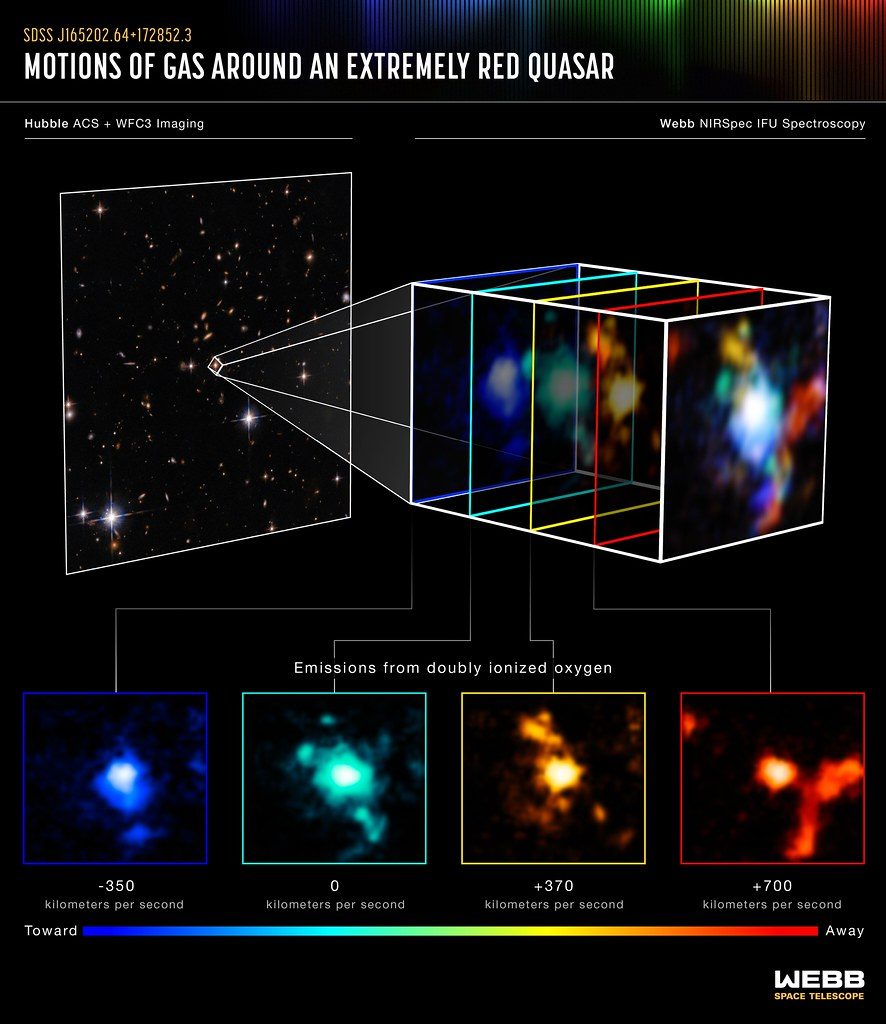
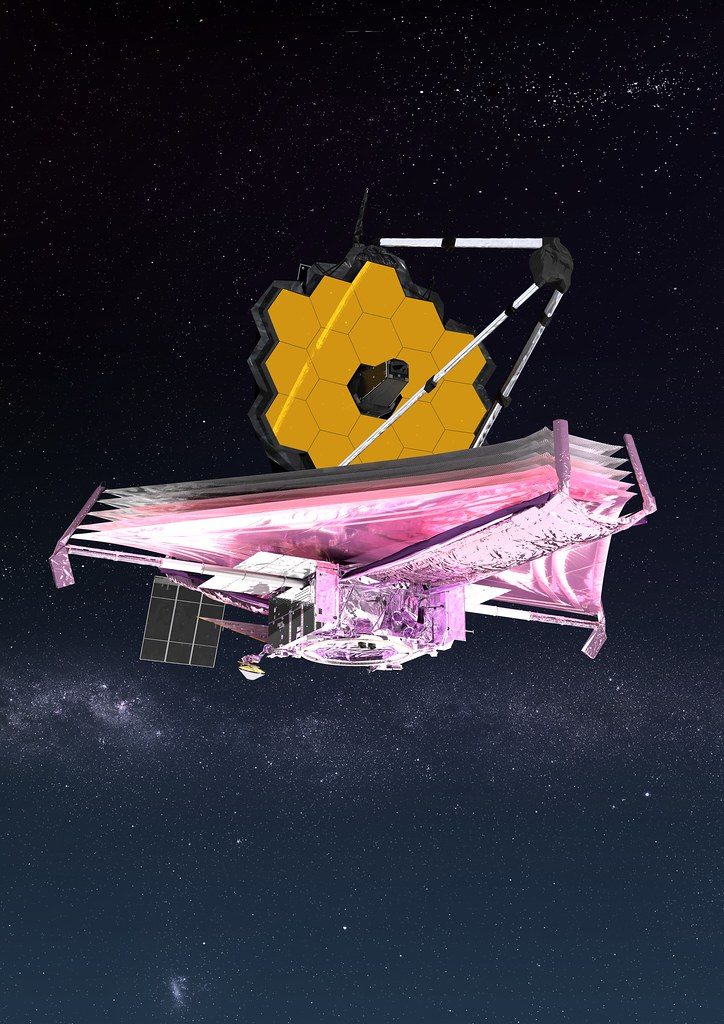
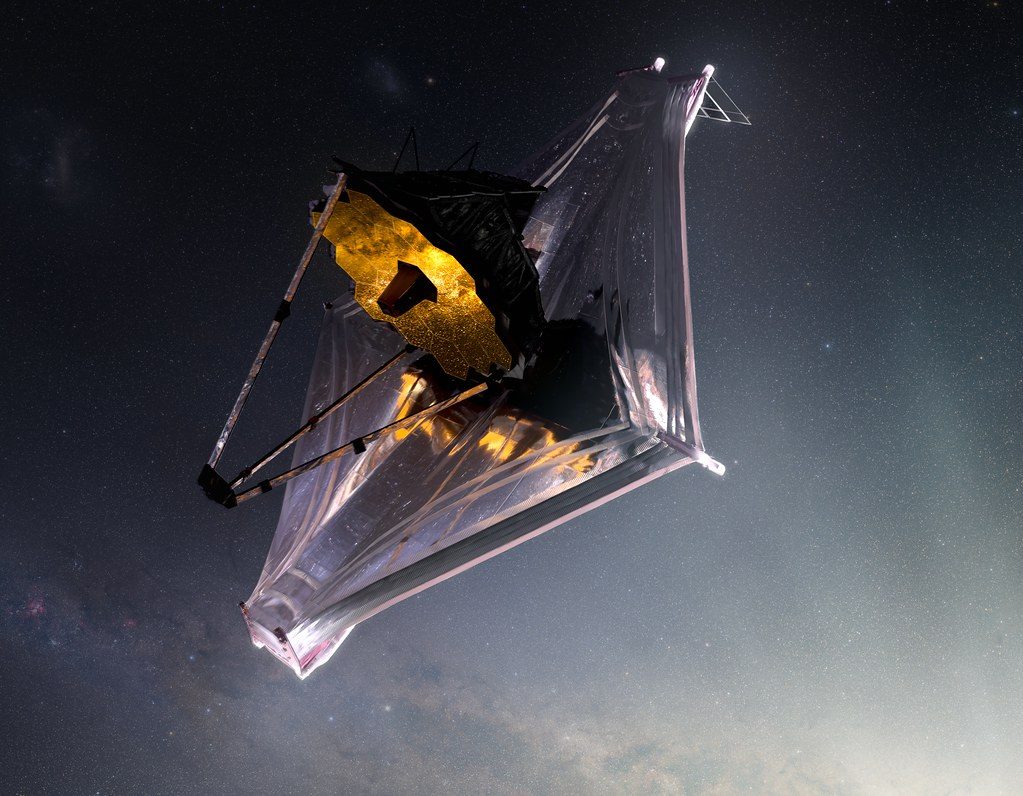
In January 2026, NASA confirmed MoM-z14 as the most distant galaxy ever observed, formed 280 million years after the Big Bang. JWST has kept adding to the list: a non-rotating dead galaxy, a dust-rich red galaxy at 400 million years old, and a 164,000-galaxy map of the cosmic web—all published in the months since.
None of these findings are breaking cosmology—astronomers still think Lambda-CDM is broadly right. But the early universe is turning out to be more structurally complex and chemically advanced than pre-JWST models assumed. Revisions to galaxy formation theory are becoming unavoidable.
Why it matters
When astronomers can't explain the early universe, they can't fully explain how stars, planets, or we ourselves ended up here.
Questions about this story
Free account needed to ask — your question is kept and asked for you right after sign-up. Answers are public.
1
What's the coolest thing that this telescope could teach us about the universe?
JWST's best shot at a jaw-dropping discovery is solving where supermassive black holes came from — a mystery that touches on why every large galaxy, including ours, exists at all.
Why it matters: Every massive galaxy has a black hole millions or billions of times the Sun's mass at its center, and no one knows how they got there so fast after the Big Bang.
—JWST found a 1.6 million solar mass black hole actively feeding in GN-z11 just 430 million years after the Big Bang — far too massive to have formed by conventional stellar collapse in the time available, which means the standard formation story is almost certainly wrong.
—Harvard/CfA researchers are now using JWST to study ancient 'monster stars' — hypothetical supermassive objects predicted to be the direct seeds of the first black holes, never directly observed before JWST had the resolution to look.
—A separate class of mysterious 'little red dots' JWST keeps finding in the early universe may be these same supermassive stars, or heavily obscured active black holes — either answer rewrites early cosmic history.
—JWST's detection of benzene and the methyl radical outside the Milky Way for the first time hints at a second profound question: organic chemistry may be universal, raising the odds that life's raw ingredients are scattered across billions of galaxies.
The 'little red dots' are contested: some teams think they are supermassive stellar objects (the monster-star hypothesis), while others argue they are ordinary but heavily dust-obscured active black holes — the two interpretations carry very different implications for how early black holes formed, and the debate is unresolved as of mid-2026.
AI-generated with web search — may be wrong. Check the linked sources.
Key Indicators
280 million
Years After Big Bang
MoM-z14 exists from when the universe was just 2% of its current age
14.44
Redshift Record
Highest spectroscopically confirmed redshift, surpassing previous record of 14.18
100x
More Bright Galaxies
JWST has found roughly 100 times more bright early galaxies than pre-mission models predicted
33.8 billion
Light-Years Away
Proper distance to MoM-z14 due to cosmic expansion
15 events
Latest: May 6th, 2026 · 5 months ago
Showing 8 of 15
JK to step
Tap a bar to jump to that date
Jump to
May 2026
JWST Confirms Non-Rotating Dead Galaxy XMM-VID1-2075
LatestDiscovery
Published in Nature Astronomy, a UC Davis-led team confirms that XMM-VID1-2075 is a massive dead galaxy formed when the universe was less than two billion years old, with almost no rotation. Non-rotating galaxies are normally found only in the oldest, most evolved systems far closer to us in time.
March 2026
EGS-z11-R0 Confirmed as Most Distant Red Galaxy
Discovery
EGS-z11-R0, described in a March 2026 preprint, is the most distant red galaxy confirmed to date, sitting at redshift 11.45 just 400 million years after the Big Bang. Unlike typical high-redshift galaxies, it carries significant dust, showing that chemical enrichment happened far earlier than models assumed.
Most Distant Jellyfish Galaxy Discovered
Discovery
A University of Waterloo team reports COSMOS2020-635829, the most distant jellyfish galaxy ever observed, sitting at redshift 1.156 with light that traveled 8.5 billion years to reach us. The trailing gas streams show that galaxy clusters were already stripping material from member galaxies far earlier than previously documented.
February 2026
JWST Detects Organic Molecules Beyond the Milky Way for First Time
Discovery
A CAB/CSIC-INTA team detected benzene, methane, acetylene, and the methyl radical inside the dust-shrouded core of IRAS 07251-0248, an ultra-luminous infrared galaxy. The methyl radical detection, published in Nature Astronomy, was the first time that molecule had been found outside the Milky Way.
January 2026
NASA Officially Announces MoM-z14 as Most Distant Galaxy
Announcement
Following peer review and publication in the Open Journal of Astrophysics, NASA confirms MoM-z14 as the most distant spectroscopically confirmed source ever observed.
August 2025
300 Mysteriously Bright Objects Identified
Discovery
University of Missouri researchers report finding 300 objects in JWST data that are brighter than current models can explain.
May 2025
MoM-z14 Discovery Announced
Discovery
Rohan Naidu and 45 co-authors publish preprint identifying MoM-z14 at redshift 14.44—280 million years after the Big Bang.
April 2025
MIT Team Collects MoM-z14 Data
Observation
Using JWST's NIRSpec instrument, astronomers obtain spectroscopic confirmation of a galaxy candidate at unprecedented distance.
May 2024
JADES-GS-z14-0 Becomes New Distance Record Holder
Discovery
NASA announces JADES-GS-z14-0 at redshift 14.32, observed 290 million years after the Big Bang, surpassing all previous records.
January 2024
JWST Finds Black Hole in GN-z11
Discovery
Webb detects a 1.6 million solar mass black hole actively accreting matter in GN-z11—the earliest known supermassive black hole.
December 2022
JADES Confirms Galaxies at Redshift 13.2
Discovery
The JWST Advanced Deep Extragalactic Survey spectroscopically confirms galaxies existing just 325 million years after the Big Bang.
July 2022
JWST Releases First Science Images
Mission Milestone
NASA unveils JWST's first deep field image, immediately revealing galaxies far older and more numerous than expected.
December 2021
James Webb Space Telescope Launches
Mission Milestone
After decades of development, JWST launches aboard an Ariane 5 rocket from French Guiana, beginning its journey to L2.
March 2016
Hubble Discovers GN-z11, Then-Most-Distant Galaxy
Discovery
Hubble identifies GN-z11 at redshift 10.957, existing 430 million years after the Big Bang—a record that would stand for six years.
December 1995
Hubble Deep Field Revolutionizes Cosmology
Historical Context
Over 10 days, Hubble captures the first deep field image, revealing nearly 3,000 galaxies and transforming our understanding of cosmic structure.
Scenarios
1
JWST Finds First Light: Population III Stars Detected
Possible
Discussed by: Astrophysicists including Roberto Maiolino (Cambridge) and theoretical cosmologists modeling primordial star formation
JWST could eventually detect signatures of Population III stars—the hypothetical first generation of stars composed purely of hydrogen and helium from the Big Bang. Evidence already exists in GN-z11, and future observations of even more distant objects might capture these pristine stellar populations directly, fundamentally confirming theories about how the first stars ignited.
2
Early Universe Models Revised, Lambda-CDM Intact
Likely
Discussed by: Johns Hopkins astronomers, Nature Astronomy reviewers, and cosmological simulation teams
The most likely resolution: standard cosmology holds, but galaxy formation models require significant updates. Researchers are already proposing that early stars formed more efficiently, black holes grew faster, and chemical enrichment happened more rapidly than assumed. This scenario validates JWST's design while requiring textbook rewrites on galaxy evolution.
3
New Physics Required: Cosmological Model Crisis
Unlikely
Discussed by: Theoretical physicists exploring alternatives to Lambda-CDM, researchers proposing 'tired light' or variable dark energy models
If continued observations reveal even more anomalies—galaxies too massive, too bright, or too chemically mature for any plausible revision of star formation physics—the Lambda-CDM cosmological model itself might face revision. Some theorists have proposed the universe could be significantly older than 13.8 billion years, though this remains a minority view.
4
JWST Reaches Observational Limit Before Finding First Stars
Uncertain
Discussed by: Infrared astronomy specialists and JWST mission planners
Even JWST has limits. The telescope may exhaust its ability to push further back in time before detecting the very first stellar populations. If galaxies at redshift 15 or 16 prove undetectable, or if noise overwhelms signals, the quest for 'first light' might require a successor mission—potentially decades away.
Historical Context
3 moments from history that rhyme with this story — and how they unfolded.
1 of 3
December 1995
Hubble Deep Field (1995)
Director Robert Williams made a risky decision: point Hubble at an apparently empty patch of sky for 10 consecutive days. The resulting Hubble Deep Field image revealed nearly 3,000 galaxies in a region one-thirteenth the angular diameter of the Moon, fundamentally proving that galaxies filled the early universe.
Then
Astronomers discovered galaxies as far back as 12 billion years, less than 2 billion years after the Big Bang.
Now
The Deep Field approach became standard methodology, leading to the Hubble Ultra Deep Field and ultimately JWST's deep surveys.
Why this matters now
JWST's distant galaxy discoveries directly continue the revolution Hubble began. Each new record holder—from GN-z11 to MoM-z14—uses the same deep-field technique but with exponentially more powerful infrared capabilities.
2 of 3
1965
Discovery of Cosmic Microwave Background (1965)
Arno Penzias and Robert Wilson at Bell Labs detected persistent microwave noise in their radio antenna. After eliminating all possible sources (including pigeon droppings), they realized they had found the cosmic microwave background—the afterglow of the Big Bang itself, emitted 380,000 years after the universe began.
Then
Confirmed the Big Bang theory over the competing Steady State model; Penzias and Wilson won the 1978 Nobel Prize.
Now
Established the foundation for precision cosmology, enabling measurements of the universe's age, geometry, and composition.
Why this matters now
The CMB represents the oldest light we can see directly. MoM-z14 exists from 280 million years after the Big Bang—roughly 100 million years after the first stars formed, bridging the gap between the CMB era and the galaxies we see today.
3 of 3
March 2016
Hubble Discovers GN-z11 (2016)
Using Hubble's Wide Field Camera 3, astronomers Pascal Oesch and Gabriel Brammer identified GN-z11 at redshift 10.957, observed 430 million years after the Big Bang. The galaxy was unexpectedly large and luminous for its age.
Then
Set the distance record that would stand until JWST's launch, generating intense interest in early universe observations.
Now
JWST later revealed GN-z11 hosts a supermassive black hole—and in the new ranking of distant galaxies, GN-z11 now ranks only 14th.
Why this matters now
GN-z11's record stood for six years before JWST systematically dismantled it. The same pattern—unexpectedly bright, unexpectedly mature—that surprised astronomers with GN-z11 has repeated with every subsequent record holder, suggesting early universe conditions differed fundamentally from predictions.