


Pull to refresh
Logo
Deep 7.0 earthquake strikes Bonin Islands off Japan

Deep 7.0 earthquake strikes Bonin Islands off Japan

New Capabilities

Deep-focus quake at 473 km triggers no tsunami warnings for Guam, Hawaii or the Northern Marianas

Today: No tsunami threat stated for Guam and CNMI

Overview

Updated Yesterday

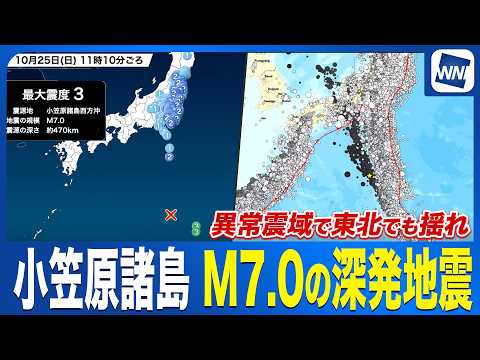
A magnitude 7.0 earthquake struck beneath the Bonin Islands, south of Tokyo, on October 24. It sat 473 kilometers down, roughly 125 Mount Fujis stacked base to peak, so deep that no tsunami warnings went out for Guam, Hawaii, or the Northern Marianas.

Depth decided the outcome. Deep-focus quakes below about 300 kilometers cannot shove the seafloor upward, so tsunamis are off the table. What matters is scientific: this Izu-Bonin subduction zone produces some of the deepest earthquakes ever recorded, and how rock breaks at those pressures is still an open question.

Why it matters

One 7.0 quake with no tsunami shows why depth, not magnitude, decides earthquake risk in subduction zones.

Questions about this story

Free account needed to ask — your question is kept and asked for you right after sign-up. Answers are public.

No questions yet — be the first to ask.

Key Indicators

7.0
Magnitude of the main shock
Reported by the USGS and Pacific Tsunami Warning Center for the October 24 event.
473 km
Depth of the main shock
Great depth kept the rupture far from the seafloor and suppressed tsunami risk.
6.5
Largest aftershock magnitude
Struck October 25 at 492 km depth, along with a 4.8 at 498 km.
None
Tsunami warnings issued
No tsunami threat was declared for Guam, the Northern Marianas, or Hawaii.

Voices

Curated perspectives — historical figures and your fellow readers.

Ever wondered what historical figures would say about today's headlines?

Sign up to generate historical perspectives on this story.

Organizations Involved

Timeline

4 events Latest: Today
Tap a bar to jump to that date
  1. No tsunami threat stated for Guam and CNMI

    Today Statement

    Pacific Tsunami Warning Center bulletin finds no tsunami danger and says no action is required.

  2. Magnitude 6.5 aftershock at 492 km

    Today Seismic Event

    A day after the main shock, a magnitude 6.5 event struck at nearly the same depth in the region.

  3. Magnitude 4.8 aftershock at 498 km

    Today Seismic Event

    A smaller aftershock followed within the hour, deepening slightly to 498 km.

  4. Magnitude 7.0 earthquake hits Bonin Islands

    Seismic Event

    Deep-focus quake at 473 km depth south of Tokyo; weak shaking at the surface, no seafloor rupture.

Scenarios

1

More magnitude-6 aftershocks strike the Bonin Islands

Likely Resolves by Nov 24, 2026

Discussed by: USGS catalog data; the 2015 Mw 7.9 Ogasawara quake produced multiple M6-class shocks within minutes

Deep-focus earthquakes in this arc tend to cluster. After the 2015 Mw 7.9 Ogasawara quake, three magnitude-6 class events struck within four minutes. If the 2026 main shock follows that pattern, the USGS catalog would pick up another magnitude-6 or larger event in the region within weeks.

2

Aftershock sequence fades without another magnitude-6 event

Unlikely Resolves by Nov 24, 2026

Discussed by: USGS; deep earthquakes produce few aftershocks because high pressures limit fracture networks

Seismologists note that deep earthquakes generate few aftershocks because high confining pressures prevent extensive fracture networks from forming. If no more large shocks emerge, the sequence fades into routine monitoring, and the event's main legacy becomes a data point in the debate over how rock breaks at 500-kilometer depths.

Historical Context

2 moments from history that rhyme with this story — and how they unfolded.

May 2015

Ogasawara deep-focus earthquake (2015)

On May 30, 2015, a magnitude 7.9 earthquake ruptured about 680 kilometers beneath the Bonin Islands, one of the deepest and largest deep-focus earthquakes ever recorded. It broke near the base of the upper mantle beneath the Izu-Bonin subduction zone.

Then

The quake set off a burst of magnitude-6 class aftershocks; one was later reported as a record 751-kilometer-deep event.

Now

The deepest-aftershock claim was challenged by a 2025 reanalysis, and the sequence became a key case study in a decades-old debate about what allows rock to break at extreme depth.

Why this matters now

The 2026 magnitude 7.0 struck in the same subduction zone roughly 200 kilometers shallower, adding a fresh data point to that same debate.

January 2025

Deepest-earthquake claim revisited (2025)

University of Southern California seismologist Hao Zhang and colleagues re-examined the 2015 Ogasawara aftershock sequence and found no evidence for a reported 751-kilometer-deep aftershock, which had been called the deepest earthquake ever recorded.

Then

The study instead found aftershocks consistent with a 12-kilometer sliver of the mineral olivine, supporting the idea that deep quakes arise from a metastable olivine wedge.

Now

It highlighted how uncertain the interpretation of deep earthquake signals remains, and how new analyses can overturn record claims.

Why this matters now

It frames the scientific stakes behind the 2026 event, where the same proposed mechanisms are in play at comparable depths.

Sources

(8)