
Pull to refresh
Logo
Maryland voters clear path for Democrats to redraw congressional map

Maryland voters clear path for Democrats to redraw congressional map

Rule Changes

Question 3 removes the state constitutional standards a judge used to strike down the last Democratic-drawn map

Overview

Updated 1 hour ago

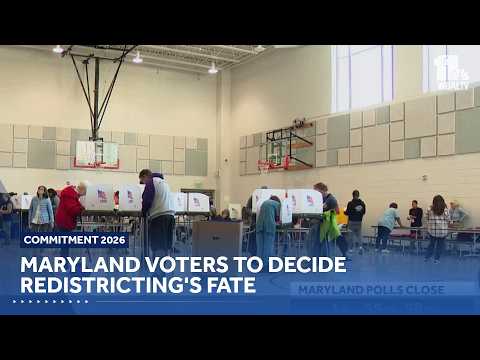
For years, Maryland's constitution said congressional districts had to be compact, contiguous, and drawn with regard for county lines and natural boundaries. On Nov. 3, voters agreed to drop those requirements for Congress while keeping them for the state legislature.

The change matters because of a 2022 court ruling. A state judge used those standards to throw out Maryland's last Democratic-drawn congressional map. With the standards now limited to state legislative districts, the Democratic-controlled General Assembly has a clearer path to redraw the state's eight House seats before 2028.

Maryland currently sends seven Democrats and one Republican, Andy Harris, to the House. Harris's district covers the Eastern Shore and parts of Baltimore, Carroll, and Harford counties. Question 3 takes effect for the 2028 cycle; the 2026 elections were already run under the existing map.

Why it matters

Maryland's eight House seats are seven Democratic and one Republican. The new rules let the legislature try to make it eight to zero for 2028.

Questions about this story

Free account needed to ask — your question is kept and asked for you right after sign-up. Answers are public.

No questions yet — be the first to ask.

Key Indicators

1
Republican-held U.S. House seats in Maryland
Andy Harris holds the 1st District; the other seven are held by Democrats.
8
Maryland's U.S. House seats
The state's delegation size after the 2020 census.
9
States that enacted new congressional maps since 2025
Alabama, California, Florida, Louisiana, North Carolina, Ohio, Tennessee, Texas, and Utah.
96-38
Maryland House vote to place Question 3 on the ballot
The August 2026 special-session vote was largely along party lines; the Senate passed it 32-13.

Voices

Curated perspectives — historical figures and your fellow readers.

Sign up to generate historical perspectives on this story.

People Involved

Organizations Involved

Timeline

2022 November 2026

5 events Latest: Yesterday
Tap a bar to jump to that date
  1. Voters approve Question 3

    Latest Election

    Amendment limits compactness and boundary rules to state legislative districts, not congressional ones.

  2. General Assembly sends amendment to the ballot

    Legislation

    Special session passes House Bill 2100, 96-38 in the House and 32-13 in the Senate.

  3. Republican states redraw maps mid-decade

    Rule Change

    Trump pushes Republican-run states to draw new House maps; nine states enact them by 2026.

Scenarios

1

Democrats redraw the map and Harris's seat turns Democratic

Likely Resolves by Jul 1, 2028

Discussed by: Supporters of Question 3, who pitched the amendment as a way to answer Republican redistricting in other states

With the compactness requirement no longer applying to Congress, the legislature can split the Eastern Shore or fold it into Baltimore-area precincts. The trigger is a redistricting bill in the 2027 or 2028 session, followed by review in the Maryland Supreme Court if the legislature grants it original jurisdiction. The new lines would first apply to the 2028 primaries.

2

New map drawn, then blocked in federal court

Possible Resolves by Jun 1, 2028

Discussed by: Republican lawmakers who opposed the amendment and argued it strips voters of fair districts

Question 3 changes state constitutional law, not federal law. A new map could still face claims under the Voting Rights Act or the U.S. Constitution in federal court, where the state amendment offers no shield. A single injunction before the 2028 filing deadline would send the map back to the drawing board.

3

Legislature never draws a new map

Possible Resolves by Apr 10, 2028

Discussed by: Senate President Bill Ferguson's earlier position, when he declined to take up redistricting citing the 2022 court loss and political risk

The amendment permits a new map but does not require one. Lawmakers could calculate that an aggressive gerrymander costs more in suburban swing districts than it gains, or that the 2026 results argue against reopening the fight. In that case Question 3 changes the rules on paper and nothing else before the next census.

Historical Context

2 moments from history that rhyme with this story — and how they unfolded.

2022

Maryland congressional map struck down (2022)

After the 2020 census, Maryland's Democratic legislature drew a congressional map that a state judge found violated the constitution's compactness and boundary requirements. The ruling blocked an attempt to break up the 1st District, held by Republican Andy Harris, and forced the legislature to pass a replacement map.

Then

Maryland ran the 2022 elections under a redrawn map, and Harris kept his seat.

Now

The decision established that state constitutional standards applied to congressional districts, the exact interpretation Question 3 was written to reverse.

Why this matters now

Question 3 removes the legal basis for the 2022 ruling, which is why supporters of a new map see it as the key that unlocks the door.

2025-2026

Mid-decade redistricting wave (2025-2026)

President Trump called on Republican-run states to redraw congressional maps ahead of the 2026 midterms, aiming to protect the party's narrow House majority. Nine states enacted new maps: Alabama, California, Florida, Louisiana, North Carolina, Ohio, Tennessee, Texas, and Utah. Courts stopped redrawn maps from being used in Missouri and Virginia.

Then

Several states entered the 2026 elections under maps drawn mid-decade rather than after the census.

Now

The cycle broke the norm of redrawing only once a decade, and both parties began treating mapmaking as a live tool between censuses.

Why this matters now

Maryland's amendment is a Democratic entry into that cycle, timed so the new rules are in place for 2028 rather than 2026.

Sources

(10)