
Pull to refresh
Logo
Daily Brief
Following
Why Sign Up
Texas mid-decade redistricting battle

Texas mid-decade redistricting battle

Rule Changes
By Newzino Staff |

Supreme Court clears GOP-drawn map for 2026 midterms while gerrymandering challenges continue

Today: Supreme Court reinstates the Texas map

Overview

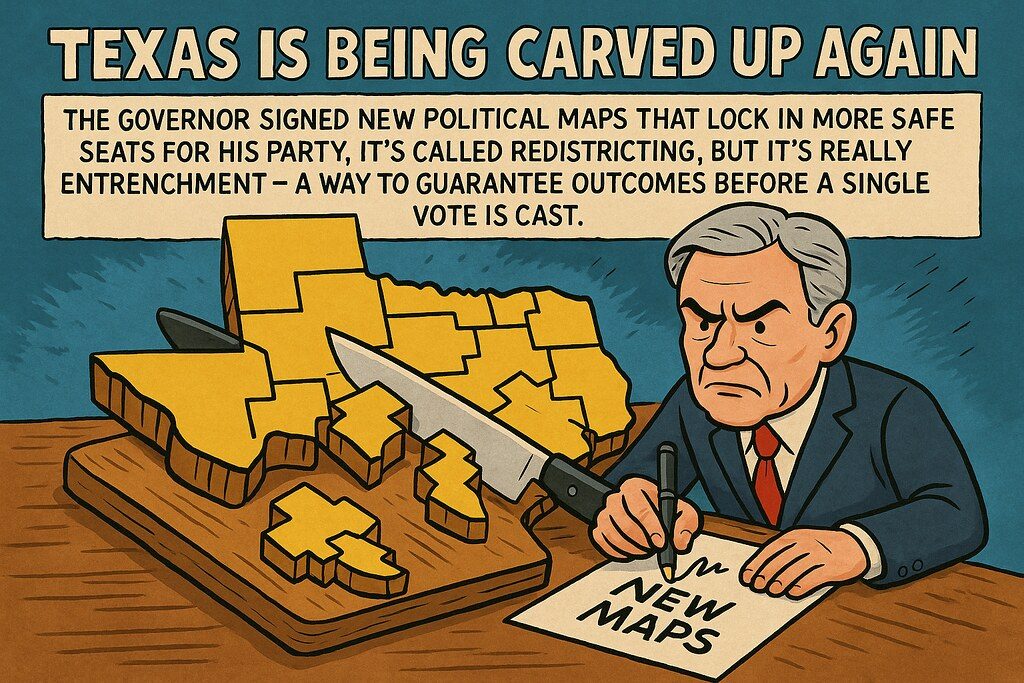
States usually redraw congressional districts once a decade, after the census. Texas just redrew its map four years early—and the U.S. Supreme Court has now cleared it for the 2026 midterm elections.

Why it matters

Five U.S. House seats could flip parties under maps a federal court found likely racially gerrymandered—enough to decide control of Congress in 2026.

Key Indicators

5
House seats potentially swung
Republican gains projected from the redrawn Texas congressional districts.
2030
Map locked in through
Boundaries will govern Texas U.S. House elections until the next regular redistricting cycle.
38
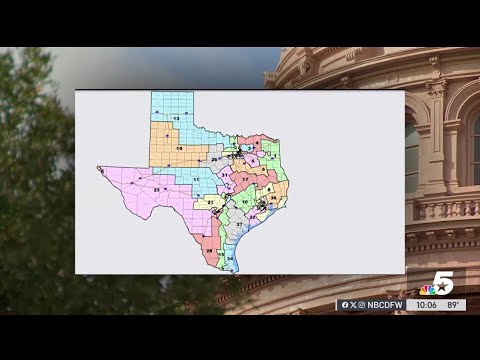
Texas U.S. House districts
Total congressional seats Texas allocates under the redrawn map.
0
Merits resolved
The Supreme Court lifted the injunction without ruling on whether the map is unconstitutional.

Interactive

Exploring all sides of a story is often best achieved with Play.

Ever wondered what historical figures would say about today's headlines?

Sign up to generate historical perspectives on this story.

Sign Up

Debate Arena

Two rounds, two personas, one winner. You set the crossfire.

People Involved

Organizations Involved

Timeline

  1. Supreme Court reinstates the Texas map

    Legal

    Without a written opinion, the high court summarily reverses the lower court and allows Texas to use the GOP-drawn boundaries through at least 2030.

  2. Texas appeals to Supreme Court

    Legal

    The state files an emergency stay application asking the high court to lift the injunction in time for 2026 election preparations.

  3. Federal panel blocks Texas map

    Legal

    A three-judge district court finds the map likely the product of intentional racial gerrymandering and orders Texas to revert to its 2021 lines.

  4. California voters approve Proposition 50

    Political

    Voters suspend the state's independent commission and adopt a Democratic-favoring map in response to the Texas redraw.

  5. LULAC and MALDEF sue in federal court

    Legal

    Civil rights groups file suit alleging the map violates the Voting Rights Act and the 14th and 15th Amendments by sorting voters by race.

  6. Texas enacts new congressional map

    Legislation

    Governor Abbott signs the GOP-drawn map projected to give Republicans up to five additional U.S. House seats in 2026.

  7. Texas House Democrats break quorum

    Political

    Dozens of Democratic state representatives leave Texas to deny Republicans the quorum needed to pass the new map, delaying but not stopping the redistricting bill.

  8. Texas governor calls special session on redistricting

    Political

    Greg Abbott convenes a special legislative session that includes mid-decade congressional redistricting on the agenda, breaking with the post-census convention.

Scenarios

1

Republicans gain House seats in Texas, hold majority in 2026

Discussed by: Cook Political Report, Texas Tribune, FiveThirtyEight

With the map in place for the November election, Republicans win three to five additional U.S. House seats from Texas, offsetting Democratic gains in California and giving the GOP a slightly larger or similar majority in the next Congress. This is the most direct and widely projected near-term outcome of the Supreme Court order.

2

Supreme Court strikes down map after 2026, ordering new lines for 2028

Discussed by: SCOTUSblog, election-law scholars including Rick Hasen

The underlying lawsuits proceed to a full merits ruling. A district court reaffirms its finding of intentional racial gerrymandering, and the Supreme Court—on a fuller record—agrees in part, requiring Texas to redraw at least some districts before 2028. Republicans keep the seats won under the current map for one cycle but lose the structural advantage going forward.

3

Court upholds Texas map on the merits, narrowing racial-gerrymandering doctrine

Discussed by: Election Law Blog, conservative legal commentators

After full briefing, the Supreme Court rules that Texas's use of race in drawing districts was either justified by Voting Rights Act compliance or insufficiently proven, locking in the map through 2030 and making future racial-gerrymandering challenges harder to win. This would mark a significant doctrinal shift extending recent rulings narrowing voting-rights remedies.

4

Mid-decade redistricting becomes the new normal

Discussed by: Brennan Center for Justice, Politico

Other states follow the Texas and California examples, redrawing maps whenever one party controls the levers of state government. Redistricting becomes a continuous political weapon rather than a once-a-decade event, with courts routinely reviewing new maps in the run-up to each federal election.

Historical Context

Texas mid-decade redistricting (2003)

2003

What Happened

Then-U.S. House Majority Leader Tom DeLay engineered a mid-decade redrawing of Texas's congressional districts after Republicans took full control of state government. Democratic state senators fled to New Mexico to break quorum before the map ultimately passed, shifting six U.S. House seats to Republicans.

Outcome

Short Term

Republicans gained six Texas U.S. House seats in the 2004 elections, helping cement their national House majority.

Long Term

In LULAC v. Perry (2006), the Supreme Court upheld most of the map but struck down one district as a Voting Rights Act violation, establishing that mid-decade redistricting was constitutionally permissible.

Why It's Relevant Today

The 2003 episode is the direct precedent for the 2025 redraw and established the legal baseline that Texas now relies on. The 2026 litigation will test how far that baseline stretches when racial-gerrymandering claims are central.

Shelby County v. Holder (2013)

June 2013

What Happened

The Supreme Court struck down the formula in Section 4 of the Voting Rights Act that determined which jurisdictions—including Texas—needed federal preclearance before changing voting rules or maps. The 5-4 ruling effectively ended preclearance.

Outcome

Short Term

Texas implemented voter-ID laws and redistricting changes that had previously been blocked or modified under preclearance review.

Long Term

Voting-rights challenges shifted from pre-implementation federal review to slower, after-the-fact litigation in federal court—the procedural posture in which the 2025 Texas map is now being fought.

Why It's Relevant Today

Without preclearance, Texas could enact its 2025 map without federal sign-off, leaving challengers to pursue injunctions and appeals—precisely the path the Supreme Court has now narrowed by lifting the lower court's stay.

Rucho v. Common Cause (2019)

June 2019

What Happened

The Supreme Court ruled 5-4 that partisan gerrymandering claims are 'political questions' beyond the reach of federal courts, even when maps were drawn for explicit partisan advantage. Racial-gerrymandering claims, however, remained justiciable.

Outcome

Short Term

Federal courts could no longer strike down maps purely for partisan bias; plaintiffs had to frame challenges around race or other constitutional violations.

Long Term

Litigation strategy in redistricting cases pivoted toward racial-gerrymandering and Voting Rights Act theories, including in the current Texas case.

Why It's Relevant Today

Rucho explains why challengers must prove the Texas map sorted voters by race, not just by party—the very theory the lower court accepted and the Supreme Court has now temporarily set aside.

Sources

(5)