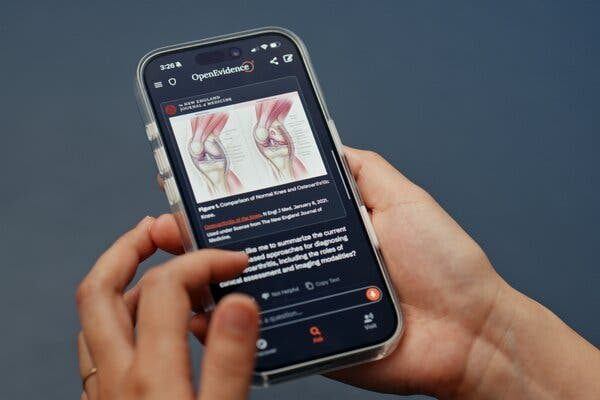
By April 2026, OpenEvidence was recording nearly 27 million clinical consultations per month, up 50 percent from December 2025. Roughly 65 percent of U.S. physicians now use the platform.
In April, Mount Sinai Health System signed an enterprise deal to embed OpenEvidence inside its Epic electronic health record for use by nurses and pharmacists across its seven New York hospitals. A month earlier, the company launched Coding Intelligence™, an automated billing tool that generates diagnosis and procedure codes directly from clinical notes.
An NBC News investigation in May 2026 found that most patients don't know their doctors consult the tool, and some physicians reported the AI occasionally gives wrong answers on rare conditions or edge cases. CEO Daniel Nadler acknowledged the pharmaceutical advertising model may not be the company's long-term approach and indicated the company might shift toward hospital licensing fees. The Trump administration and HHS Secretary Robert F. Kennedy Jr. separately moved in May to loosen FDA oversight requirements for AI health software.
Why it matters
Most Americans' doctors now consult AI before treating them—and most patients have no idea.
Questions about this story
Free account needed to ask — your question is kept and asked for you right after sign-up. Answers are public.
0
How can I determine if my doctor uses it? I hope they do.
There's no public lookup tool — the only reliable way to find out is to ask your doctor directly.
Why it matters: No law or regulation currently requires physicians to disclose when AI tools inform their clinical decisions, so the answer depends entirely on your doctor's willingness to share.
—OpenEvidence is restricted to credentialed clinicians whose identity is verified through their National Provider Identifier (NPI) — it's not a consumer product, so there's no patient-facing portal or opt-in notification system.
—With 65% of U.S. physicians using the platform, odds are reasonably good your doctor has at least tried it — but active use varies widely by specialty and practice setting.
—Mount Sinai embedded OpenEvidence directly inside Epic (its electronic health record) in April 2026, meaning doctors at those seven hospitals may use it without a separate app — making it even less visible to patients.
—The NBC News investigation (May 2026) found most patients are unaware their doctor consults the tool; some physicians who were asked said they simply hadn't thought to mention it — so a direct question is likely to get a straight answer.
Some physicians argue AI tools like OpenEvidence are no different from consulting a textbook or UpToDate — a routine reference step that doesn't require patient disclosure. Patient advocates counter that AI-assisted decisions carry distinct risks (including documented errors on rare conditions) that patients deserve to know about before consenting to care.
AI-generated with web search — may be wrong. Check the linked sources.
Key Indicators
1,000,000
Physician-AI consultations on March 10
First time any medical AI system reached this volume in a single day.
$12B
OpenEvidence valuation
As of January 2026 Series D round, up from $1 billion just eleven months earlier.
~$150M
Estimated annual revenue
Generated primarily through pharmaceutical advertising served to physicians between queries.
27M
Monthly consultations in April 2026
Up from 18 million in December 2025, as 65 percent of U.S. physicians now actively use the platform.
Images from Openverse under Creative Commons licenses.
Videos from YouTube.
Voices
Curated perspectives — historical figures and your fellow readers.
Cecil Rhodes
(1853-1902) ·Victorian Era · industry
Fictional AI pastiche — not real quote.
"A million consultations in a single day — the railways of medicine have arrived, and just as I laid iron across a continent to bind its peoples to one civilising order, so this machine binds the scattered knowledge of ten thousand journals into a single imperial intelligence that no provincial doctor dare ignore."
0% found this insightful
Dorothy Parker
(1893-1967) ·Jazz Age · wit
Fictional AI pastiche — not real quote.
"So the doctors have traded one oracle for another — only this one is sponsored by the very pills it's prescribing. We used to worry that medicine was becoming an art; now I see it's merely become advertising."
0% found this insightful
Ever wondered what historical figures would say about today's headlines?
Sign up to generate historical perspectives on this story.
15 events
Latest: May 12th, 2026 · 5 months ago
Showing 8 of 15
JK to step
Tap a bar to jump to that date
Jump to
May 2026
Trump administration moves to loosen AI healthcare safeguards
LatestRegulatory
The Trump administration and HHS Secretary Robert F. Kennedy Jr. proposed relaxing federal oversight requirements for AI health software, including dropping transparency requirements for AI decision-making algorithms and reducing FDA review burdens on clinical decision support tools. The American Hospital Association raised concerns about removing algorithmic transparency standards.
NBC News investigation: most patients unaware doctors use OpenEvidence
Media
NBC News reported that roughly 650,000 U.S. physicians actively use OpenEvidence, with 1.2 million using it internationally, while most patients have not been told their doctor consults the tool. Some physicians told NBC the AI occasionally gives wrong answers on rare conditions. CEO Daniel Nadler said the pharmaceutical ad model may not be the company's long-term approach.
April 2026
Mount Sinai signs first enterprise deal, embeds OpenEvidence in Epic
Enterprise Adoption
Mount Sinai Health System became OpenEvidence's first enterprise-wide customer, embedding the platform inside its Epic electronic health record and extending access to registered nurses and pharmacists—not just physicians—across all seven of its New York hospitals.
March 2026
OpenEvidence launches Coding Intelligence, entering medical billing
Product Launch
OpenEvidence released Coding Intelligence™, which automatically generates ICD-10 diagnosis codes, CPT billing codes, and evaluation-and-management level recommendations from clinical notes at the end of each visit, expanding the platform from clinical search into revenue cycle management.
One million physician-AI consultations in a single day
Adoption Milestone
OpenEvidence announced that on March 10, verified physicians conducted one million consultations with its AI in 24 hours, the first time this threshold has been crossed by any medical AI system.
January 2026
Series D doubles valuation to $12 billion
Funding
OpenEvidence raised $250 million co-led by Thrive Capital and DST Global, bringing total funding to nearly $700 million and doubling the company's valuation in three months.
Food and Drug Administration loosens clinical decision support guidance
Regulatory
The FDA updated its guidance on clinical decision support software, loosening requirements for tools that meet certain criteria—a regulatory shift that may affect how platforms like OpenEvidence are classified.
October 2025
Series C at $6 billion valuation
Funding
OpenEvidence raised $200 million led by Google Ventures, with Sequoia, Kleiner Perkins, Blackstone, and Thrive participating—tripling months after the Series B.
August 2025
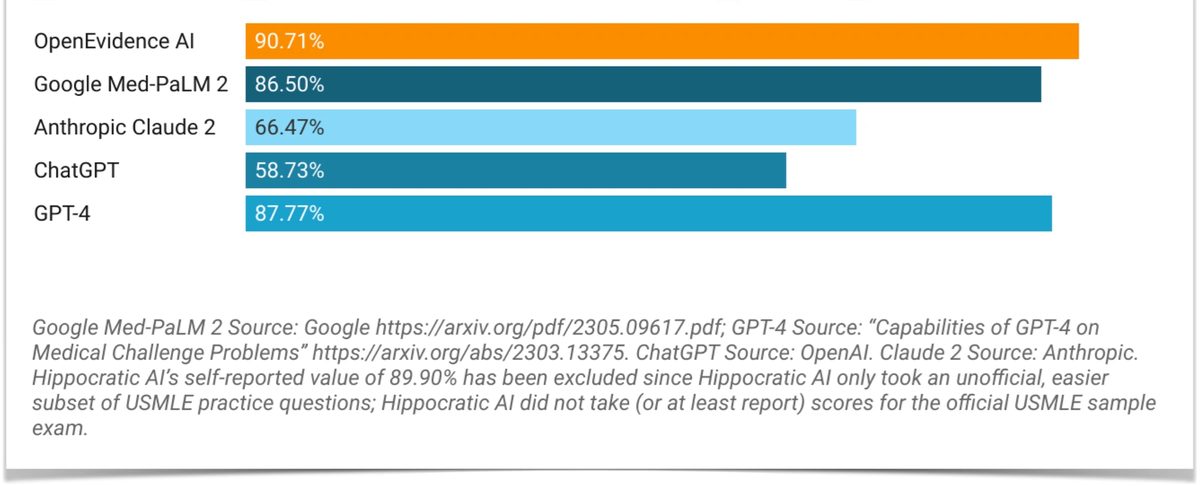
First AI to score a perfect 100% on the USMLE
Technical Milestone
OpenEvidence's AI became the first in history to achieve a perfect score on the United States Medical Licensing Examination, the standardized test required for all physicians practicing in the country.
July 2025
Series B at $3.5 billion; DeepConsult AI agent launched
Funding
OpenEvidence raised $210 million co-led by Google Ventures and Kleiner Perkins and released DeepConsult, a free AI agent that autonomously analyzes and cross-references peer-reviewed studies for physicians.
June 2025
JAMA Network signs content partnership
Partnership
The JAMA Network, a consortium of 13 peer-reviewed journals published by the American Medical Association, signed a multi-year deal to provide full-text content to OpenEvidence.
April 2025
OpenEvidence named to Forbes AI 50 list
Recognition
Forbes included OpenEvidence in its annual AI 50 ranking of the most promising artificial intelligence companies.
February 2025
Sequoia-led Series A at $1 billion valuation; NEJM partnership
Funding
OpenEvidence raised approximately $75 million from Sequoia Capital and simultaneously signed a multi-year content agreement with the New England Journal of Medicine, granting access to all published content from 1990 forward.
July 2023
OpenEvidence AI first to score above 90% on medical licensing exam
Technical Milestone
OpenEvidence's AI system became the first to score above 90% on the United States Medical Licensing Examination, an early signal of the platform's clinical reasoning capabilities.
2021
OpenEvidence founded
Company
Daniel Nadler and Zachary Ziegler found OpenEvidence to build an AI-powered medical search engine grounded in peer-reviewed literature, self-funding the company initially.
Scenarios
1
AI-assisted clinical reasoning becomes standard of care
Likely
Discussed by: Sequoia Capital partners, health technology analysts at Fierce Healthcare, clinical AI researchers at Stanford
OpenEvidence and similar tools become so embedded in physician workflows that failing to consult AI before making certain clinical decisions is eventually viewed as a deviation from the standard of care. Medical schools integrate AI-assisted reasoning into training. Malpractice insurers begin factoring AI tool usage into risk assessments. This path follows the trajectory of UpToDate, which went from novel reference tool to something physicians are effectively expected to use within two decades, but compressed into a fraction of that time.
2
Pharmaceutical ad model triggers regulatory scrutiny or physician backlash
Possible
Discussed by: MedCity News, health policy analysts, Johns Hopkins researchers studying AI liability
As physicians grow more dependent on OpenEvidence, scrutiny intensifies around its pharmaceutical advertising revenue model. Critics question whether a tool that serves targeted drug ads between clinical queries can remain an unbiased source of medical guidance. The Food and Drug Administration (FDA) or the Federal Trade Commission (FTC) investigates whether the platform's ad targeting based on clinical search terms constitutes a form of off-label promotion. Alternatively, competing platforms with subscription models gain share by marketing themselves as ad-free alternatives.
3
A high-profile clinical error traced to AI triggers malpractice reckoning
Possible
Discussed by: Johns Hopkins AI liability researchers, the American Medical Association, medical malpractice law firms
A patient harm event is linked to a physician following an AI-generated recommendation that turned out to be incorrect or incomplete. The resulting lawsuit forces courts to grapple with liability allocation: is the physician responsible for over-reliance, the AI company responsible for the recommendation, or both? The case sets legal precedent and prompts either federal legislation or professional association guidelines on how physicians should document and verify AI-assisted decisions. Under current law, physicians bear full liability regardless of what the AI recommended.
4
Competitive landscape fragments as incumbents and new entrants close the gap
Possible
Discussed by: Clinical AI Report, Wolters Kluwer (UpToDate parent), Contrary Research, health technology venture analysts
UpToDate, Doximity, Glass Health, and new entrants integrate generative AI into their own platforms, eroding OpenEvidence's first-mover advantage. Electronic health record companies like Epic build AI clinical decision support directly into their systems, making standalone tools less necessary. OpenEvidence's growth plateaus as the market shifts from acquisition to retention battles. The company responds by expanding into enterprise pricing, electronic health record integration, and international markets.
5
OpenEvidence drops pharma ads and shifts to hospital licensing fees
Possible
Resolves by End of 2027
Discussed by: Daniel Nadler (NBC News, May 2026), Sacra Research, health technology analysts at Modern Healthcare and Fierce Healthcare
CEO Daniel Nadler has said publicly that the pharmaceutical advertising model may not be the company's long-term approach. The Mount Sinai and Sutter Health enterprise deals suggest a parallel revenue stream is already forming. If OpenEvidence converts to hospital licensing, it removes the conflict-of-interest criticism around drug ads—but physicians who now use it free would need employers to cover the cost.
Historical Context
3 moments from history that rhyme with this story — and how they unfolded.
1 of 3
2013–2022
IBM Watson for Oncology (2013–2022)
IBM invested roughly $4 billion acquiring health data companies and building Watson for Oncology, an AI system designed to recommend cancer treatments. Watson was deployed at hospitals worldwide, including Memorial Sloan Kettering Cancer Center, with the promise of democratizing expert oncology care.
Then
Reports surfaced that Watson recommended unsafe and incorrect treatments in some cases. Physicians found the system unreliable for their local clinical contexts, and adoption stalled.
Now
IBM sold most of its Watson Health assets in 2022. The failure became a cautionary tale about deploying AI that couldn't integrate into real physician workflows or handle the messiness of actual clinical data.
Why this matters now
OpenEvidence's approach—grounding answers in specific peer-reviewed sources rather than attempting autonomous diagnosis—appears designed to avoid Watson's core failures. But the question of whether any AI system can be trusted at the scale of one million daily consultations without Watson-style errors emerging remains open.
2 of 3
1992–present
UpToDate's rise as clinical reference standard (1992–present)
UpToDate launched in 1992 as a digital clinical reference tool authored by physicians. Over two decades, it grew to serve more than 2 million clinicians in over 190 countries and became used by 90% of United States academic medical centers. More than 80 published studies linked its use to improved patient outcomes.
Then
UpToDate became effectively mandatory in many clinical settings, with physicians expected to consult it as part of standard practice.
Now
Wolters Kluwer acquired UpToDate's parent company. The tool proved that physician-facing reference tools could reach near-universal adoption, but the process took roughly two decades. UpToDate charges approximately $559 per year per user.
Why this matters now
OpenEvidence is compressing UpToDate's multi-decade adoption curve into a few years, achieving comparable physician penetration with a free, ad-supported model rather than a subscription. The comparison raises the question of whether OpenEvidence is the next UpToDate or whether the speed of adoption outpaces the validation that made UpToDate trustworthy.
3 of 3
2019–present
Google's entry into health search (2019–present)
Google began surfacing medical information panels and symptom-checker features in search results, partnering with the Mayo Clinic and other health organizations. By the early 2020s, an estimated 7% of all Google searches were health-related, making the search engine the de facto first stop for health questions among consumers.
Then
Google became the dominant gateway for consumer health information, though concerns about misinformation and self-diagnosis persisted.
Now
The experience demonstrated that whoever controls the search interface for health information wields enormous influence. Google's health search, however, never achieved deep adoption among physicians for clinical use, leaving a gap that purpose-built tools filled.
Why this matters now
OpenEvidence is doing for physicians what Google did for consumer health queries—becoming the default first stop. Multiple analysts have described the company as becoming 'the Google of medicine,' with similar implications for influence over clinical information flow and similar questions about whether an advertising-funded model serves users' best interests.