

Pull to refresh
Logo
A 3D-printable hydrogel that strengthens under repeated strain

A 3D-printable hydrogel that strengthens under repeated strain

New Capabilities

WashU chemists thread sugar rings onto polymer chains so the material stiffens exactly where it is bent, and a solvent soak resets it

Overview

Updated 2 hours ago

Bend a metal paperclip back and forth and it snaps. A hydrogel built in Chenfeng Ke's lab at Washington University in St. Louis does the reverse. After 10,000 bends on a knee-like joint, the material came back stiffer exactly where it had been strained.

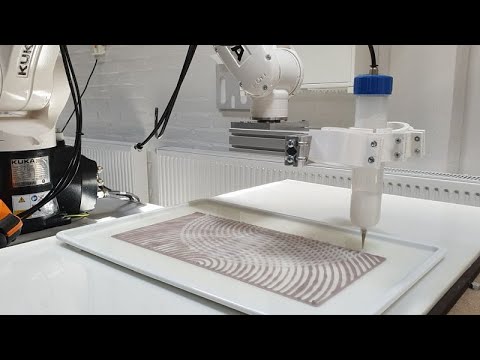
The polymer is a polyethylene glycol network threaded with rings of α-cyclodextrin, a sugar. Strain drags those rings along the chains and they re-form as smaller, better-aligned crystals, so the material keeps a record of where it was worked. Ke's team measured gains of up to tenfold in stiffness, tensile strength, fracture energy and fatigue threshold, and the material prints on a 3D printer. No animal or human testing has been done.

Why it matters

A material that stiffens only where it is loaded is what joint implants and tissue repair have lacked.

Questions about this story

Free account needed to ask — your question is kept and asked for you right after sign-up. Answers are public.

No questions yet — be the first to ask.

Key Indicators

10×
Gain after mechanical training
Up to an order of magnitude in modulus, tensile strength, fracture energy and fatigue threshold.
10,000
Bend cycles on a joint prototype
The material was flexed 10,000 times and behaved as the team predicted.
tens of grams
Batch size in the lab
Production scale so far; the team says it could be scaled up.

Voices

Curated perspectives — historical figures and your fellow readers.

Sign up to generate historical perspectives on this story.

People Involved

Organizations Involved

Timeline

April 2025 November 2026

3 events Latest: 4 days ago
  1. WashU announces the polymer and its 10,000-cycle test

    Latest Announcement

    The university's news office describes a patented, 3D-printable hydrogel made from sugar crystals and polyethylene glycol, bent 10,000 times on a knee-like joint. Ke says the lab produces tens of grams at a time.

  2. Adapt-ring networks paper published in Nature Materials

    Publication

    The study reports that strain fragments α-cyclodextrin crystals, slides them along polyethylene glycol chains, and realigns them into smaller domains that stiffen the gel. Training raised modulus, tensile strength, fracture energy and fatigue threshold by up to tenfold.

  3. Ke pitches smart fabrics at a university research competition

    Research

    At A&S Innovates, Ke proposed a generation of smart fabrics built with 3D printing and designed chemistry. He describes it as groundwork for the later polymer.

Scenarios

1

Orthopedic device company licenses the adapt-ring patent

Possible Resolves by Q2 2028

Discussed by: Ke, who said he expects interest from surgeons and orthopedic device companies

Ke has a patent and a working demonstration but no manufacturing partner. A license would move the polymer from tens of grams in a lab to a device program with capital behind it. The trigger is a company deciding the strengthening effect is worth paying for before animal data exists, which is a high bar for an untested implant material.

2

An independent lab reproduces the self-strengthening

Likely Resolves by End of 2028

Discussed by: No independent assessment has been published yet

The claims rest on one lab's mechanical testing. Replication is the usual test of whether a materials result travels: another group mixes its own α-cyclodextrin and polyethylene glycol, trains the gel, and measures whether modulus and fracture energy rise. A successful repeat would turn a single paper into a design rule others build on.

3

The hydrogel is implanted in a live animal

Uncertain Resolves by End of 2029

Discussed by: Coverage of the result, which notes that no animal or human testing has been done

Tissue compatibility is a claim, not a finding. The material is built from sugar and polyethylene glycol, both common in medical products, but an implant study has to show the gel does not provoke a reaction and keeps its trained stiffness inside a body. A published animal study is the gate before any human trial.

Historical Context

3 moments from history that rhyme with this story — and how they unfolded.

1880s

Hadfield manganese steel (1880s)

Metallurgist Robert Hadfield alloyed iron with roughly 12 percent manganese and found the result hardened under impact instead of cracking. Railway crossings and rock crushers made from it outlasted ordinary steel.

Then

Hadfield steel became standard for wear parts and later for armor.

Now

Work hardening became a design principle: a metal could be made to strengthen itself in service.

Why this matters now

The hydrogel copies the idea in a soft, water-filled material. Unlike steel, it can be reset: a solvent soak re-forms the crystals and returns it to its original state.

Early 2020s

Slide-ring hydrogels and strain-induced crystallization (early 2020s)

Gels in which cyclodextrin rings slide along polyethylene glycol chains were already known to be tough. A University of Tokyo team led by Mayumi and Ito showed that stretching aligns the chains and triggers fast polyethylene glycol crystallization, which reinforces the gel.

Then

The gel recovered after more than 100 loading cycles with almost no loss of performance.

Now

It established that strain-induced crystallization, not just ring sliding, drives reinforcement in these materials.

Why this matters now

Ke's adapt-ring networks use the same cyclodextrin-on-polyethylene-glycol architecture but hold the reorganized crystals after the load comes off, which is what makes the strengthening persist.

1960s-1970s

Kevlar and aligned polymer fibers (1960s-1970s)

Chemist Stephanie Kwolek at DuPont found that a liquid-crystalline polymer solution, spun into fiber, came out with its molecular chains lined up along the fiber axis. The alignment produced high tensile strength at low weight.

Then

DuPont commercialized the fiber as Kevlar in the early 1970s, first for tires and then for body armor.

Now

Fiber spinning became the standard way to turn an ordinary polymer into a strong one.

Why this matters now

Alignment strengthens both materials. Kevlar gets its alignment once, at the factory. The hydrogel gets it in place, under load, and can lose it again in solvent.

Sources

(5)