

Pull to refresh
Logo
Penn engineers build artificial muscles that sense their own position

Penn engineers build artificial muscles that sense their own position

New Capabilities

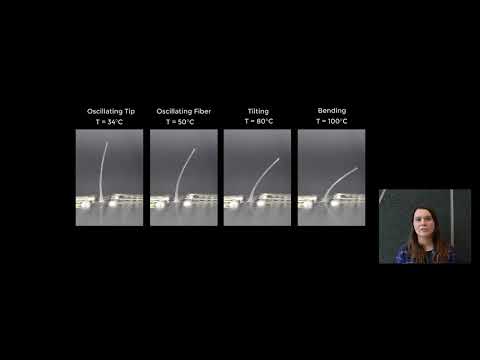
CoilLCE fibers pair liquid crystal elastomers and graphene with a copper coil that both heats and measures, letting soft actuators hold a pose

Overview

Updated 29 minutes ago

A robotic finger presses a piano key, pauses, then moves to the next note. Across the lab, an artificial eye shifts its gaze through a series of controlled stops. Both run on the same new component: a fiber that contracts like a muscle and reports where it is mid-contraction.

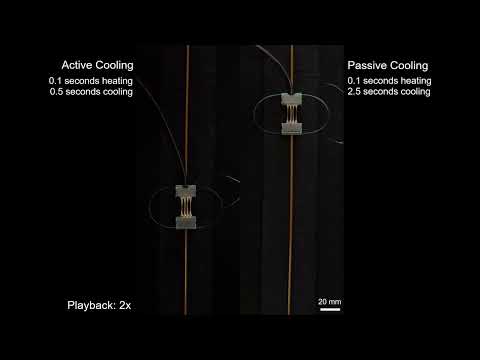
Earlier soft actuators could bend or squeeze, but they could not reliably stop halfway and stay there. The Penn team's fix is a copper coil embedded inside the fiber that doubles as heater and position sensor, closing a feedback loop on a liquid crystal elastomer actuator for the first time, the researchers say.

Why it matters

Soft robots have lacked muscles that can stop mid-motion. This one can, which is what dexterous hands require.

Questions about this story

Free account needed to ask — your question is kept and asked for you right after sign-up. Answers are public.

No questions yet — be the first to ask.

Key Indicators

44%
Gain in antagonistic actuation strain
Adding 0.25 wt.% graphene lifted opposing-pair strain to 16.1%, versus 11.2% for pure LCE.
>40%
Peak actuation strain
The fibers contract by more than 40% of their length.
343 J/kg
Work capacity
Energy output per kilogram of muscle fiber, measured by the Penn team.
0.25 wt.%
Graphene loading
A small fraction of graphene softens the composite enough for opposing muscles to coordinate.

Voices

Curated perspectives — historical figures and your fellow readers.

Sign up to generate historical perspectives on this story.

People Involved

Organizations Involved

Timeline

September 2026 November 2026

2 events Latest: Today
  1. Penn Engineering announces the artificial muscles

    Today Announcement

    The school publicizes CoilLCE with demonstrations of a piano-playing robotic hand and actuated artificial eyes.

  2. CoilLCE research published in Advanced Functional Materials

    Research

    The peer-reviewed paper describes LCE-graphene fibers with an embedded copper coil for self-sensing actuation.

Scenarios

1

CoilLCE technology licensed into a commercial robotic hand

Possible Resolves by End of 2028

Discussed by: Penn Engineering researchers and soft-robotics industry observers

A robotics or prosthetics company licenses the fiber design or a related LCE-coil actuator and ships a product that relies on closed-loop control. Trigger: a licensing deal or product announcement naming the technology. The main obstacle is manufacturing consistency across many fibers.

2

Penn team demonstrates a multi-muscle robotic face

Likely Resolves by Q2 2028

Discussed by: Ziyun Zhang and Cynthia Sung

The team names integrated systems and robotic humanoid faces as the next step. Seeing that demo requires fitting dozens of small muscles into a confined space, which is harder than the four-pair eye rig. Trigger: a follow-up peer-reviewed paper or Penn announcement showing a face or comparable dense array.

3

An independent lab matches closed-loop control on a different LCE chemistry

Possible Resolves by End of 2027

Discussed by: Materials science researchers tracking self-sensing actuators

Replication is the test of whether the result is a general technique or a one-lab trick. A separate group would need to demonstrate comparable position holding with a different sensing element, such as a liquid-metal core or thermoelectric fiber. Trigger: a peer-reviewed paper from another institution.

Historical Context

3 moments from history that rhyme with this story — and how they unfolded.

1957

McKibben artificial muscle (1957)

Joseph McKibben built a pneumatic rubber actuator wrapped in braided mesh that contracted when inflated. It became a standard artificial muscle for prosthetics and soft robotics because it was cheap and flexible.

Then

Adopted in experimental prosthetics and later in soft-robot grippers.

Now

The design set the pattern for soft actuators but requires an external air supply and valves, limiting portability.

Why this matters now

Shows how long engineers have wanted a muscle-like actuator. CoilLCE is electrically driven and untethered, which the McKibben design is not.

1959

Nitinol shape-memory alloy (1959)

Researchers at the U.S. Naval Ordnance Laboratory discovered the shape-memory effect in a nickel-titanium alloy. It can contract when heated by an electric current, making it a compact solid-state actuator.

Then

Used in aerospace connectors, medical stents, and small actuators.

Now

Widely deployed where space is tight, but slow and difficult to hold at intermediate positions because it is controlled by temperature without integral feedback.

Why this matters now

The intermediate-position problem is the same one CoilLCE tackles. Shape-memory alloys solved the compact-actuator problem but not the control problem.

May 2021

Innervated LCE actuators (2021)

A separate group reported innervated liquid crystal elastomer actuators made by core-shell 3D printing, with a liquid-metal core that sensed and a LCE shell that actuated. They demonstrated closed-loop control under load.

Then

Showed that LCE actuators can carry their own sensing element.

Now

Established the goal of self-sensing LCE actuation; different sensing approaches have followed, including the copper-coil design at Penn.

Why this matters now

CoilLCE arrives in this line of work. Penn's claim of a first for LCE feedback control sits against earlier self-sensing LCE demonstrations, so the more precise distinction is the coil-as-heater-and-sensor architecture and the graphene composite.

Sources

(3)