


Pull to refresh
Logo
MIT team shows flexible ligands can direct nanoparticle assembly

MIT team shows flexible ligands can direct nanoparticle assembly

New Capabilities

A Nature Materials paper reports that bendable, charged connector molecules produce nanoparticle lattices with lower symmetry than rigid design rules allowed.

Overview

Updated 42 minutes ago

For about 20 years, the rule for building ordered materials from nanoparticles was to make the connector molecules rigid. Flexible links were expected to produce disorder. A team at MIT has now assembled nanoparticles by doing the opposite.

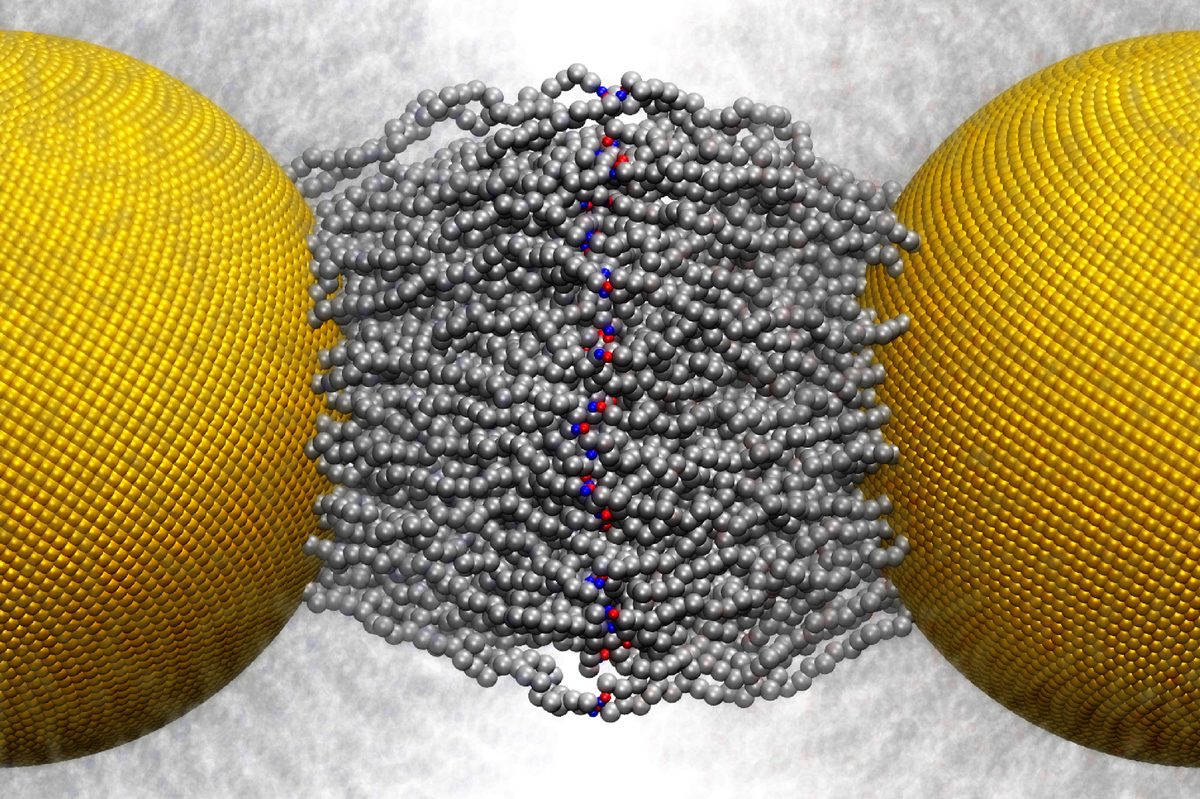
The group used flexible polymer chains, called ligands, with positively and negatively charged tips. As particles approach, the chains bend so opposite charges meet, and that bending limits how many neighbors each particle can bind. The resulting lattices have lower coordination, meaning fewer neighbors per particle, and lower symmetry than densely packed spheres would form.

Why it matters

If flexible ligands become a standard design knob, lower-density nanoparticle lattices could move from lab demonstrations into catalysts, optics, and drug-delivery gels.

Questions about this story

Free account needed to ask — your question is kept and asked for you right after sign-up. Answers are public.

No questions yet — be the first to ask.

Key Indicators

20 years
Rigid-ligand design rule
Approximate span during which rigid connector molecules were the standard assumption in nanoparticle assembly.
2
Tuning knobs demonstrated
Nanoparticle size and ligand chain length were used to control network structure.
2
Charged tip types
Positively and negatively charged ligand tips attract and bend to connect.

Voices

Curated perspectives — historical figures and your fellow readers.

Sign up to generate historical perspectives on this story.

People Involved

Organizations Involved

Timeline

2 events Latest: Today
  1. Nature Materials publishes flexible-ligand assembly paper

    Today Publication

    The paper reports that valency can emerge spontaneously from deformable ligand coronas on isotropic nanoparticles.

  2. MIT News announces the result

    Today Announcement

    The institute's news office frames ligand flexibility as a new design parameter for nanoparticle superlattices.

Scenarios

1

Independent labs replicate flexible-ligand assembly

Likely Resolves by Q2 2028

Discussed by: Macfarlane and the paper's authors, who describe the method as a general design parameter

The paper's mechanism is simple enough that other groups can test it with their own nanoparticles and charged polymers. Replication would show that spontaneous valency is not tied to one particle system.

2

A working optical or catalytic device uses the lattices

Possible Resolves by End of 2029

Discussed by: MIT News and the authors, who name photonics and catalysis as target applications

Lower-density lattices could expose more nanoparticle surface to light or reactants. A device demonstration would move the method from structural curiosity to applied materials.

3

A company licenses the method for scale-up

Possible Resolves by End of 2028

Discussed by: The authors, who say the approach could make custom nanoparticle materials easier to scale

The paper claims the method avoids bespoke synthesis steps that work for only one material or size. A licensing deal would test whether that claim holds outside academic labs.

Historical Context

3 moments from history that rhyme with this story — and how they unfolded.

1996

DNA-functionalized nanoparticle assembly (1996)

Chad Mirkin's group at Northwestern and Paul Alivisatos's group at Berkeley attached DNA strands to gold nanoparticles. Complementary strands hybridized, linking the particles into ordered aggregates.

Then

The papers established DNA as a programmable linker for nanoparticle assembly.

Now

The approach became a template for encoding bond direction in the linker itself.

Why this matters now

The MIT work keeps the charged-tip idea but removes the rigid directional encoding that DNA linkers provided.

1999–2000s

Metal-organic frameworks and reticular chemistry (1999–2000s)

Omar Yaghi's group reported MOF-5, a porous crystal built from metal nodes and rigid organic linkers. The rigidity made the framework's topology predictable.

Then

Reticular chemistry became a way to design porous materials with chosen pore sizes.

Now

Later work with flexible linkers produced frameworks that breathe or gate-open, behaviors rigid design did not predict.

Why this matters now

Shows that flexibility can add behaviors while complicating prediction, the trade-off the MIT paper is testing in nanoparticle lattices.

1950s–1986

Hard-sphere colloidal crystallization (1950s–1986)

Theorists and experimentalists studied how spherical particles with no directional forces pack. They crystallize into dense face-centered cubic and hexagonal close-packed lattices.

Then

Hard-sphere packing became the baseline for predicting colloidal crystal structures.

Now

Dense packing limits the open structures that catalysis and photonics often need.

Why this matters now

The MIT lattices have lower coordination than hard-sphere packing predicts, which is the departure the paper is claiming.

Sources

(8)