





Pull to refresh
Logo
XellSmart Parkinson's cell therapy shows Phase I motor gains, completes Phase II enrollment

XellSmart Parkinson's cell therapy shows Phase I motor gains, completes Phase II enrollment

New Capabilities

Off-the-shelf iPSC-derived therapy improved OFF-state motor scores by over 30 points in nine patients; FDA Fast Track already secured

Today: Phase I results presented at MDS congress

Overview

Updated 1 hour ago

Nine patients with advanced Parkinson's each received one injection of XS411 into the putamen, the brain region that degenerates in the disease. Six months later, average OFF-state motor scores improved by more than 30 points on the MDS-UPDRS Part III scale, and patients gained over five hours of good ON time per day. The results, presented October 18 at the International Congress of Parkinson's Disease and Movement Disorders, came with zero dose-limiting toxicities, serious adverse events, or graft-induced dyskinesia.

XS411 is an off-the-shelf allogeneic therapy derived from induced pluripotent stem cells, so it needs no patient-specific HLA matching or personalized production. Its Phase II registrational trial in China has fully enrolled 30 patients and uses a PROBE design — prospective, randomized, open-label with blinded endpoint assessment — which the company says is a first for Parkinson's stem cell trials. The US Food and Drug Administration granted Fast Track designation in July 2026, meaning XS411's developer can seek rolling review and expedited approval.

Why it matters

Parkinson's cell replacement stalled for two decades on graft complications and trial-design weaknesses; a blinded-endpoint off-the-shelf therapy could revive it.

Questions about this story

Free account needed to ask — your question is kept and asked for you right after sign-up. Answers are public.

No questions yet — be the first to ask.

Key Indicators

9
Phase I participants
Three dose cohorts using a 3+3 escalation design; mean disease duration about 10 years.
>30 points
Mean OFF-state MDS-UPDRS Part III improvement at 6 months
Average improvement across nine participants, above minimal clinically important difference thresholds.
>5 hours
Mean daily gain in good ON time at 6 months
Good ON time defined as ON without troublesome dyskinesia, from patient diaries.
30
Phase II participants fully enrolled
Randomized 2:1 across four Chinese Parkinson's treatment centers; transplant completed in treatment group.
0
Dose-limiting toxicities in Phase I
No serious adverse events or graft-induced dyskinesia reported during follow-up.

Voices

Curated perspectives — historical figures and your fellow readers.

Ever wondered what historical figures would say about today's headlines?

Sign up to generate historical perspectives on this story.

People Involved

Organizations Involved

Timeline

2025 October 2026

4 events Latest: Today
Tap a bar to jump to that date
  1. Phase I results presented at MDS congress

    Today Clinical Trial

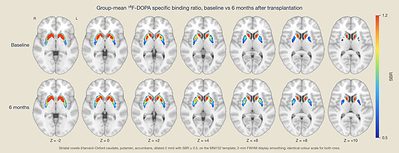
    Investigator shared safety and efficacy data; ¹⁸F-DOPA PET showed transplanted cell engraftment and dopamine synthesis at injection sites.

  2. FDA grants Fast Track designation

    Regulatory

    Designation enables frequent FDA communication and eligibility for rolling BLA submission and Priority Review.

  3. Phase II registrational trial completes enrollment

    Clinical Trial

    All 30 patients enrolled across four Chinese centers; transplants completed in the treatment group.

  4. NMPA clears XS411; Phase I starts in China

    Regulatory

    China's drug regulator cleared the trial; Phase I initiated at Beijing Tiantan Hospital.

Scenarios

1

XS411 Phase II meets efficacy endpoints, Phase III moves forward

Likely Resolves by Q2 2028

Discussed by: Company press materials; the Phase II is described as 'registrational' suggesting NMPA could accept it directly

The Phase I signal was strong — over 30 points of OFF-state motor improvement. If the blinded-endpoint Phase II replicates that in the randomized comparison, XellSmart would advance to a Phase III registrational trial, likely global given the FDA Fast Track designation.

2

FDA requires a US bridging study before US approval

Likely Resolves by End of 2028

Discussed by: FDA's conventional data requirements; Fast Track designation anticipates US development

NMPA could approve in China on the registrational Phase II data, but FDA will likely demand US-based safety and efficacy data. This extends timelines but is a standard path, and Fast Track shortens the review window.

3

Phase II blinded endpoints fall short of open-label signal

Possible Resolves by Q2 2028

Discussed by: Known failure mode in cell and gene therapy; the PROBE design exists precisely because open-label data carries bias risk

If the control arm performs closer to the treated arm than the Phase I open-label data suggested, the registrational path in China lengthens and the US program slows. This is the risk the blinded design is meant to expose.

Historical Context

2 moments from history that rhyme with this story — and how they unfolded.

1987–2001

Fetal tissue transplantation for Parkinson's (1987–2001)

Researchers in Sweden, the US, and elsewhere transplanted fetal dopamine neurons into Parkinson's patients' brains. The NIH-funded double-blind trial led by Curt Freed, published in 2001 in the New England Journal of Medicine, showed modest motor gains but also found roughly 15% of patients developed graft-induced dyskinesia — uncontrollable movements caused by the graft itself.

Then

The dyskinesia finding dampened enthusiasm for cell replacement in Parkinson's and shifted attention to gene therapy and device-based approaches.

Now

Cell replacement research continued in smaller studies, but graft-induced dyskinesia became a standard safety endpoint for any new approach.

Why this matters now

XS411's Phase I explicitly tracked for graft-induced dyskinesia and reported none; its blinded-endpoint Phase II design targets the trial-design weaknesses that undermined confidence in earlier cell therapy studies.

September 2014

RIKEN iPSC retinal pigment epithelium transplant (2014)

Masayo Takahashi's team at RIKEN transplanted iPSC-derived retinal pigment epithelial cells into a patient with age-related macular degeneration — the first clinical use of induced pluripotent stem cell-derived cells in humans. The initial approach used the patient's own cells; the program later moved to donor-derived cells to cut cost and manufacturing time.

Then

The transplant proved safe and demonstrated that iPSC-derived cells could be manufactured and delivered clinically.

Now

The shift from autologous to allogeneic cells became a template for off-the-shelf cell therapy economics.

Why this matters now

XS411 applies the same allogeneic logic to a much larger patient population — Parkinson's — and its Phase I PET imaging shows transplanted cells surviving and producing dopamine in the putamen.

Sources

(5)