


Pull to refresh
Logo
Daily Brief
Following
Why Sign Up
Nexstar absorbs Tegna to create largest U.S. broadcast company after FCC waives ownership cap

Nexstar absorbs Tegna to create largest U.S. broadcast company after FCC waives ownership cap

Money Moves
By Newzino Staff |

Combined company owns 265 stations reaching 80% of American households; eight states sue to block the deal

Today: FCC approves merger, waiving the 39% ownership cap

Overview

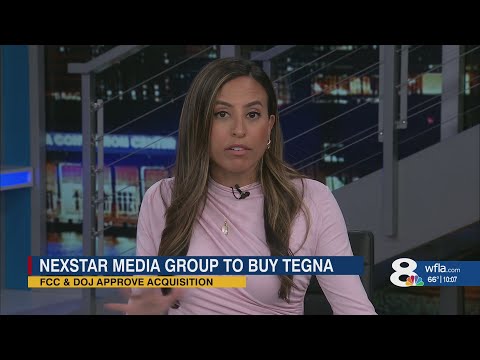
For two decades, federal law has barred any single company from owning television stations that reach more than 39% of American households. On March 20, the Federal Communications Commission (FCC) waived that rule for the first time, clearing Nexstar Media Group's $6.2 billion acquisition of rival broadcaster Tegna. The combined company now owns 265 stations in 44 states, reaching roughly 80% of U.S. TV households — more than double the legal cap.

Why it matters

If the ownership cap is effectively dead, the next wave of broadcast mergers could leave most local TV news controlled by two or three companies.

Key Indicators

265
Combined TV stations
Nexstar now owns or operates 265 stations across 44 states and Washington, D.C.
80%
U.S. household reach
The combined company reaches roughly 80% of American TV households, far exceeding the 39% cap
$6.2B
Deal value
Tegna shareholders received $22 per share in cash
5,000%
Retransmission fee increase
Industry-wide retransmission fees grew from $215 million in 2006 to an estimated $11.9 billion in 2025

Interactive

Exploring all sides of a story is often best achieved with Play.

Ever wondered what historical figures would say about today's headlines?

Sign up to generate historical perspectives on this story.

Sign Up

Debate Arena

Two rounds, two personas, one winner. You set the crossfire.

People Involved

Organizations Involved

Timeline

  1. FCC approves merger, waiving the 39% ownership cap

    Regulatory

    The FCC's Media Bureau — not the full commission — approved the deal and waived the national ownership cap for the first time, allowing the combined company to reach 80% of U.S. households. The Department of Justice also cleared the transaction.

  2. Eight state attorneys general sue to block the deal

    Legal

    California, New York, Colorado, Illinois, Oregon, North Carolina, Connecticut, and Virginia filed suit in federal court alleging the merger violates the Clayton Act by substantially lessening competition in local TV markets.

  3. DirecTV files separate lawsuit

    Legal

    DirecTV sued to block the merger, arguing the combined company would have extraordinary leverage to raise retransmission fees paid by cable and satellite providers.

  4. Trump reverses course, endorses the merger

    Political

    Trump endorsed the deal on Truth Social, saying it 'will help knock out the Fake News because there will be more competition.' FCC Chairman Carr responded: 'Let's get it done.'

  5. FCC accepts transfer applications

    Regulatory

    The FCC formally accepted applications to transfer control of Tegna stations to Nexstar, beginning its review process.

  6. Trump initially questions the deal

    Political

    President Trump wrote on Truth Social that he would 'not be happy' if the merger also allowed networks he considers hostile to expand.

  7. Tegna shareholders approve merger by 98% vote

    Corporate

    Approximately 98% of Tegna shares voted approved the deal, representing about 83% of total outstanding shares.

  8. Nexstar announces $6.2 billion deal to buy Tegna

    Corporate

    Nexstar and Tegna announced a merger agreement at $22 per share in cash, which would combine the first- and third-largest U.S. station groups.

  9. Nexstar acquires Tribune Media

    Corporate

    Nexstar completed its acquisition of Tribune Media, becoming the largest local TV broadcast company in the United States.

  10. FCC blocks Sinclair-Tribune merger over sham divestitures

    Regulatory

    Even under the business-friendly Pai FCC, the Sinclair-Tribune broadcasting merger was blocked after evidence that proposed station sales were designed to let Sinclair maintain de facto control.

  11. FCC reinstates UHF discount under Chairman Pai

    Regulatory

    FCC Chairman Ajit Pai reinstated the UHF discount, which counts UHF station audiences at half their actual size for ownership cap calculations, effectively loosening the cap.

  12. Congress caps broadcast ownership at 39%

    Regulatory

    The Consolidated Appropriations Act sets the national TV ownership cap at 39% of U.S. households, codifying a limit that had been debated since the Telecommunications Act of 1996.

Scenarios

1

Courts uphold the merger, setting precedent for further consolidation

Discussed by: Wall Street analysts and the National Association of Broadcasters, which has urged the FCC to eliminate the cap entirely

Federal courts decline to grant injunctions, ruling the FCC had authority to waive the ownership cap or that the states lack standing to challenge an FCC regulatory action. The completed merger stands, and other broadcasters — including Sinclair, Gray Television, and E.W. Scripps — pursue their own large-scale acquisitions, citing the Nexstar precedent. The 39% cap becomes effectively defunct without Congress ever voting to repeal it.

2

Courts block the merger on antitrust grounds, forcing divestitures

Discussed by: The eight state attorneys general and antitrust scholars who argue the Clayton Act claim is strong regardless of FCC approval

A federal judge grants an injunction or rules the merger violates antitrust law, forcing Nexstar to divest stations in overlapping markets. Because the deal has already closed, the unwinding process would be complex and costly. This outcome would signal that FCC approval alone cannot immunize broadcast mergers from antitrust challenges — a significant constraint on future consolidation.

3

Courts rule the FCC lacks authority to waive the statutory cap

Discussed by: The American Television Alliance (ATVA) and legal scholars including those at the Yale Journal on Regulation

A court finds that Congress set the 39% cap as a statutory requirement in 2004, not a regulation the FCC can waive. This would invalidate the ownership waiver and potentially require Nexstar to divest enough stations to fall below 39% — a far more drastic unwinding than targeted antitrust divestitures. It would also foreclose the FCC's path to loosening ownership rules without congressional action.

4

Merger survives legal challenges but with conditions that limit Nexstar's leverage

Discussed by: Media industry analysts and pay-TV distributors concerned about retransmission fee increases

Courts allow the merger to stand but impose conditions — such as extended retransmission fee caps, local news investment requirements, or restrictions on future acquisitions — that blunt Nexstar's market power. The FCC's existing conditions (maintaining retransmission rates through November 2026 and increasing local news) could be extended or strengthened. This outcome preserves the deal while addressing the most acute competition concerns.

Historical Context

Sinclair-Tribune merger blocked (2018)

March 2017 – August 2018

What Happened

Sinclair Broadcast Group attempted to buy Tribune Media for $3.9 billion, which would have made it the largest U.S. station group. FCC Chairman Ajit Pai — a Republican appointee generally favorable to deregulation — blocked the deal after discovering that Sinclair's proposed station divestitures were shams designed to let the company maintain control of 'sold' stations through executives with close ties to Sinclair.

Outcome

Short Term

Tribune terminated the merger and sued Sinclair for breach of contract. Sinclair's stock dropped sharply.

Long Term

The failure demonstrated that even a deregulation-minded FCC had limits. Nexstar, not Sinclair, ultimately bought Tribune Media in 2019, becoming the largest station group.

Why It's Relevant Today

The Nexstar-Tegna deal succeeds where Sinclair-Tribune failed, but through a different mechanism: rather than proposing questionable divestitures to stay under the cap, Nexstar persuaded the FCC to waive the cap entirely — a more aggressive regulatory approach than even the Sinclair deal attempted.

Clear Channel radio consolidation (1999–2008)

1999 – 2008

What Happened

After the 1996 Telecommunications Act lifted radio ownership caps, Clear Channel Communications acquired over 1,200 radio stations nationwide, including its $17.4 billion purchase of AMFM Inc. in 1999. The company went from 40 stations to controlling roughly 10% of all U.S. radio stations and captured a third of all radio advertising revenue.

Outcome

Short Term

Local radio programming was widely replaced by centralized, nationally syndicated content. Hundreds of local radio jobs were eliminated.

Long Term

Clear Channel went private in a $26.7 billion leveraged buyout in 2006, was renamed iHeartMedia, and filed for bankruptcy in 2018 with $16 billion in debt. The episode became a cautionary tale about debt-fueled media consolidation.

Why It's Relevant Today

The closest precedent for what the Nexstar-Tegna merger could mean for local television. Radio consolidation after 1996 showed how lifting ownership caps can rapidly concentrate an industry — and how the debt taken on to fund acquisitions can become unsustainable.

FCC's 2003 attempt to raise the ownership cap (2003–2004)

June 2003 – January 2004

What Happened

FCC Chairman Michael Powell pushed through new rules raising the national ownership cap from 35% to 45%. The decision triggered a rare bipartisan backlash in Congress, with both Republicans and Democrats objecting to media concentration. Over three million public comments opposed the change — at the time, the largest public response to any FCC proceeding in history.

Outcome

Short Term

Congress passed legislation in January 2004 rolling the cap back to 39% — a compromise between 35% and 45%.

Long Term

The 39% cap was written into statute, and Congress removed the FCC's ability to revisit it in its regular quadrennial ownership reviews, intending the number to be permanent.

Why It's Relevant Today

The current FCC's waiver of the 39% cap achieves through regulatory action what Congress explicitly rejected in 2003–2004. Whether the FCC has authority to waive a cap that Congress set by statute is the central legal question in the pending lawsuits.

Sources

(12)