Pull to refresh
Logo
Daily Brief
Following
Why Ranks Sign Up
NinjaOne doubles to $12.3 billion valuation in secondary-heavy funding round

NinjaOne doubles to $12.3 billion valuation in secondary-heavy funding round

Money Moves

An Austin IT-software maker reaches decacorn status as investors buy out existing shares rather than fund new growth

Yesterday: NinjaOne hits $12.3 billion, reaches decacorn status

Overview

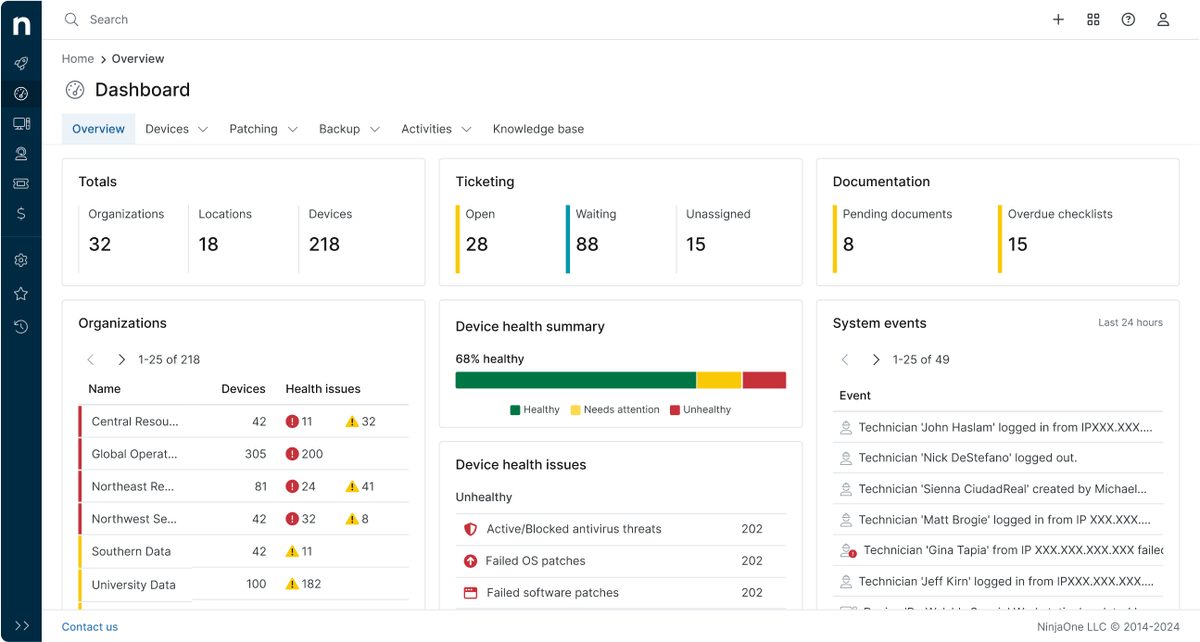
NinjaOne, a company that makes software to manage and secure a business's computers, raised more than $400 million on June 9, 2026. The deal valued the Austin firm at $12.3 billion, roughly double its price a year earlier.

Almost none of that money goes into the company. The round was nearly all secondary equity, meaning new investors bought shares from existing owners and employees. NinjaOne is profitable, carries no debt, and is still controlled by its two founders.

Why it matters

Investors paid a record price for a profitable software firm without putting cash into it, a sign of how starved they are for safe enterprise bets.

Questions about this story

0

Wow, sounds like a company that would not survive long after coding being solved by ai.

NinjaOne manages physical devices and security patches — not a casualty of AI coding tools, and possibly a beneficiary as more AI infrastructure needs managing.

Why it matters: The 'SaaSpocalypse' is real but uneven: it's gutting task-tracking and CRM SaaS, while device management and security infrastructure are more defensible.

  • NinjaOne's core product — patching fleets of computers, detecting vulnerabilities, securing endpoints — exists regardless of who or what writes the software running on those devices.
  • AI coding automating away developers doesn't shrink the number of servers and endpoints enterprises run; if anything, AI deployment expands the hardware footprint IT teams must manage.
  • The real SaaS threat is to seat-based workflow tools: Atlassian dropped 35% and Salesforce 28% in early 2026 as AI agents automated their core tasks — data entry, ticket logging, task tracking. NinjaOne's workflows are harder to replicate with a general-purpose agent.
  • NinjaOne is already shipping AI features — real-time vulnerability detection, Patch Intelligence AI — and Sequoia (which priced AI disruption risk into every deal it makes) just bought in at a $12.3B valuation for the first time.
Room for disagreement
  • The bear case: if AI agents can autonomously manage IT infrastructure end-to-end, the human-facing NinjaOne dashboard becomes unnecessary — the same disruption hitting Atlassian could eventually hit operational platforms too, just on a longer lag.
  • The bull case (Sequoia's implicit view): device management and security require accountability, audit trails, and human judgment at the edge in ways that make full automation legally and operationally risky for enterprises — making NinjaOne's platform sticky even in an AI-heavy world.
AI-generated with web search — may be wrong. Check the linked sources.


Key Indicators

$12.3B
Post-money valuation
Up from about $5 billion in February 2025.
$400M+
Round size
Almost entirely secondary shares, not new company capital.
~70%
Year-over-year growth
Revenue growth reported for its 2025 fiscal year.
$600M+
Annual recurring revenue
Up from about $500 million at the end of 2025.
~40,000
Customer organizations
Across more than 140 countries.

Voices

Curated perspectives — historical figures and your fellow readers.

Ever wondered what historical figures would say about today's headlines?

Sign up to generate historical perspectives on this story.

Play

Exploring all sides of a story is often best achieved with Play.

Log in to play. Track your picks, climb the leaderboards. Log in Sign Up
Predict 3 ways this could play out. Contrarian picks score more — points lock when the scenario resolves. Log in to play
Higher or Lower Two numbers from this story. Guess which is bigger. 5 rounds to set a streak. Log in to play
Connections Sixteen names from the news. Find the four hidden groups of four. Log in to play

People Involved

Organizations Involved

Timeline

February 2024 June 2026

3 events Latest: Yesterday
  1. NinjaOne hits $12.3 billion, reaches decacorn status

    Latest Funding

    The company raises more than $400 million, almost entirely secondary shares, doubling its valuation again. Sequoia, Wellington, and Ontario Teachers' join.

  2. Valuation jumps to $5 billion

    Funding

    NinjaOne raises $500 million in Series C extensions led by ICONIQ and Alphabet's CapitalG, more than doubling its price in a year.

  3. NinjaOne valued at $1.9 billion

    Funding

    An ICONIQ-led Series C round prices the company at about $1.9 billion, its first unicorn-scale valuation.

Historical Context

2 moments from history that rhyme with this story — and how they unfolded.

March 2023

Stripe's secondary-led valuation reset (2023)

Payments firm Stripe raised more than $6.5 billion that mostly bought out employee shares rather than funding the business. The deal valued it at $50 billion, down from $95 billion in 2021.

Then

Employees got liquidity and Stripe covered a large tax bill tied to expiring stock units.

Now

Stripe stayed private and later saw its valuation climb back, using more secondary deals instead of going public.

Why this matters now

Like NinjaOne, Stripe used a big secondary round to reward insiders and delay an IPO. It shows how mature private firms now treat secondaries as a tool, not a last resort.

December 2024

Databricks raises at a soaring private valuation (2024)

Data and AI firm Databricks raised about $10 billion at a $62 billion valuation, much of it earmarked to buy out employee shares. The company was growing fast but still private.

Then

Staff gained liquidity without a public listing, and new investors bought in at a record price.

Now

Databricks kept compounding in value privately, reinforcing that top software firms can stay off public markets for years.

Why this matters now

It is the closest recent parallel to NinjaOne: a profitable-leaning, fast-growing software company using huge private rounds and secondaries instead of an IPO.

Sources

(5)