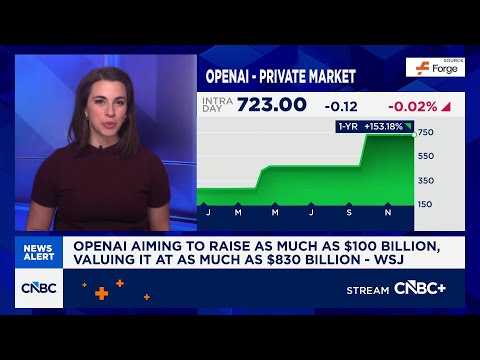
After the $122 billion round closed in April, OpenAI ended its Azure cloud exclusivity and capped Microsoft's revenue share at $38 billion through 2030. On May 18, a jury dismissed Elon Musk's suit seeking $134 billion and the reversal of OpenAI's for-profit structure.
The path to IPO is now internally contested. Altman is pushing for a Q4 2026 listing at up to $1 trillion, with Goldman Sachs, JPMorgan, and Morgan Stanley engaged as underwriters. CFO Sarah Friar is urging 2027, warning that $600 billion in infrastructure commitments may outpace revenue growth.
Why it matters
OpenAI's path to a $1 trillion IPO hinges on whether $600 billion in infrastructure bets pay off before the losses compound.
Questions about this story
Free account needed to ask — your question is kept and asked for you right after sign-up. Answers are public.
0
I thought I heard that Anthropic is not valued more? Don't they now make more revenue than openai?
You're right on both counts: Anthropic is now valued higher than OpenAI ($965B vs $852B) and appears to generate more revenue (~$47B annualized vs OpenAI's ~$24B).
Why it matters: This is a historic reversal — OpenAI spent years as the unchallenged leader in AI value and scale, and Anthropic has now overtaken it on both metrics in a matter of months.
—Anthropic closed a $65B Series H on May 28 at a $965B valuation, led by Altimeter, Dragoneer, Greenoaks, and Sequoia — nearly tripling its $380B February valuation.
—OpenAI's post-money valuation is $852B after its $122B round closed in April, leaving it ~$113B behind Anthropic.
—Anthropic's annualized revenue run rate hit $47B at the time of the raise, up from $30B in April; OpenAI reports roughly $2B/month (~$24B annualized).
—Anthropic's edge comes from enterprise dominance — ~80% of revenue from business customers — while OpenAI's mix is heavier on consumers.
OpenAI disputes the revenue comparison framing: its CFO Sarah Friar has signaled confidence in accelerating growth, and the company's consumer reach via ChatGPT (hundreds of millions of users) gives it scale Anthropic lacks — some analysts argue OpenAI's revenue trajectory will close the gap quickly as enterprise deals mature.
Anthropic's $47B figure is a run rate, not audited revenue, and at least one SoftBank lender cited missed internal targets and slowing growth at OpenAI as a cautionary sign that run-rate figures can be misleading in fast-moving AI markets.
AI-generated with web search — may be wrong. Check the linked sources.
Images from Openverse under Creative Commons licenses.
Videos from YouTube.
Voices
Curated perspectives — historical figures and your fellow readers.
George Orwell
(1903-1950) ·Modernist · satire
Fictional AI pastiche — not real quote.
"They have built a machine to think for mankind, and mankind has responded by pouring into it sums so vast they require new mathematics to express — all to fund a venture that loses nearly two dollars for every dollar earned, sustained by the collective faith that intelligence, once artificial, will prove more profitable than the real thing ever was."
0% found this insightful
Dorothy Parker
(1893-1967) ·Jazz Age · wit
Fictional AI pastiche — not real quote.
"They've built a machine that loses money faster than it can think, and called it intelligence."
0% found this insightful
Ever wondered what historical figures would say about today's headlines?
Sign up to generate historical perspectives on this story.
23 events
Latest: May 18th, 2026 · 5 months ago
Showing 8 of 23
JK to step
Tap a bar to jump to that date
Jump to
May 2026
Jury Dismisses Musk Lawsuit Against OpenAI
LatestLegal
A federal jury ruled against Elon Musk after less than two hours of deliberation. Musk had sought $134 billion and the unwinding of OpenAI's 2025 for-profit restructuring; the case was dismissed on statute of limitations grounds.
SoftBank Posts Surprise Profit on OpenAI Valuation Gains
Financial
SoftBank reported a surprise quarterly profit driven by roughly $45 billion in unrealized gains on its OpenAI stake. The result validated Son's AI-first strategy after years of Vision Fund losses.
CFO Friar Warns IPO May Slip to 2027
Corporate
CFO Sarah Friar privately told company leaders that OpenAI may not meet public-company reporting standards in time for a 2026 listing, and that $600 billion in infrastructure commitments may not be coverable if revenue growth does not accelerate.
April 2026
SoftBank $40B Bridge Loan Syndicated to Eight-Plus Banks
Funding
The bridge loan SoftBank used to fund its additional OpenAI stake was fully syndicated to at least eight banks, adding HSBC, BNP Paribas, and Intesa Sanpaolo alongside original underwriters JPMorgan, Goldman Sachs, Mizuho, SMBC, and MUFG.
OpenAI Ends Microsoft Azure Exclusivity; Caps Revenue Share
Corporate
OpenAI renegotiated its Microsoft partnership, ending Azure cloud exclusivity and capping Microsoft's revenue share at $38 billion through 2030. OpenAI can now sell API access through any provider, including Amazon Web Services and Google Cloud.
OpenAI abandoned plans to rent 230 megawatts of compute from a Norwegian data center in Narvik, with Microsoft taking over that capacity. Separately, SoftBank began inviting additional banks to sub-underwrite its $40 billion bridge loan.
SoftBank Delivers Second $10B Tranche; Round Completes at $122B
Funding
SoftBank's second $10 billion tranche from its $40B loan commitment arrived, finalizing the round at $122 billion total with Andreessen Horowitz and D.E. Shaw Ventures participating. Post-money valuation reached $852 billion. OpenAI reports $2B monthly revenue.
March 2026
SoftBank Secures $40B Loan for Further OpenAI Investment
Funding
SoftBank Group arranged a $40 billion bridge loan facility maturing March 2027, led by JPMorgan, Goldman Sachs, and Japanese banks, explicitly to fund additional investments in OpenAI as the funding round remains open.
February 2026
OpenAI Closes Record $110B Funding Round
Funding
OpenAI officially closes $110 billion funding round at $730 billion pre-money valuation ($840 billion post-money). Amazon commits $50B ($15B upfront, $35B contingent on AGI or IPO by year-end), Nvidia and SoftBank each commit $30B. Round remains open for additional investors.
OpenAI Expands AWS Partnership by $100B
Partnership
As part of Amazon investment, OpenAI commits to consuming at least 2GW of AWS Trainium compute and will develop stateful runtime environments on Amazon Bedrock platform. Expands previous $38B AWS deal by $100B over eight years.
Nvidia Commits to 5GW of Capacity for OpenAI
Partnership
Nvidia will provide 3 gigawatts of dedicated inference capacity and 2 gigawatts of training capacity using Vera Rubin systems as part of its $30 billion equity investment.
Nvidia Reaches Terms on $30B Equity Investment
Funding
Nvidia neared final terms on a $30 billion direct equity stake in OpenAI at a $730 billion pre-money valuation, replacing the stalled $100 billion milestone-linked deal.
Full $100B+ Round Takes Shape
Funding
Reports indicated OpenAI was finalizing a round exceeding $100 billion at a valuation above $850 billion, with Nvidia, SoftBank, and Amazon as anchor investors.
Amazon-OpenAI Talks Expand to Include Alexa
Partnership
Reports indicated OpenAI models could help power Amazon's Alexa voice assistant as part of the broader investment discussions.
January 2026
Reports Surface That $100B Deal Is 'On Ice'
Report
Media reports indicated negotiations had stalled, with some inside Nvidia expressing doubts about OpenAI's business model. Both chief executives publicly denied tension.
December 2025
Nvidia CFO Confirms Deal Still Not 'Definitive'
Disclosure
Nvidia's chief financial officer Colette Kress acknowledged the $100 billion OpenAI deal remained unsigned, more than two months after it helped fuel an AI stock rally.
November 2025
Nvidia Files 'No Assurance' Warning
Disclosure
Nvidia disclosed in a quarterly filing that there was "no assurance" it would finalize the $100 billion OpenAI deal, signaling internal doubts about the transaction's structure.
Amazon Signs $38B Cloud Deal with OpenAI
Partnership
OpenAI committed to spending $38 billion on Amazon Web Services over seven years for access to Nvidia GPUs and cloud infrastructure.
October 2025
OpenAI Completes For-Profit Restructuring
Corporate
OpenAI reorganized into a public benefit corporation, with the nonprofit OpenAI Foundation retaining 26% ownership and Microsoft receiving a 27% stake.
September 2025
Nvidia Signs $100B Infrastructure Letter of Intent
Partnership
Nvidia and OpenAI announced a non-binding agreement under which Nvidia would invest up to $100 billion as OpenAI deployed 10 gigawatts of Nvidia-powered data center capacity.
April 2025
SoftBank Leads $40B Round at $300B Valuation
Funding
OpenAI raised $40 billion in what was then the largest private technology deal in history, with SoftBank as lead investor. Microsoft, Coatue, Altimeter, and Thrive also participated.
January 2025
Stargate Project Announced at the White House
Partnership
President Trump, alongside Altman, Son, and Oracle's Larry Ellison, unveiled a $500 billion AI data center joint venture called Stargate, with SoftBank as chairman.
October 2024
OpenAI Raises $6.6B at $157B Valuation
Funding
OpenAI closed a funding round with Microsoft, Nvidia, SoftBank, and others. The investment carried a condition: the company must convert to a for-profit structure or the funds would become debt.
Scenarios
1
Round Closes Above $100B, OpenAI Files for IPO
Likely
Discussed by: TechCrunch, Caproasia, and multiple Wall Street analysts tracking OpenAI's trajectory
All three anchor investors—Nvidia, SoftBank, and Amazon—finalize their commitments, bringing the round above $100 billion. The capital injection funds OpenAI's $600 billion compute spending plan through 2030 and positions the company for an initial public offering in late 2026 or 2027 at a valuation approaching $1 trillion. OpenAI's chief financial officer Sarah Friar has told associates the company is targeting a 2027 listing, and the for-profit restructuring completed in October 2025 removed the final structural barrier.
2
Round Shrinks as One or More Investors Pull Back
Possible
Discussed by: Business Standard, The Information, and analysts who noted the $100B Nvidia deal's collapse as a precedent
One or more anchor investors reduce their commitments or drop out, shrinking the round significantly. Amazon's talks—which involve OpenAI adopting Amazon's custom Trainium chips—face the same structural complications that stalled the original Nvidia deal. OpenAI still raises tens of billions but at a lower valuation, and the IPO timeline slips as the company's $9 billion annual losses continue to require fresh capital.
3
Circular Funding Draws Regulatory or Investor Scrutiny
Possible
Discussed by: TechCrunch, which flagged the 'circular deals' dynamic, and financial analysts questioning the structure
The intertwined nature of these deals—Amazon invests in OpenAI, OpenAI spends $38 billion on Amazon's cloud; Nvidia takes equity, OpenAI buys Nvidia chips—attracts scrutiny from regulators or skeptical institutional investors. Questions about whether the investments represent genuine capital allocation or subsidized customer acquisition could complicate the IPO process or trigger antitrust review, particularly given the Federal Trade Commission's existing interest in AI industry concentration.
4
AI Spending Boom Cools, OpenAI's Losses Force a Reckoning
Unlikely
Discussed by: Medium's Will Lockett, Naked Capitalism, and analysts projecting $143 billion in cumulative negative free cash flow through 2029
If demand for AI products plateaus or a competing open-source model erodes OpenAI's pricing power, the company's path to profitability—which it projects for 2029 or 2030—becomes less credible. Investors who poured in at a $730 billion-plus valuation face significant markdowns. The parallel to SoftBank's Vision Fund era, where massive capital commitments preceded a wave of down rounds and writedowns, becomes harder to dismiss.
5
IPO Slips to 2027 as CFO-CEO Rift Goes Unresolved
Possible
Resolves by End of 2026
Discussed by: Gizmodo, TechTimes, and Notebookcheck, citing internal OpenAI communications from May 2026
CFO Sarah Friar's concerns about readiness and infrastructure risk delay the IPO beyond 2026. If ChatGPT weekly active users stay below 1 billion and revenue growth slows, the case for a year-end listing weakens. The 12-month maturity on SoftBank's $40 billion bridge loan (due March 2027) creates pressure to list, but a forced IPO in soft market conditions could price below the $1 trillion target.
Historical Context
3 moments from history that rhyme with this story — and how they unfolded.
1 of 3
2017-2019
SoftBank Vision Fund and WeWork (2017-2019)
SoftBank invested approximately $16 billion in WeWork through its Vision Fund and other vehicles, pushing the coworking company's valuation to $47 billion. WeWork's September 2019 initial public offering filing revealed unsustainable losses, and the IPO collapsed. Within weeks, WeWork's implied valuation fell 83% to $8 billion, and SoftBank assembled a $9.5 billion rescue package.
Then
WeWork abandoned its IPO, ousted its founder-CEO Adam Neumann, and accepted a SoftBank bailout that gave the Japanese conglomerate effective control of the company.
Now
The episode became shorthand for the dangers of massive private-market overvaluation. SoftBank's Vision Fund I ultimately recovered much of its losses through other bets, but investor confidence in mega-round private market valuations took years to rebuild.
Why this matters now
SoftBank is again one of the largest investors in a money-losing private company seeking a valuation in the hundreds of billions. The key difference: OpenAI's revenue is growing rapidly (from $3.7 billion in 2024 to roughly $13 billion in 2025), whereas WeWork never had a credible path to profitability. The key similarity: the sheer scale of capital at risk if growth assumptions prove wrong.
2 of 3
August 1997
Microsoft's $150 Million Investment in Apple (1997)
Microsoft invested $150 million in Apple at a time when the computer maker was near bankruptcy. The investment came with agreements for Microsoft to continue developing Office for the Mac and to settle patent disputes. Steve Jobs announced the deal at Macworld to a chorus of boos from Apple loyalists who saw it as capitulation to a rival.
Then
The investment stabilized Apple financially and signaled market confidence, helping reverse a multiyear stock decline.
Now
Apple went on to become the world's most valuable company. Microsoft sold its shares by 2003, missing out on hundreds of billions in gains. The deal demonstrated that a strategic investment by a dominant platform company in a key partner can reshape an entire industry.
Why this matters now
Nvidia's equity investment in OpenAI mirrors the structural logic: a dominant supplier (Microsoft made the software, Nvidia makes the chips) takes a financial stake in a company that is simultaneously its largest customer and potential competitor. The question is whether Nvidia is buying into a transformative partner or subsidizing a customer whose long-term hardware choices remain uncertain.
3 of 3
January 2000 - January 2001
AOL-Time Warner Merger (2000)
At the peak of the dot-com bubble, America Online acquired Time Warner for $164 billion in what was then the largest corporate merger in history. AOL's stock price had inflated its market value to over $200 billion on the promise that internet connectivity would transform media. The deal closed in January 2001.
Then
The combined company wrote down nearly $99 billion in value within two years as AOL's dial-up business collapsed amid the rise of broadband.
Now
The merger became the defining cautionary tale of using inflated valuations to acquire real assets. Time Warner eventually spun off AOL in 2009 at a fraction of the original price.
Why this matters now
The parallel is not in the deal structure but in the valuation question. OpenAI's $730 billion pre-money valuation is roughly 56 times its 2025 revenue, at a time when the company projects losses through 2028. If artificial intelligence revenue growth follows the trajectory its backers expect, the valuation looks prescient. If growth slows, it risks looking like another case of capital chasing hype at historic scale.