

Pull to refresh
Logo
Physicists trap a single positron, opening a precision test of antimatter

Physicists trap a single positron, opening a precision test of antimatter

New Capabilities

Northwestern's one-positron quantum cyclotron could measure the antiparticle's magnetic moment as sharply as the electron's — and show whether the two really are mirror images.

Overview

Updated 20 minutes ago

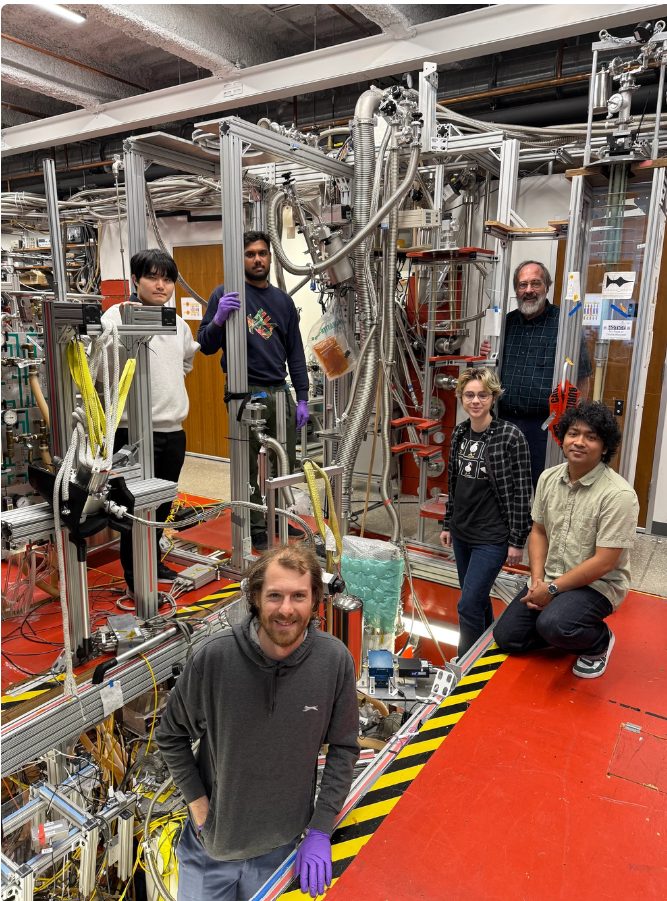
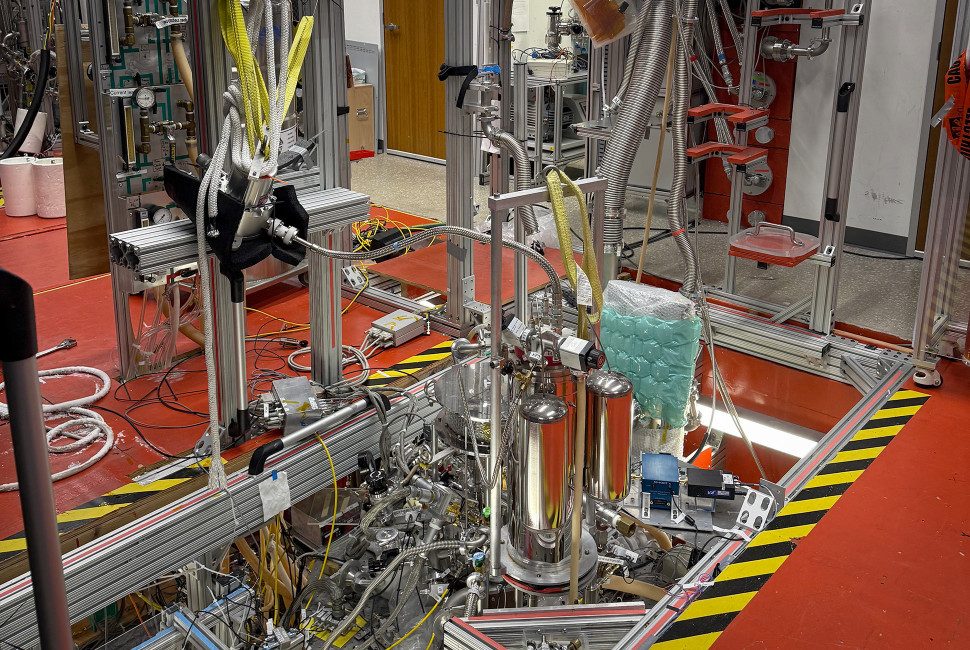
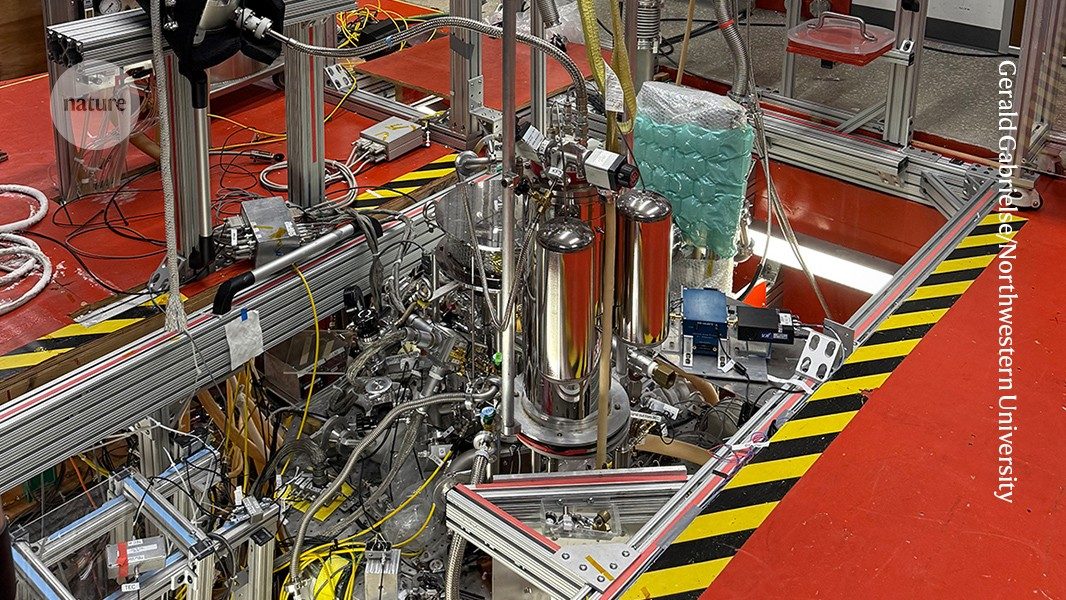
A single positron, suspended in a vacuum at 0.3 degrees above absolute zero, has been cooled into its lowest quantum state and pushed between energy levels on command. The Northwestern University team that built the device calls it a one-positron quantum cyclotron, and says it could measure the antiparticle's magnetism at a precision antimatter experiments have never reached.

The target is the positron's magnetic moment, the number describing how strongly the particle responds to a magnetic field. The Standard Model says it should equal the electron's exactly. The electron's value is known to about one part in 10 trillion, so any measurable gap would be a crack in the theory — and a possible clue to why the universe holds so much more matter than antimatter.

Why it matters

A measurable gap between positron and electron magnetism would mean the Standard Model is wrong, and could show why matter survived the Big Bang.

Questions about this story

Free account needed to ask — your question is kept and asked for you right after sign-up. Answers are public.

No questions yet — be the first to ask.

Key Indicators

1
Positrons in the trap
The experiment holds a single particle at a time; any contact with ordinary matter would annihilate it.
300 mK
Trap temperature
Roughly 0.3 degrees above absolute zero, cold enough for the positron to settle into its lowest energy state.
1 part in 10 trillion
Electron magnetic moment precision
The benchmark the positron measurement would have to match for a meaningful comparison.
30x
Expected gain over previous positron precision
The improvement physicists expect once the trap is used for a magnetic-moment measurement.

Voices

Curated perspectives — historical figures and your fellow readers.

Sign up to generate historical perspectives on this story.

People Involved

Organizations Involved

Timeline

October 2026 November 2026

3 events Latest: Yesterday
  1. Result reaches general-science coverage

    Latest Publication

    ScienceDaily describes the 300-millikelvin trap and the planned matter-antimatter comparison for a wider audience.

  2. One-positron quantum cyclotron published

    Publication

    Physical Review Letters carries the result: a single positron suspended indefinitely in a Penning trap, with quantum control of its energy levels.

  3. Northwestern reports months-long storage

    Statement

    The university says the positron has been held and controlled longer than any previous attempt, and outlines the planned electron comparison.

Scenarios

1

Positron and electron magnetic moments match, and CPT holds

Likely Resolves by End of 2031

Discussed by: Gerald Gabrielse and the Northwestern team, who say current theory predicts no difference

The group runs the electron-style measurement on the trapped positron and publishes a value whose uncertainty overlaps the electron's. That would tighten the strictest existing test of CPT symmetry in the lepton sector without breaking the Standard Model. The result would be a limit, not a discovery: physics would know the mirror holds to whatever precision the trap achieves.

2

A gap opens between positron and electron magnetism

Unlikely Resolves by End of 2032

Discussed by: Gabrielse, who calls such a result the biggest discovery in physics in a century, and Fermilab's Roni Harnik

The positron measurement lands outside the electron value by more than the combined experimental error, and independent groups confirm it. That would break CPT invariance as the Standard Model states it, and give theorists a new ingredient for explaining the universe's matter surplus. Harnik notes that no convincing theory yet predicts such a difference, which is what would make a confirmed one so disruptive.

3

Precision improves sharply but stays short of the electron

Possible Resolves by Q2 2029

Discussed by: Phys.org's analysis of the accuracy gap between electron and positron measurements

The trap delivers a positron magnetic moment roughly 30 times more precise than the previous best, a large step that still leaves the comparison too coarse to test CPT at the electron's level. The result would establish the technique and set up a longer measurement campaign, with the decisive comparison pushed years out.

Historical Context

3 moments from history that rhyme with this story — and how they unfolded.

2008-2023

One-electron quantum cyclotron measurements (2008-2023)

Gabrielse's group held single electrons in a Penning trap, cooled them with microwaves and read their quantum states, refining the electron's magnetic moment across two published results. The later measurement reached a precision of about one part in 10 trillion, among the most exact figures in particle physics.

Then

The electron value became a benchmark for testing quantum electrodynamics, the theory of how light and charged particles interact.

Now

It set the standard a positron measurement must meet, because a comparison is only as meaningful as the two numbers' precision.

Why this matters now

The positron experiment is the same apparatus and method applied to the opposite particle. Without the electron number, the positron result would have nothing to be compared against.

2010-2011

Antihydrogen trapped at CERN (2010-2011)

CERN's ALPHA collaboration captured 38 antihydrogen atoms in 2010 for about a sixth of a second, then held 309 of them for roughly 1,000 seconds the following year. The atoms were kept in a magnetic bottle, away from the walls of the apparatus, so they could be studied before annihilating.

Then

Holding antiatoms long enough to shine light on them made antimatter spectroscopy possible.

Now

It established a pattern for antimatter research: isolate the stuff, cool it, and measure a property that can be compared with ordinary matter.

Why this matters now

The Northwestern positron work follows the same logic at the single-particle scale, trading atoms for one trapped particle and magnetic bottles for electric and magnetic fields.

1964

CP violation in neutral kaons (1964)

James Cronin and Val Fitch, working at Brookhaven, found that neutral K mesons decay in a way that violates the combined charge-parity symmetry physicists had assumed held. The result showed that matter and antimatter do not behave identically in every process.

Then

The finding forced a rewrite of assumptions about symmetry in weak interactions.

Now

Cronin and Fitch shared the 1980 Nobel Prize in Physics, and CP violation became a required ingredient in explanations of the universe's matter excess.

Why this matters now

Known CP violation is too small to account for the matter-antimatter imbalance, which is why physicists keep testing other symmetries, including the CPT symmetry the positron measurement targets.

Sources

(5)