

Pull to refresh
Logo
Physicists observe the optical Magnus effect in quantum light for the first time

Physicists observe the optical Magnus effect in quantum light for the first time

New Capabilities

A tightly focused laser interacts with a trapped ion off-center, risking qubit-control errors while hinting at new gate designs

Today: Physicists announce first optical Magnus effect observation

Overview

Updated 2 hours ago

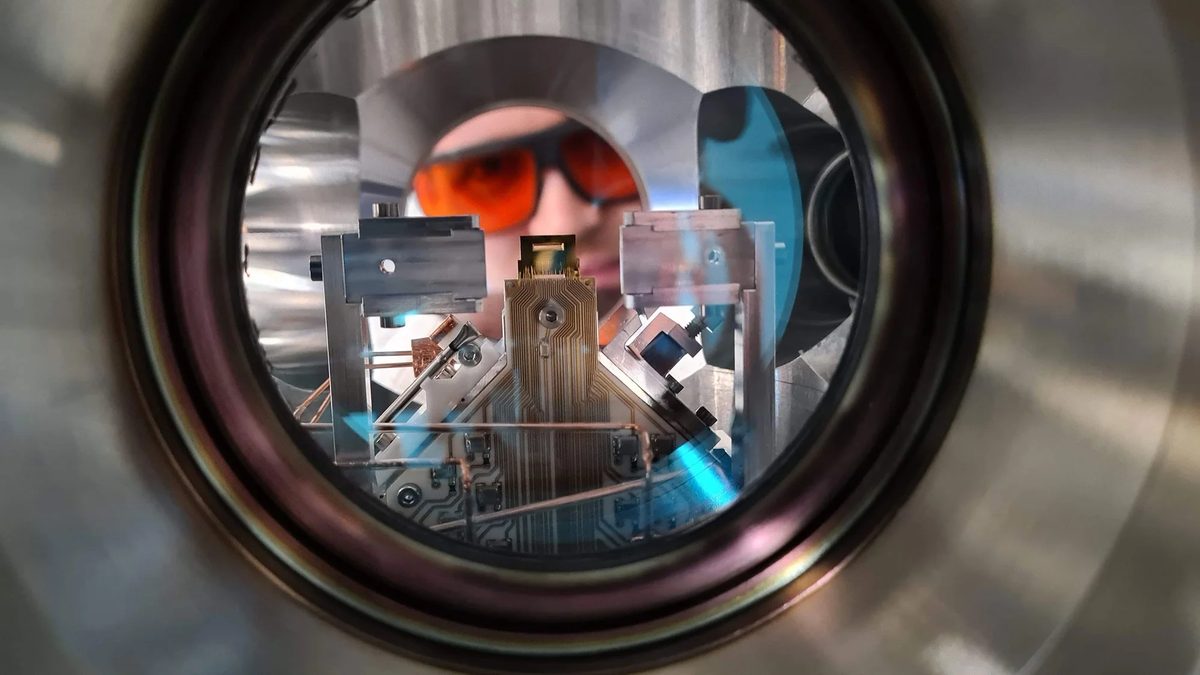
A laser aimed at the center of a trapped atom should interact most strongly at its bright center. It doesn't. Researchers at the Paul Scherrer Institute (PSI) in Switzerland measured the strongest interaction slightly off to one side — a shift they've named the optical Magnus effect, after the physics that curves a spinning table tennis ball.

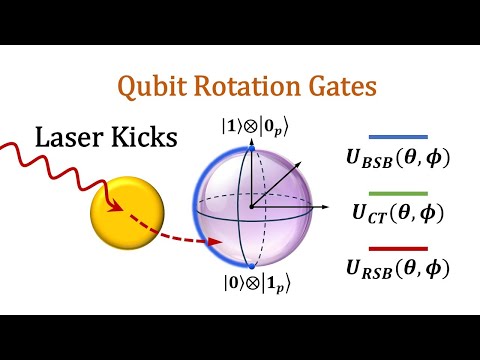
The finding has a direct stake in quantum computing. Trapped ions are a leading qubit platform, and tightly focused lasers steer their quantum states. An unaccounted-for shift introduces errors. The same effect produces purely transverse forces — perpendicular to the beam's path — that could couple qubits together in new gate designs, according to the team.

Why it matters

Trapped-ion quantum computers steering qubits with tight lasers face a known control error — and a possible new qubit-coupling tool.

Questions about this story

Free account needed to ask — your question is kept and asked for you right after sign-up. Answers are public.

No questions yet — be the first to ask.

Key Indicators

240 nm
Measured off-center shift for Δmj=±1 transitions
Matches the predicted λ/π = 232 nm for the 729 nm calcium transition.
463 nm
Measured off-center shift for Δmj=±2 transitions
Consistent with the predicted 2λ/π = 464 nm.
729 nm
Wavelength of the probed quadrupole transition
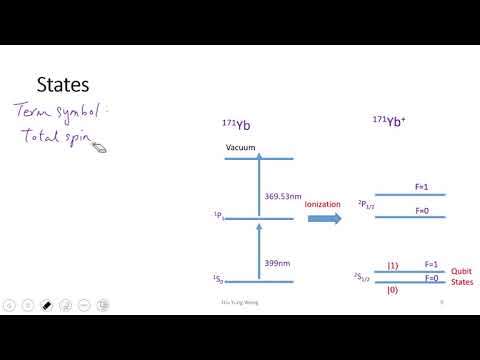
Calcium-40 ion transition from 4S1/2 to 3D5/2.
First
Direct observation status
First experimental demonstration of the optical Magnus effect, confirming prior theory.

Voices

Curated perspectives — historical figures and your fellow readers.

Ever wondered what historical figures would say about today's headlines?

Sign up to generate historical perspectives on this story.

People Involved

Organizations Involved

Timeline

January 2026 September 2026

2 events Latest: Today
  1. Physicists announce first optical Magnus effect observation

    Today Announcement

    ScienceDaily and the Paul Scherrer Institute report the discovery, noting implications for qubit control and coupling in quantum computers.

  2. Team posts optical Magnus effect paper to arXiv

    Publication

    Paper arXiv:2601.22981 reports the first direct observation of the optical Magnus effect with a trapped calcium-40 ion.

Scenarios

1

Optical Magnus effect enables transverse-field two-qubit gates

Possible Resolves by Jun 13, 2027

Discussed by: The PSI/ETH Zurich team, via first author Philip Leindecker and the Physical Review Letters paper

The paper notes that Δmj=±1 transitions show vanishing carrier coupling and a non-zero field gradient at the beam center — properties suited to gate schemes. Because the induced forces are purely transverse, perpendicular to beam propagation, they could simplify gate design compared with Mølmer–Sørensen schemes that rely on the axial wave-vector projection. A follow-up experiment demonstrating a two-qubit gate would validate the approach.

2

Quantum computer builders fold the optical Magnus shift into control models

Likely Resolves by Mar 13, 2027

Discussed by: The PSI team and press coverage, including interestingengineering.com's report on remaining optical imperfections

Trapped-ion and neutral-atom quantum computing efforts increasingly rely on tightly focused beams and optical tweezers. The measured few-hundred-nanometer displacement is large enough to matter for high-fidelity operations. Control software and error budgets would incorporate the shift, similar to how other systematic effects like AC Stark shifts are handled. Press reports note that understanding these transverse interactions becomes important as tweezers become central to atomic physics.

3

Optical Magnus effect stays a fundamental-physics curiosity

Unlikely Resolves by Sep 13, 2027

Discussed by: Null hypothesis implied by reports that frame the effect mainly as a control consideration rather than an immediate application

If the effect proves too small to drive practical gate designs, or if error-budget corrections handle it without the transverse forces finding application, the finding would remain an interesting but niche confirmation of the theory. The measurements matched theory exactly, so fundamental physics benefits regardless, but quantum computing applications would not materialize.

Historical Context

3 moments from history that rhyme with this story — and how they unfolded.

1955–1972

Imbert–Fedorov shift (1955–1972)

Physicists predicted and then measured a tiny transverse shift of a light beam when it reflects off a surface, perpendicular to the plane of incidence. The shift comes from the spin-orbit interaction of light. Soviet physicist Fyodorov predicted it in 1955; Imbert confirmed it experimentally in 1972.

Then

The effect was initially a curiosity, measurable only with careful experiments.

Now

The Imbert–Fedorov shift found later applications in precision metrology, sensing, and studies of structured light.

Why this matters now

Like the optical Magnus effect, it is a subtle transverse shift in optics predicted by theory and confirmed only with careful measurement decades later.

1992

Orbital angular momentum of light (1992)

Allen, Beijersbergen, Spreeuw, and Woerdman showed that light beams with helical wavefronts carry orbital angular momentum (OAM). The idea was theorized well before practical generation of such beams became routine.

Then

Researchers found ways to generate OAM beams in the laboratory.

Now

OAM light now underpins optical tweezers, high-capacity communications, and quantum information experiments. A decades-long gap separated theory from widespread application.

Why this matters now

Shows how a fundamental property of light moves from prediction to tools that enable new experimental and commercial capabilities — the trajectory the optical Magnus effect may follow.

2004–present

Optical spin Hall effect (2004 onwards)

Physicists predicted an optical analog of the spin Hall effect, in which light's spin gives rise to a transverse, spin-dependent deflection. The prediction followed the well-known electron spin Hall effect in condensed-matter physics.

Then

The effect was confirmed experimentally and studied in reflection and refraction geometries.

Now

It demonstrated the value of finding optical counterparts to condensed-matter phenomena, an approach now applied broadly in nanophotonics.

Why this matters now

The optical Magnus effect is the same kind of optical analog — a mechanical phenomenon (the curving spin of a table tennis ball) translated into quantum optics.

Sources

(7)