
Pull to refresh
Logo
Delft team flips a single atom's nuclear spin without the expected coupling

Delft team flips a single atom's nuclear spin without the expected coupling

New Capabilities

The nucleus responded to radio-frequency signals after being decoupled from its electron, and no one can yet say how

Overview

Updated 2 hours ago

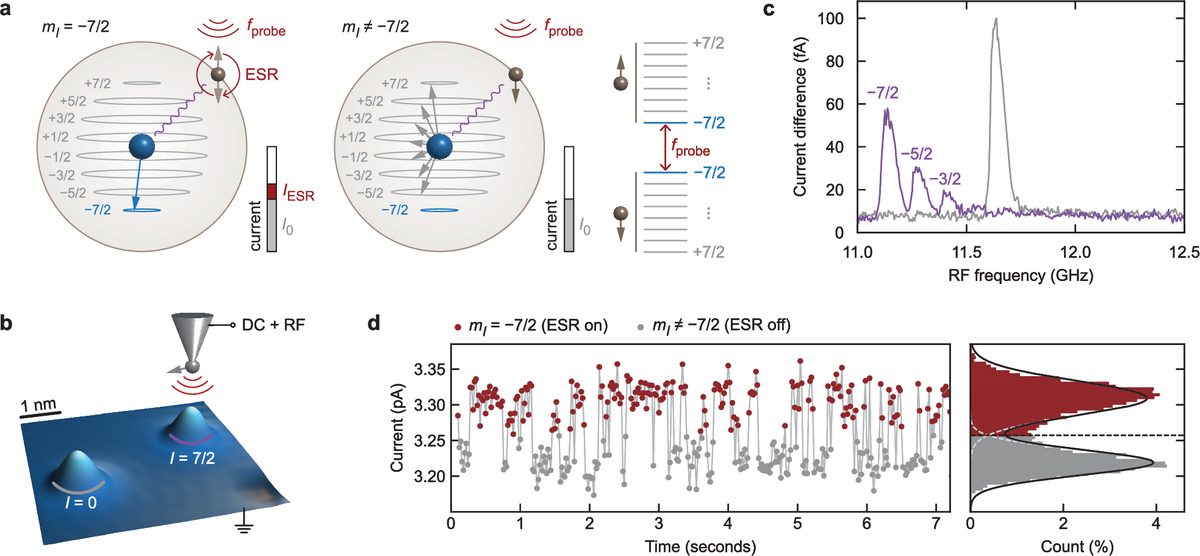
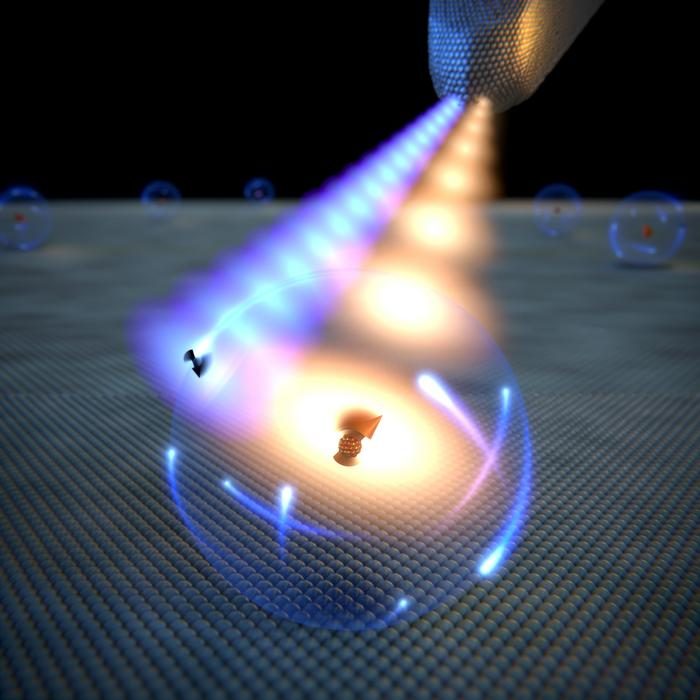
A scanning tunneling microscope at Delft University of Technology has flipped the magnetic spin of a single atom's nucleus with radio-frequency signals. The nucleus responded even after it had been largely decoupled from its electron, which physicists thought was the only route for reaching it.

The result, published in Nature Communications, points to a control channel nobody has explained. Nuclear spins hold quantum states far longer than electrons do, which makes them candidates for memory, and a way to write them with a microscope needle would matter.

Why it matters

Nuclear spins keep quantum information far longer than electrons. A way to write one with a microscope needle would give atomic-scale quantum memory a practical write head.

Questions about this story

Free account needed to ask — your question is kept and asked for you right after sign-up. Answers are public.

No questions yet — be the first to ask.

Key Indicators

100–1,000×
Nuclear vs electron resonance frequency
A nuclear spin's resonance sits 100 to 1,000 times lower than an electron's in the same atom.
~5 s
Time for a nuclear spin to flip
Measured in the group's 2025 readout work, against about 100 nanoseconds for the electron spin.
1
Atoms addressed per experiment
The microscope writes to and reads from one atom at a time.

Voices

Curated perspectives — historical figures and your fellow readers.

Sign up to generate historical perspectives on this story.

People Involved

Organizations Involved

Timeline

September 2024 November 2026

3 events Latest: Yesterday
  1. Radio signals flip the nucleus with the coupling off

    Latest Research

    Two simultaneous signals, one per spin, flip the nuclear spin even when the two are largely disentangled.

  2. Nuclear spin flip watched in real time

    Research

    The team reads a single nuclear spin without destroying it, seeing flips about every five seconds.

  3. Electron and nucleus wobble together

    Research

    A voltage pulse pushes a titanium atom's electron spin out of equilibrium; it and the nuclear spin then oscillate together.

Scenarios

1

Delft group identifies the mechanism behind the unexpected flip

Likely Resolves by End of 2027

Discussed by: Otte and colleagues, who say the physical mechanism remains unclear

The team follows the 2026 paper with measurements that isolate which interaction lets the microscope's electric signal reach the nucleus. If they find it, the effect moves from anomaly to tool, and other groups can engineer it deliberately.

2

An independent lab reproduces nuclear-spin control without hyperfine coupling

Possible Resolves by Q2 2028

Discussed by: Not yet claimed by any group; the result awaits outside replication

A second scanning tunneling microscopy group, working on a different element or surface, repeats the two-signal experiment. Reproduction on a different atom would show the effect is general rather than a quirk of one sample.

3

A microscope-addressed nuclear spin is driven as a coherent qubit

Unlikely Resolves by End of 2029

Discussed by: Quantum memory researchers who see nuclear spin as a storage candidate

Control advances from a single flip to a sequence: a pulse, a wait, a second pulse, and an interference pattern that shows the spin held a quantum state without decohering. That is the step between demonstrating a flip and storing information.

Historical Context

3 moments from history that rhyme with this story — and how they unfolded.

1989–1990

IBM writes its name in xenon atoms (1989–1990)

Don Eigler and Erhard Schweizer at IBM Almaden used a scanning tunneling microscope to position 35 xenon atoms on a nickel surface, spelling out the company's name. It was the first public demonstration that individual atoms could be placed on demand.

Then

The image became the standard proof that a microscope needle could move matter atom by atom.

Now

Atom manipulation became a routine laboratory technique, and the same instrument class later began addressing spin rather than position.

Why this matters now

The Delft experiment uses that instrument lineage, but now the target is a magnetic state inside the atom rather than the atom's location.

July 2004

Single electron spin detected by force microscopy (2004)

Dan Rugar's team at IBM Almaden reported detecting the magnetic moment of a single electron spin using magnetic resonance force microscopy, a mechanical rather than electrical readout.

Then

It established that magnetic resonance, long a bulk technique, could be pushed to one spin.

Now

Single-spin magnetic resonance became a research target, with nuclear spins as the harder prize because their signal is far weaker.

Why this matters now

Nuclear spins respond at frequencies 100 to 1,000 times lower than electrons, which is why reaching one nucleus with a local probe was considered impractical.

September 2024

Delft couples an electron and a nucleus in one atom (2024)

Otte's group used the hyperfine interaction in a titanium-47 atom to make the electron and nuclear spins oscillate together for a fraction of a microsecond after a voltage pulse.

Then

The experiment showed quantum information survived the interaction between the two spins.

Now

It set up the assumption the 2026 result breaks: that the electron is the only channel to the nucleus.

Why this matters now

The new experiment flips the nucleus with that channel largely switched off, which is exactly what the 2024 framework said should not work.

Sources

(4)