

Pull to refresh
Logo
Physicists clock electron tunneling at the space-time limit

Physicists clock electron tunneling at the space-time limit

New Capabilities

A Regensburg team timed single-electron tunneling in attoseconds and found a trade-off between timing precision and spatial confinement

Overview

Updated 1 hour ago

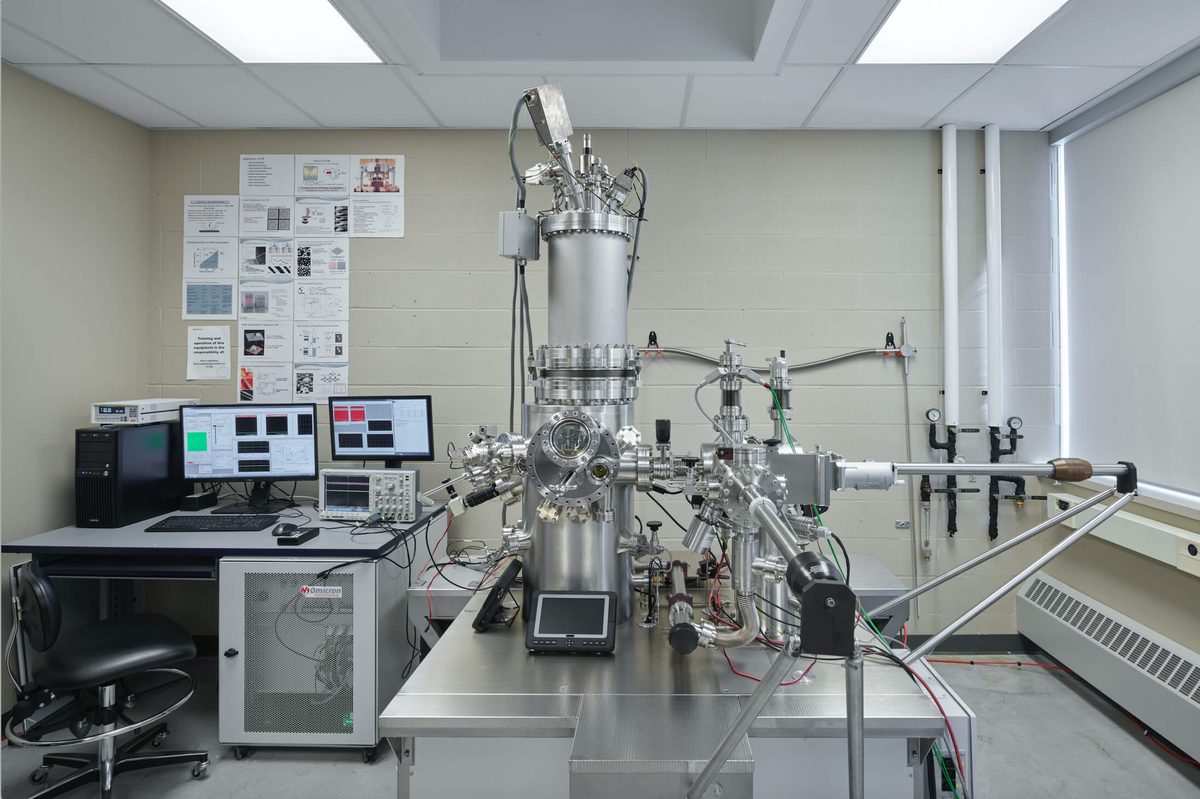
Physicists in Regensburg have timed a single electron tunneling through an energy barrier to within a fraction of a femtosecond. The measurement, published in Nature Photonics, is the first to watch an electron's quantum motion at both atomic spatial scale and attosecond time scale.

The experiment turned up a trade-off. The more precisely the team pinned down when the electron moved, the more its quantum wave packet spread out in space. That coupling had been assumed but never measured, and it sets a practical ceiling on how fast and how small future electronics can get.

Why it matters

Chips that switch at the speed of electron motion would run hundreds of thousands of times faster than today's. This experiment shows what stands in the way.

Questions about this story

Free account needed to ask — your question is kept and asked for you right after sign-up. Answers are public.

No questions yet — be the first to ask.

Key Indicators

500
Attoseconds of lag between laser field and electron response
Electrons did not react to the light instantly; their motion trailed the driving field.
under 1
Femtoseconds: upper bound on measured tunneling transients
Isolated electron tunneling events were resolved below one femtosecond.
angstrom
Spatial scale on which the tunneling wave packet was localized
The team mapped a single copper adatom on a silver surface with that resolution.
1 trillion
Amperes per square centimeter: peak current density from one confined electron transfer
Concentrating a single electron in a tiny region of space and time produces an extreme local current.
100,000×
Long-term speed target versus current CMOS electronics
A stated goal, not a demonstrated device; no such circuit exists yet.

Voices

Curated perspectives — historical figures and your fellow readers.

Sign up to generate historical perspectives on this story.

People Involved

Organizations Involved

Timeline

July 2026 November 2026

2 events Latest: Yesterday
  1. Detailed account of the experiment reaches broad science coverage

    Latest Publication

    ScienceDaily publishes a full description of the tunneling measurement and its long-term electronics implications.

  2. Regensburg team publishes attosecond tunneling results

    Publication

    Nature Photonics carries the study; the university announces the instrument reached the space-time limit.

Scenarios

1

Independent lab reproduces the 500-attosecond tunneling delay

Possible Resolves by Q2 2028

Discussed by: The Regensburg and Hamburg authors, who note that absolute clocking experiments could clarify the role of attosecond delays in field-driven tunneling

The measurement relies on a bespoke laser and microscope, so confirmation has to come from another group with comparable timing resolution. A second measurement in the same range would turn a single result into a property of tunneling itself.

2

A shaped electron wave packet breaks a chosen chemical bond

Uncertain Resolves by End of 2029

Discussed by: Jascha Repp, who names triggering and observing chemical reactions as the group's next target

The group wants to concentrate an electron into a tiny volume of space and time and deliver it to a specific molecule. If the resulting current density does what the paper suggests, it could alter one bond rather than heating the whole molecule.

3

An instrument maker ships an attosecond scanning tunneling microscope

Unlikely Resolves by Q2 2030

Discussed by: No company has announced one; the capability currently exists only in the Regensburg apparatus

Every result so far depends on a custom laser-and-tip system. Commercialization would require turning phase-controlled single-cycle pulses into a product that outside labs can run. The paper does not describe a product path.

Historical Context

3 moments from history that rhyme with this story — and how they unfolded.

1927

Heisenberg's uncertainty principle (1927)

Werner Heisenberg set a floor on how precisely a particle's position and momentum can be known at the same time. The limit is a property of nature, not of instruments.

Then

It became a founding statement of quantum mechanics and a constraint every measurement has to respect.

Now

It also became a working tool, explaining why atoms hold their size and why certain measurements trade off against each other.

Why this matters now

The new result is a limit of the same kind, but between space and time, a pairing the original principle never covered.

October 2023

Attosecond physics wins the Nobel Prize (2023)

Pierre Agostini, Ferenc Krausz and Anne L'Huillier shared the Nobel Prize in Physics for methods that generate attosecond light pulses. Their work made electron motion in matter observable rather than merely theorized.

Then

Attosecond metrology became a recognized field with dedicated labs across Europe.

Now

The techniques pushed time resolution below a femtosecond, opening electron dynamics as a subject of direct experiment.

Why this matters now

The Regensburg experiment depends on that generation of pulse-control techniques, then applies them to a single tunneling electron rather than a gas or solid sample.

1981

Scanning tunneling microscopy invented (1981)

Gerd Binnig and Heinrich Rohrer, working at IBM's Zurich lab, showed that a sharp metal tip held a nanometer from a surface produces a current that tracks the surface atom by atom.

Then

The instrument gave researchers their first routine view of individual atoms.

Now

Binnig and Rohrer shared the 1986 Nobel Prize in Physics, and the technique became standard in surface science and nanotechnology.

Why this matters now

The new experiment is a scanning tunneling microscope with lasers bolted on, using the same tunneling current as a clock rather than just an image signal.

Sources

(5)