
Pull to refresh
Logo
Protein generator scaffolds enzymes predicted to switch off when calcium binds

Protein generator scaffolds enzymes predicted to switch off when calcium binds

New Capabilities

ProDiT denoises sequence and structure together, and designs two conformational states without any multistate training data

Overview

Updated 39 minutes ago

Most generative protein models design one shape at a time. ProDiT, published in Nature Machine Intelligence on 27 November 2026, denoises sequence and structure together and can be conditioned on 463 Gene Ontology terms describing what the protein should do.

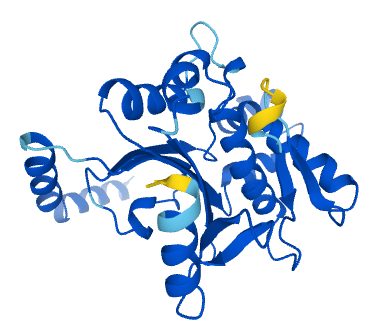
The harder trick is multistate design. By tying two structure-denoising trajectories to one shared sequence, the model scaffolded lysozyme and carbonic anhydrase active sites next to a calcium-binding motif taken from calmodulin, using training data of single-state proteins only. None of the designs has been tested at the bench; the paper reports computational screening with Chai-1 and metadynamics simulations.

Why it matters

Protein design tools usually produce one shape; a model that designs two points toward enzymes switched on and off by a dose of calcium.

Questions about this story

Free account needed to ask — your question is kept and asked for you right after sign-up. Answers are public.

No questions yet — be the first to ask.

Key Indicators

128 million
Proteins in the training set
Sequences, three-dimensional structures and functional annotations drawn from across sequenced life.
463
Gene Ontology terms the model accepts as input
Molecular functions a designer can specify, from binding to catalysis.
12
Residues in the calcium-binding motif
An EF-hand segment lifted from calmodulin and inserted to make the designs calcium-responsive.
15.3 Å
Trp108 displacement in the calcium-bound lysozyme design
The tryptophan that recognises substrate moves more than 15 angstroms in predicted structures, which would break the binding cleft.
0.15 Å
Active-site error for the carbonic anhydrase design, calcium-free
Thr199 is placed within a fraction of an angstrom of its native geometry before calcium is added.

Voices

Curated perspectives — historical figures and your fellow readers.

Sign up to generate historical perspectives on this story.

People Involved

Organizations Involved

Timeline

October 2026 November 2026

4 events Latest: Today
Tap a bar to jump to that date
  1. ProDiT paper published in Nature Machine Intelligence

    Today Publication

    The model generates sequence and structure together, conditioned on 463 Gene Ontology terms, after training on 128 million proteins.

  2. Coupled diffusion designs enzymes with a calcium off-switch

    Today Research result

    Two structure trajectories tied to one sequence scaffolded lysozyme and carbonic anhydrase active sites beside a calmodulin EF-hand motif.

  3. Journal commentary calls the model a step toward functional design

    Today Commentary

    A companion News & Views piece describes a simple generative model learning sequence, structure and functional context together.

  4. ProDiT presented at New England Computational Biology meeting

    Conference

    Anna Sappington described the model and its calcium-switched enzyme designs in Cambridge, Massachusetts, eight weeks before publication.

Scenarios

1

Wet-lab assays confirm a calcium-switched enzyme

Possible Resolves by Q2 2028

Discussed by: The ProDiT authors, who write that experimental studies will be required to verify activity and regulation

The designs are predictions, not measurements. A lab would need to express a ProDiT scaffold, assay its activity with and without calcium, and show it turns off. The metadynamics run on the lysozyme design already suggests the active state is destabilised once calcium binds, which is the strongest in silico evidence in the paper.

2

Outside labs adopt coupled structure diffusion

Likely Resolves by End of 2027

Discussed by: Computational design groups tracking diffusion-based protein generation

The protocol needs no multistate training data, so any lab with the model can attempt it. The test is whether a group unaffiliated with the authors uses coupled diffusion to build a two-state protein of its own, which would show the method generalises past the two enzymes in the paper.

3

The calcium switches fail in the test tube

Possible Resolves by Q2 2028

Discussed by: The authors themselves, who note that scaffolding an active-site motif does not guarantee catalytic activity

Second-shell contacts, electrostatic effects and residues far from the active site were not part of the conditioning. Assays could find the designs fold but do not catalyse, or bind calcium without changing shape.

Historical Context

3 moments from history that rhyme with this story — and how they unfolded.

2008

Computational Kemp eliminase design (2008)

David Baker's group at the University of Washington designed enzymes from scratch to catalyse a reaction with no natural counterpart, the Kemp elimination. The designs worked, but far more weakly than natural enzymes.

Then

Researchers had to run repeated rounds of directed evolution to bring catalytic rates up.

Now

Design-then-evolve became the standard pipeline for making novel enzymes, with computation supplying the starting scaffold and the lab supplying the performance.

Why this matters now

ProDiT's designs sit at the same stage the Kemp eliminases sat in 2008: plausible on paper, unmeasured in a test tube.

November 2020

AlphaFold2 at CASP14 (2020)

DeepMind's structure prediction system produced models of protein structure accurate enough to rival experimental methods at a biennial blind assessment.

Then

Structural biology gained a fast, cheap first pass at any known sequence.

Now

Predicted structures became routine screening tools, which pushed the hard problems toward function and dynamics rather than fold alone.

Why this matters now

ProDiT leans on that shift. Its designs were screened with a structure predictor, Chai-1, and judged on whether motifs and states came out right.

2023

Diffusion models for protein backbone design (2023)

RFdiffusion and related methods showed that a diffusion model could generate protein backbones and build new structures around a chosen binding or catalytic motif.

Then

Motif scaffolding went from a specialist craft to a routine operation available to non-specialists.

Now

The field's bottleneck moved from generating a plausible backbone to specifying what the protein should do.

Why this matters now

ProDiT adds sequence co-generation and function conditioning to that recipe, and then asks the same diffusion process to produce two states at once.

Sources

(4)