




Pull to refresh
Logo
Quantinuum roadmap automates error correction across its quantum hardware generations

Quantinuum roadmap automates error correction across its quantum hardware generations

New Capabilities

Nexus aims to carry a program from today's Helios chip to the fault-tolerant Apollo machine planned for 2029

Overview

Updated Yesterday

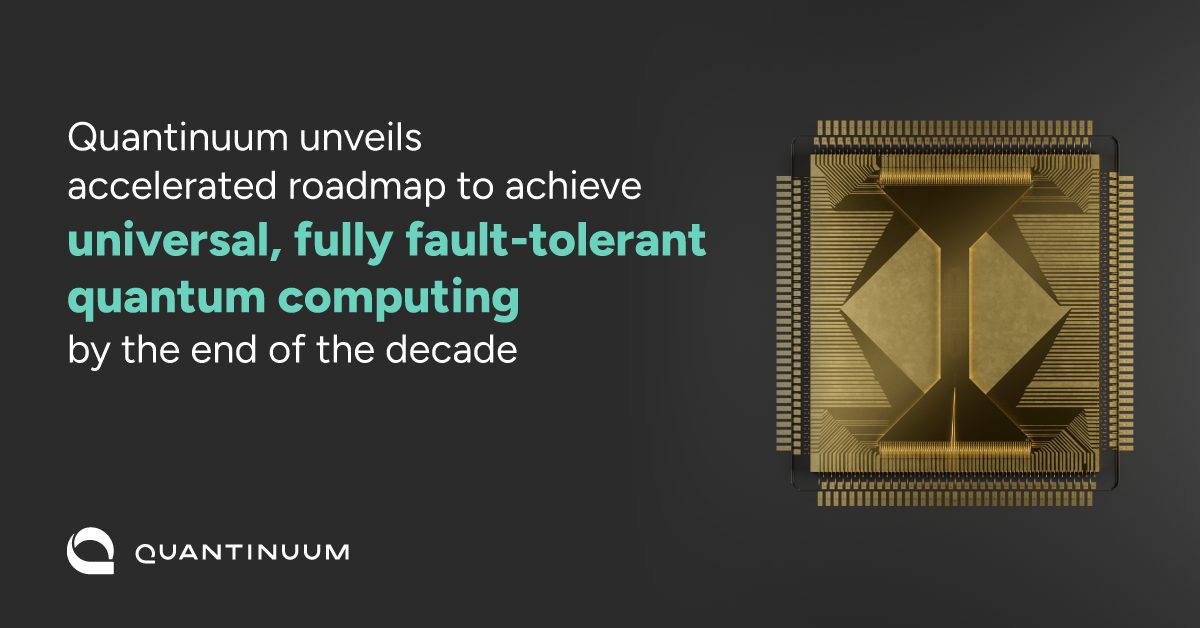
Quantinuum published a roadmap on Nov. 6 for Nexus, the cloud platform where customers write, test and run quantum programs. The plan ties each software release to a hardware generation: Helios today, Sol in 2027 and Apollo, a fault-tolerant machine, in 2029.

The pitch is that a developer writes a program once, and Nexus handles the error-correction encoding as the hardware improves. That would make switching platforms expensive. The open question is whether the hardware arrives on schedule.

Why it matters

If the roadmap holds, a quantum program written today could run on better hardware for years, making Quantinuum the default platform.

Questions about this story

Free account needed to ask — your question is kept and asked for you right after sign-up. Answers are public.

No questions yet — be the first to ask.

Key Indicators

215
Organizations using Nexus
Up 45% in 2026, according to Quantinuum.
10x
Growth in job submissions
Twelve months through August 2026 versus the prior twelve months.
98
Physical qubits on Helios
Quantinuum's current quantum computer.
48
Logical qubits demonstrated on Helios
Error-corrected qubits shown in a company milestone.
~100
Logical qubits targeted for Sol
Target for 2027, at a logical error rate of 10⁻⁵.
2029
Target year for Apollo
The universal, fault-tolerant machine the roadmap points to.

Voices

Curated perspectives — historical figures and your fellow readers.

Sign up to generate historical perspectives on this story.

People Involved

Organizations Involved

Timeline

2024 November 2026

5 events Latest: Yesterday
Tap a bar to jump to that date
  1. Nexus roadmap unveiled

    Latest Announcement

    Quantinuum ties Nexus releases to Helios, Sol and Apollo, with automated error-correction encoding.

  2. Q3 results reaffirm hardware timelines

    Financial

    Quantinuum keeps Sol on track for the second half of 2027 and Apollo for 2029.

  3. Helios memory test shows error reduction

    Research

    Increasing protection reduced errors, with a best reported rate of about five per million operations.

  4. Guppy FT and Guppy Algorithms ship

    Product

    The release adds supported error-correction schemes, fault-tolerant operations and algorithmic building blocks.

  5. Nexus launches

    Product

    Quantinuum's platform starts as a way to manage cloud-based quantum workflows.

Scenarios

1

Sol runs a customer's error-corrected program on schedule in 2027

Possible Resolves by End of 2027

Discussed by: Quantinuum's roadmap and third-quarter results

Quantinuum says Sol is on track for the second half of 2027, targeting about 100 logical qubits at a logical error rate of 10⁻⁵. If a customer program moves from Helios to Sol through Nexus without a rewrite, the platform's central promise holds.

2

Apollo slips past 2029

Possible Resolves by End of 2029

Discussed by: Quantum Litmus and Wall Street Today, which call the 2029 date a target rather than a commitment

Apollo is the fault-tolerant machine the whole roadmap points to. Quantinuum says it remains on track for 2029, supported by design milestones. A slip would strand the later Nexus releases and weaken the case for writing programs today.

3

A customer publishes a repeatable quantum result that beats classical methods

Uncertain Resolves by End of 2028

Discussed by: Quantum Litmus, which set the next test as a real problem solved repeatedly with published accuracy, runtime and cost

Nexus makes it easier to try error-corrected programs on Helios. The harder test is a customer using it to solve a real problem more than once and showing how accuracy, runtime and cost compare with the best classical method.

Historical Context

2 moments from history that rhyme with this story — and how they unfolded.

April 1964

IBM System/360 (1964)

IBM announced a family of mainframe computers that shared one instruction set, so software written for one model ran on the others. IBM spent roughly $5 billion on the bet, more than it had committed to a single project before.

Then

Customers could upgrade hardware without rewriting software, and IBM's mainframe line became the industry standard.

Now

The compatible-family model set the pattern for computing platforms: control the software layer and hardware generations become upgrades rather than migrations.

Why this matters now

Quantinuum is making the same bet: one platform, Nexus, that carries a program across Helios, Sol and Apollo.

2006

NVIDIA CUDA (2006)

NVIDIA released CUDA, a programming platform that let developers write general-purpose code for its graphics chips in C. Code written for one generation of GPU could run on later ones.

Then

CUDA became the default way to program GPUs for scientific and AI work.

Now

It gave NVIDIA a software moat: competitors could match the chips but not the installed base of CUDA code.

Why this matters now

Nexus is aimed at the same position in quantum computing, where the software layer, not the qubit count, decides who keeps the developers.

Sources

(4)