Pull to refresh
Logo
Rutgers pairs a brain speller with an on-device AI to speed up typing by thought

Rutgers pairs a brain speller with an on-device AI to speed up typing by thought

New Capabilities

In healthy volunteers, ChatBCI-Assist spelled text at 19.7 characters per minute, and reached 30.7 when users picked AI-suggested phrasing instead of reproducing every letter.

Overview

Updated 5 hours ago

Spelling a sentence on a noninvasive brain-computer interface means picking every letter, one at a time, by holding attention on a flashing key. Rutgers University engineers have published results for a system that lets the user pick an AI-generated phrase instead, and it roughly halves the time the task takes.

The system, ChatBCI-Assist, pairs a decades-old method for reading brain signals with a language model small enough to run on the user's own laptop. Users keep control of each suggestion, but the AI supplies the wording, and that shift pushed communication to 30.7 characters per minute in tests where meaning, not exact text, was the goal.

Why it matters

People with advanced ALS can spend minutes composing one sentence. Doubling that speed changes how much of a conversation they can hold.

Questions about this story

Free account needed to ask — your question is kept and asked for you right after sign-up. Answers are public.

No questions yet — be the first to ask.

Key Indicators

105.2 bits/min
Information transfer rate
The authors report this as a record for an online noninvasive speller, up from 52.2 bits/min for their dictionary-based baseline.
30.7 characters/min
Semantic spelling speed
Rate when participants conveyed meaning and accepted AI-suggested wording rather than typing each letter.
19.7 characters/min
Exact copy spelling speed
Rate when participants had to reproduce a sentence word for word, still near double the dictionary baseline.
52.9 bits/min
Character-level mutual information rate
A measure of how much information the interface carried per minute at the character level.
147.1 bits/min
Semantic information transfer rate
A metric the team proposed for intent-based communication, where meaning rather than exact text is the output.

Voices

Curated perspectives — historical figures and your fellow readers.

Sign up to generate historical perspectives on this story.

People Involved

Organizations Involved

Timeline

1988 November 2026

4 events Latest: Today
Tap a bar to jump to that date
  1. ChatBCI-Assist results published

    Today Publication

    Healthy participants reached 19.7 characters per minute spelling text exactly and 30.7 when conveying meaning, with the authors reporting a record information transfer rate for online spelling.

  2. Rutgers team adds language-model suggestions to a speller

    Research

    The group publishes ChatBCI, a P300 speller that uses a language model to offer word completions during sentence composition.

  3. Intent-based version designed for ALS presented

    Research

    The team presents ChatBCI-4-ALS, describing it as the first intent-based brain-computer communication system built around ALS patients' needs.

  4. The P300 speller is invented

    Research

    Lawrence Farwell and Emanuel Donchin show that a brain response appearing about 300 milliseconds after a flash can select letters on a screen, founding the paradigm ChatBCI-Assist still uses.

Scenarios

1

ALS patients reproduce the speed gains in a Rutgers trial

Possible Resolves by End of 2028

Discussed by: The Rutgers research team and its clinical collaborator, who say testing with ALS patients is in the planning stage

If people with ALS reach rates close to the healthy volunteers, the case for intent-based communication moves from a lab result to a usable assistive tool. The risk is that fatigue, altered brain signals and the effort of staying on task shrink the advantage. The team has not announced a start date or a patient count.

2

Other speller labs adopt on-device language models

Possible Resolves by End of 2028

Discussed by: Brain-computer interface researchers who have spent years working on P300 decoding rather than language prediction

The design choice that matters most is not the language model itself but where it runs: locally, so private messages about health and physical needs never leave the machine. If other groups copy that architecture and publish comparable gains, prediction becomes the default for noninvasive spellers. If gains turn out to depend on this team's fine-tuning corpus, it stays a one-off.

3

The intent-based gains fade outside the lab

Unlikely Resolves by End of 2028

Discussed by: Clinicians who work with augmentative communication, and the Rutgers team itself in describing workload and comfort as open questions

The published tests asked volunteers to compose sentences under supervision. Real use is messier: users are tired, sessions are short, and a wrong suggestion costs time to undo. If ALS testing shows semantic spelling performing at or below exact spelling for the people it is meant to help, the threefold speedup becomes a healthy-volunteer artifact.

Historical Context

3 moments from history that rhyme with this story — and how they unfolded.

1988

The P300 speller (1988)

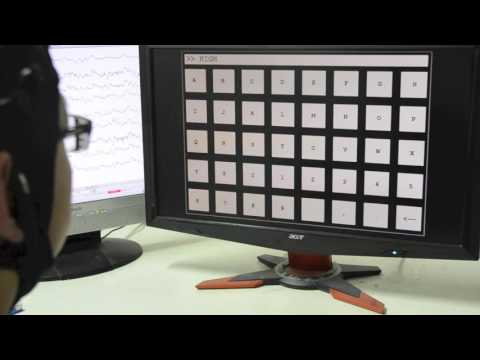
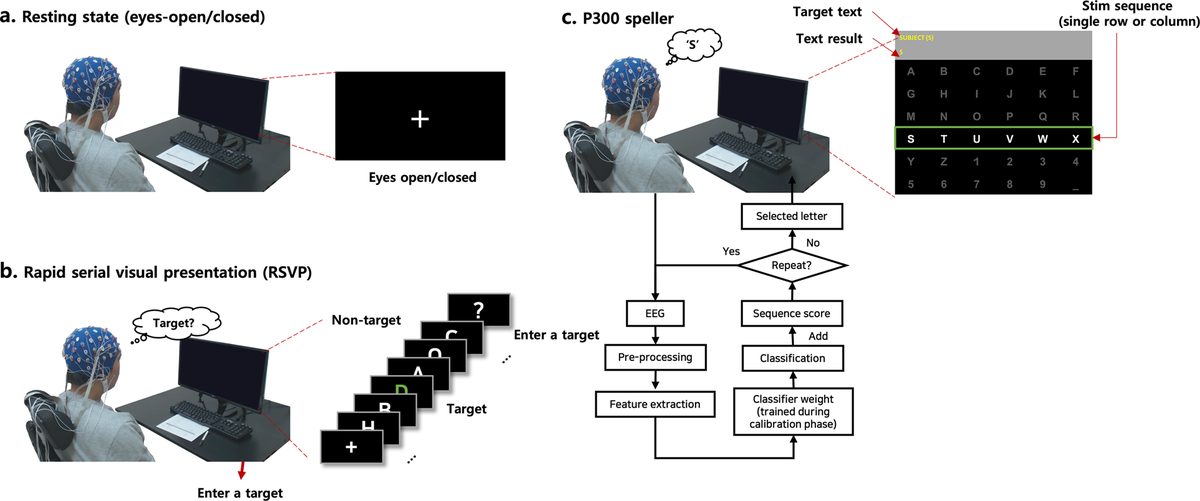
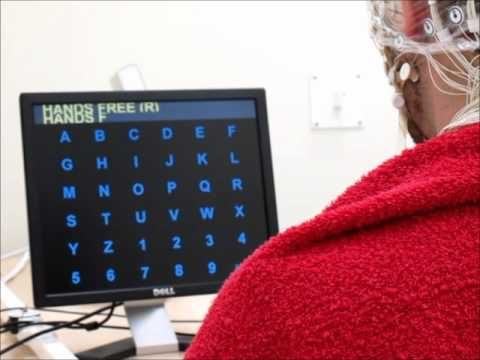
Lawrence Farwell and Emanuel Donchin published a method for typing by attention alone. A grid of letters flashed in rows and columns; when the target letter's row or column lit up, the brain produced a distinct electrical response about 300 milliseconds later. Electrodes on the scalp caught it, and the computer worked out which letter the user wanted.

Then

The technique gave paralyzed users a way to spell without moving a muscle, but at a few characters per minute.

Now

It became the standard noninvasive spelling paradigm. Decades of decoding improvements raised accuracy more than speed.

Why this matters now

ChatBCI-Assist does not replace the P300 signal; it changes what the signal is used to select, from single letters to whole predicted phrases.

Late 1990s

Predictive text on mobile phones (late 1990s)

Phone keyboards had twelve keys and three or four letters each. Predictive text systems guessed the word from the sequence of keypresses, so a user typed one press per letter instead of several, and accepted or rejected the guess.

Then

Typing got faster, and users tolerated occasional wrong guesses because correcting them was cheap.

Now

Prediction and autocorrect became standard on every keyboard, shifting the user's job from producing letters to approving words.

Why this matters now

The same bargain appears here: less exact control over wording in exchange for far fewer acts of selection. The difference is that each act costs attention, not a thumb press.

2004

BrainGate and the implanted route (2004)

A small array of electrodes was surgically implanted in the motor cortex of a paralyzed man, Matthew Nagle. He learned to move a computer cursor and operate a prosthetic hand by imagining movement.

Then

The demonstration proved that direct neural control worked outside a lab bench, and it drew heavy press attention.

Now

Implanted systems became the high-bandwidth path to communication, at the cost of brain surgery, wires through the skull and ongoing technical support.

Why this matters now

ChatBCI-Assist sits on the other side of that trade: a sensor cap that requires no surgery, chasing speed through software rather than electrode placement.

Sources

(8)