

Pull to refresh
Logo
San Francisco mayor strikes early union deal to avoid layoffs through 2029

San Francisco mayor strikes early union deal to avoid layoffs through 2029

Rule Changes San Francisco, CA local

Daniel Lurie locks in 12% raises for 24,000 workers — but hasn't said how the city will pay

Yesterday: Deal announced: raises for no layoffs

Overview

Updated 1 hour ago

San Francisco Mayor Daniel Lurie has locked in a labor deal eight months before contracts expire — a preemptive move covering 24,000 city workers across 10 unions. They get 12% raises between 2027 and 2031 in exchange for a guarantee of no layoffs through June 30, 2029.

The deal reverses Lurie's April decision to lay off 127 workers amid a projected $1 billion five-year deficit. Unions had been bracing for a bitter negotiation cycle; instead, both sides got stability. The open question is whether the city can actually afford it.

Why it matters

The deal trades an uncertain future of layoffs for guaranteed stability, but San Francisco's billion-dollar deficit still needs a funding answer.

Questions about this story

Free account needed to ask — your question is kept and asked for you right after sign-up. Answers are public.

No questions yet — be the first to ask.

Key Indicators

24,000
Workers covered by the deal
10 unions representing about 70% of the city's roughly 34,000-person workforce.
12%
Wage increase, 2027–2031
Combined with existing raises, brings covered workers on par with the 14% law enforcement received.
1,026
Days of no-layoff guarantee
No layoffs for covered workers through June 30, 2029, starting from the September 8 announcement.
6,000
Workers not covered
Roughly 6,000 employees remain outside the early deal, with no no-layoff protection.
$1B
Projected five-year budget deficit
The gap Lurie cited in April when he ordered the first wave of layoffs.

Voices

Curated perspectives — historical figures and your fellow readers.

Ever wondered what historical figures would say about today's headlines?

Sign up to generate historical perspectives on this story.

Play

Exploring all sides of a story is often best achieved with Play.

Most of these play right now — no account needed. Sign up to save scores, keep a streak, and unlock Debate and Predict. Log in Sign Up
Predict 3 ways this could play out. Back the one you believe — contrarian picks score more when a scenario has a resolution date. Log in to play

People Involved

Organizations Involved

Timeline

April 2026 September 2026

4 events Latest: Yesterday
Tap a bar to jump to that date
  1. Deal announced: raises for no layoffs

    Latest Agreement

    10 unions covering 24,000 workers get 12% raises through 2031 in exchange for a no-layoff guarantee through June 30, 2029. Ratification pending.

  2. Mayor's office approaches Labor Council

    Negotiation

    Lurie's office opens early talks with the Labor Council's public employee committee, seeking a contract extension before the 2027 expiration.

  3. 2,000 workers rally at City Hall

    Protest

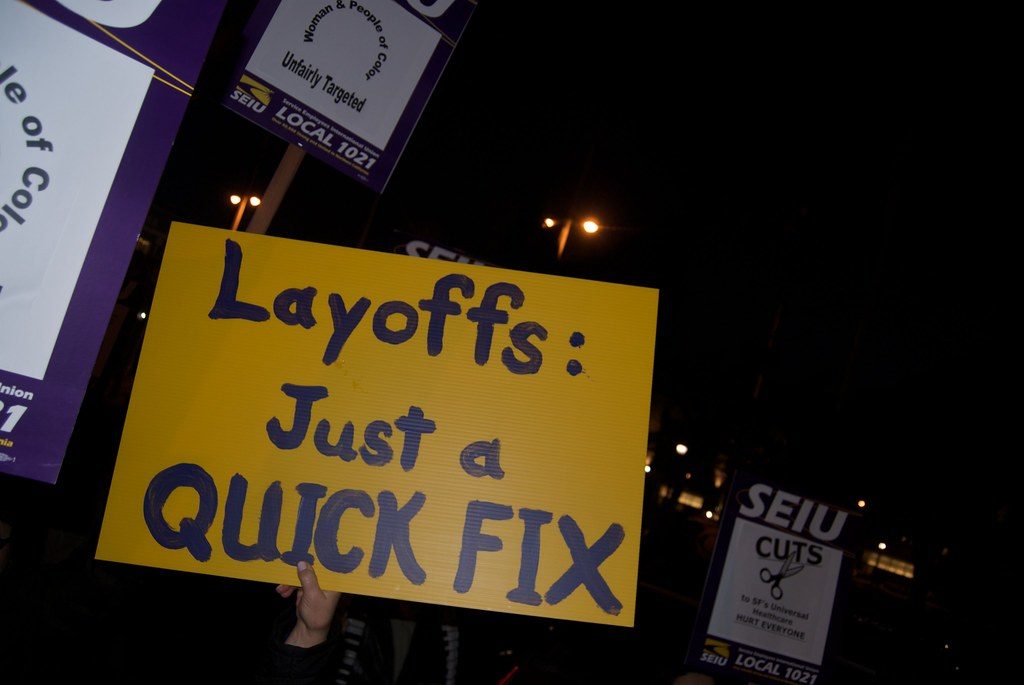
    SEIU 1021 and allies protest budget cuts, with dozens giving public comment at the Board of Supervisors budget hearing.

  4. Lurie lays off 127 city workers

    Policy

    Layoff notices sent across 18 departments as the mayor moves to close a projected $1 billion five-year deficit.

Historical Context

2 moments from history that rhyme with this story — and how they unfolded.

1975

New York City fiscal crisis (1975)

New York City faced a $1.5 billion deficit and couldn't borrow. Municipal unions bought city bonds with their pension funds — saving the city from bankruptcy in exchange for preserving jobs and, later, accepting wage freezes.

Then

The city avoided bankruptcy through union pension purchases and federal loan guarantees.

Now

Labor gained a permanent seat at the fiscal table, but austerity cuts and layoffs followed anyway within a few years.

Why this matters now

Shows the leverage municipal unions hold when a city is desperate — and that a labor deal doesn't erase the budget math. San Francisco's early deal is the preemptive version of this trade.

2013

Detroit bankruptcy (2013)

After years of deficits, Detroit filed the largest municipal bankruptcy in U.S. history. Unions resisted, but emergency managers imposed cuts through bankruptcy court, overriding union contracts and trimming pensions.

Then

Union contracts were voided; some retirees lost about 4.5% of pension value plus cost-of-living adjustments.

Now

Set a precedent that municipal bankruptcy can override union agreements, sharply weakening labor leverage in distressed cities.

Why this matters now

The counterfactual: what happens when a city and unions don't reach a preemptive deal. Detroit shows the cost of failure is total loss of union leverage — San Francisco's deal is the alternative path.

Sources

(4)