



Pull to refresh
Logo
Saudi supreme court overturns Sri Lankan worker's death sentence over Facebook post

Saudi supreme court overturns Sri Lankan worker's death sentence over Facebook post

Rule Changes

Capital sentence vacated after diplomatic push; case returns to trial court for rehearing

2 days ago: Supreme court sets aside death sentence

Overview

Updated 1 hour ago

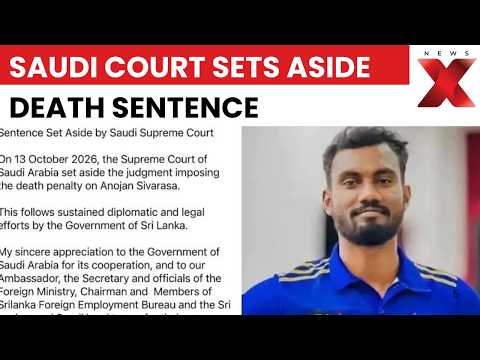
Saudi Arabia's supreme court set aside a death sentence for a Sri Lankan migrant worker who posted a Facebook comment deemed insulting to Islam. The October 14 ruling came after Colombo mounted an urgent diplomatic and legal push.

Sivarasa deleted the comment and posted an apology within days of his arrest. A criminal court first sentenced him to five years and a three-million-riyal fine, then an appeals court raised that to death. The supreme court vacated both sentences and sent the case back for a rehearing.

Why it matters

Sivarasa still faces retrial in a court that already sentenced him to death once. His life remains on the line.

Questions about this story

Free account needed to ask — your question is kept and asked for you right after sign-up. Answers are public.

No questions yet — be the first to ask.

Key Indicators

5 years
Original prison sentence
Al-Ahsa Criminal Court gave Sivarasa five years under the Anti-Cybercrime Law.
SAR 3 million
Original fine
Roughly $800,000, imposed alongside the prison term.
105 days
Arrest to supreme court ruling
From Sivarasa's July 1 arrest to the October 14 decision.

Voices

Curated perspectives — historical figures and your fellow readers.

Ever wondered what historical figures would say about today's headlines?

Sign up to generate historical perspectives on this story.

People Involved

Organizations Involved

Timeline

June 2026 October 2026

6 events Latest: 2 days ago
Tap a bar to jump to that date
  1. Sivarasa arrested in Dammam

    Arrest

    His employer holds him overnight, then takes him to police.

  2. Sivarasa posts the Facebook comment

    Inciting Incident

    He replies to a video with a Tamil comment deemed offensive to Islam.

Scenarios

1

Sivarasa Released and Repatriated to Sri Lanka

Possible Resolves by Q2 2027

Discussed by: Sri Lankan lawmakers involved in the defense, including Faiszer Musthapha

The Al-Ahsa trial court declines to pursue the case again, and Saudi authorities release Sivarasa. Colombo has already pledged to cover his legal costs and arrange his return. The supreme court's intervention signals the death sentence had become diplomatically untenable.

2

Retrial Ends in a Prison Term, Not Death

Likely Resolves by End of 2027

Discussed by: Legal analysts and the Sri Lankan defense team

The trial court convicts Sivarasa again under the Anti-Cybercrime Law but imposes a finite prison sentence, similar to the original five-year term. Since the supreme court already vacated the death penalty, a return to a non-capital sentence is the most plausible path.

3

Death Sentence Reimposed on Retrial

Unlikely Resolves by End of 2027

Discussed by: Amnesty International and Human Rights Watch, which warned of arbitrary sentencing

On rehearing, the trial court again hands down a death sentence for blasphemy, and the result survives further appeal. This would override the supreme court's signal and trigger renewed international outcry. Amnesty has noted Saudi judges exercise wide discretion under Sharia with no written penal code.

Historical Context

2 moments from history that rhyme with this story — and how they unfolded.

2010-2018

Asia Bibi Acquittal (Pakistan, 2010-2018)

Asia Bibi, a Christian farm worker in Pakistan, was sentenced to death in 2010 for blasphemy after an argument with Muslim coworkers. She spent eight years in prison while her case wound through appeals.

Then

Pakistan's Supreme Court acquitted her in October 2018, and she was flown to Canada after violent protests by hardline groups.

Now

The acquittal showed a top court willing to overturn a blasphemy death sentence under global pressure, but it also exposed Bibi and the judges to threats and street demonstrations.

Why this matters now

Like Sivarasa's case, Bibi's death sentence was reversed by a high court after international outcry — yet the underlying accusation left her in danger long after the ruling.

2012

Raif Badawi Sentenced (Saudi Arabia, 2012)

Saudi blogger Raif Badawi was arrested in 2012 for his liberal blog and convicted of insulting Islam. A court sentenced him to 10 years in prison and 1,000 lashes, delivered publicly in installments.

Then

International campaigns condemned the sentence, but Saudi courts did not fully overturn it.

Now

Badawi's case became the reference point for Saudi Arabia's punishment of online speech, showing that foreign pressure alone rarely wins a complete release.

Why this matters now

Badawi's case is the backdrop for how Saudi courts treat online dissent — and it makes Sivarasa's overturning stand out as unusual even amid broad criticism of the kingdom's speech laws.

Sources

(7)