


Pull to refresh
Logo
Researchers describe a new inherited retinal disease that erodes night vision first

Researchers describe a new inherited retinal disease that erodes night vision first

New Capabilities

A variant in EFEMP1, the gene behind a central-vision disorder, produces a late-onset disease that leaves the macula intact and attacks the periphery

Overview

Updated 1 hour ago

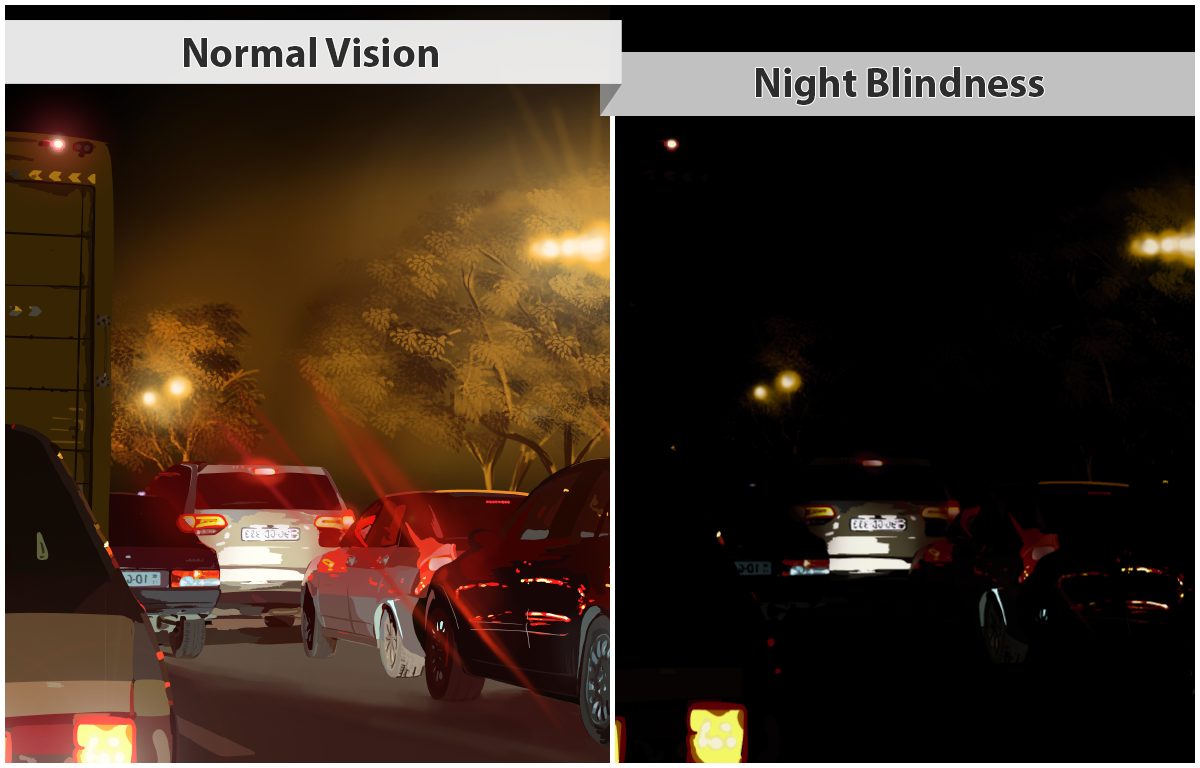
Four members of one family had 20/20 vision and retinas that looked normal on imaging. Their eyes took far too long to adjust in a dark room, and that single measurement is what told researchers they were looking at a disease nobody had described.

The team calls the condition EFEMP1-associated late-onset retinal degeneration, or L-ORD. It damages peripheral retina and night vision while central sight stays largely intact for decades, which is the opposite of the disorder already known to be caused by a different change in the same gene. The evidence comes from three unrelated families seen in Philadelphia, Basel and Prague, so how many people carry the variant is still unknown.

Why it matters

A dark-adaptation test can flag this disease before photoreceptors die, which is the only window where a future treatment could work.

Questions about this story

Free account needed to ask — your question is kept and asked for you right after sign-up. Answers are public.

No questions yet — be the first to ask.

Key Indicators

3
Unrelated families in the study
Families seen at clinics in Philadelphia, Basel and Prague all carried the same EFEMP1 variant.
4 of 5
At-risk relatives in family 1 who carried the variant
All four had delayed rod recovery in darkness despite 20/20 vision and normal-looking retinas.
2
EFEMP1 variants now linked to retinal disease
p.Arg345Trp causes a central-vision disorder; p.Arg140Trp causes the newly described peripheral one.
46°
Farthest retinal eccentricity tested
Rod dysfunction worsened toward the periphery at 15, 30 and 46 degrees from the fovea.

Voices

Curated perspectives — historical figures and your fellow readers.

Sign up to generate historical perspectives on this story.

People Involved

Organizations Involved

Timeline

October 1998 November 2026

3 events Latest: Yesterday
  1. Study team proposes the label EFEMP1-associated late-onset retinal degeneration

    Latest Announcement

    The condition has no official name. Researchers are calling it EFEMP1-associated L-ORD and describing slow rod recovery as its earliest detectable sign.

  2. JAMA Ophthalmology publishes the three-family case series

    Publication

    Researchers compare three unrelated families carrying EFEMP1 p.Arg140Trp with a family carrying the central-vision variant p.Arg345Trp.

  3. Philadelphia clinicians document an unexplained pattern of vision loss

    Research

    A US family's index case develops night blindness in his sixth decade, with field loss and an abnormal electroretinogram. The family anchors what becomes a 28-year investigation.

Scenarios

1

Independent group reports the same variant and phenotype

Likely Resolves by End of 2027

Discussed by: The study authors, who note that three families cannot capture the full range of disease expression

A clinic outside the Philadelphia, Basel and Prague group identifies its own p.Arg140Trp family, most likely after re-reading a case previously filed as gyrate atrophy-like or choroideremia-like. Confirmation would move the condition from a single case series to a recognized phenotype.

2

Clinical labs add p.Arg140Trp to retinal dystrophy test panels

Possible Resolves by Q2 2028

Discussed by: Clinical geneticists and the study authors, who say prevalence cannot be estimated yet

Retinal dystrophy gene panels already sequence EFEMP1 for the p.Arg345Trp variant. Listing the second variant as reportable is mostly a curation decision, and it would let clinicians explain peripheral vision loss that currently gets labeled idiopathic.

3

A gene-targeted treatment trial for EFEMP1 disease is registered

Unlikely Resolves by End of 2029

Discussed by: Retinal gene-therapy researchers, who have no approved therapy for either EFEMP1 disorder

The rod-dysfunction window is the argument for intervening early, but EFEMP1 codes for a structural protein deposited between cells, not an enzyme that can be replaced. The study's proposed mechanism of abnormal protein interaction is itself provisional, which raises the bar for designing a therapy.

Historical Context

2 moments from history that rhyme with this story — and how they unfolded.

2007-2017

RPE65 retinal dystrophy to the first retinal gene therapy (2007-2017)

Children born with mutations in RPE65, a gene the retina needs to recycle visual pigment, lost vision early in life. Researchers tested a gene-replacement injection delivered under the retina, measuring patients' ability to navigate a dim maze rather than only reading letters on a chart. The Food and Drug Administration approved voretigene neparvovec (Luxturna) in December 2017.

Then

A functional test of dim-light vision became the outcome measure that regulators accepted.

Now

It established that an inherited retinal degeneration could be treated, and that measuring night vision is a legitimate endpoint.

Why this matters now

The new EFEMP1 disease is also being defined by a dim-light measurement taken before cells die. That is the same kind of marker that carried RPE65 therapy to approval.

1990s-2026

Doyne honeycomb retinal dystrophy and malattia leventinese

A single recurrent change in EFEMP1, p.Arg345Trp, causes Doyne honeycomb retinal dystrophy, also called malattia leventinese. It produces early-onset, nearly confluent drusen in the central retina and damages central vision, while the periphery is largely preserved.

Then

The disorder became the reference case for what an EFEMP1 mutation does to an eye.

Now

No approved treatment emerged, and the central/peripheral split went largely unexamined.

Why this matters now

The new disease inverts that pattern: same gene, different variant, peripheral damage with a spared macula. It shows how much a single protein change can redirect where the retina fails.

Sources

(3)