
Pull to refresh
Logo
Physicists extend the tautochrone problem to quantum particles

Physicists extend the tautochrone problem to quantum particles

New Capabilities

A University of Crete team shows photons and atoms can converge at a common point, without gravity or a cycloid.

Overview

Updated 42 minutes ago

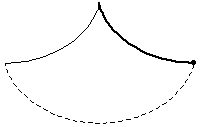
In 1659, Christiaan Huygens worked out the shape of a frictionless ramp on which a ball takes the same time to reach the bottom from any starting height. The answer was a cycloid, the curve traced by a point on a rolling circle. A team at the University of Crete has now solved the same problem for quantum particles.

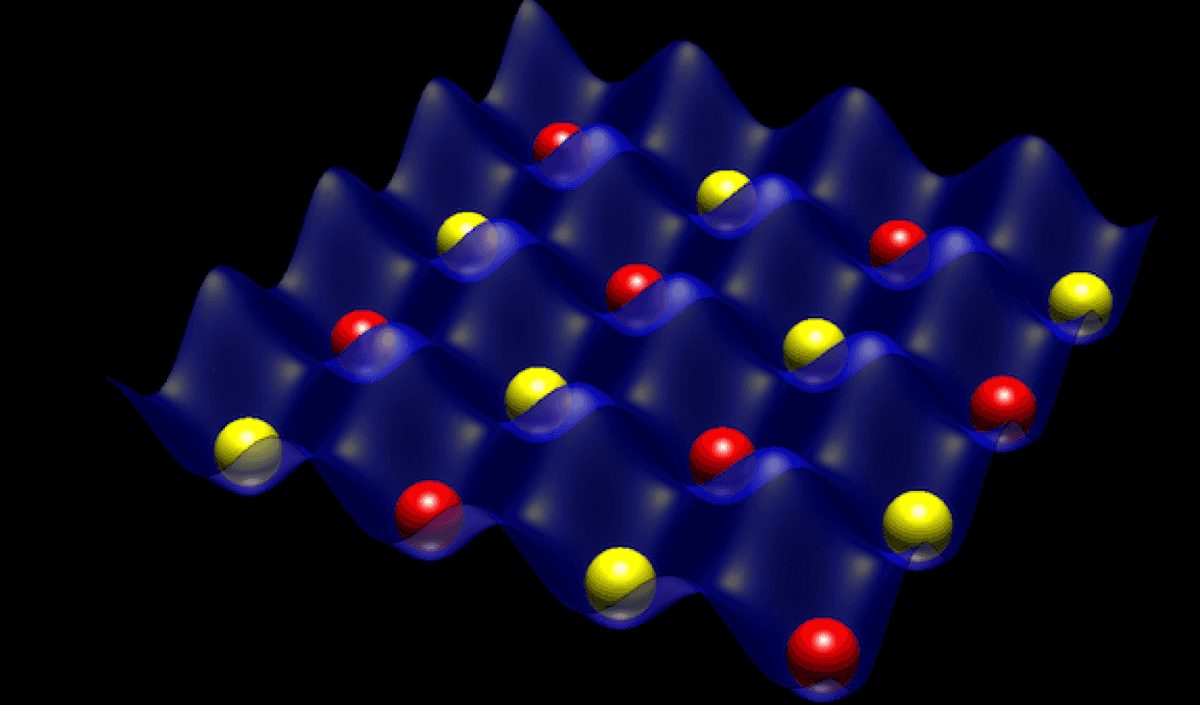
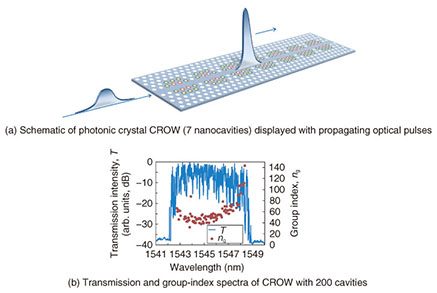
The quantum version has no ramp, no gravity and no ball. Photons and atoms hop between sites in photonic waveguides and optical lattices. Tune the couplings between neighboring sites a certain way, and particles launched from different positions arrive together, the defining property of a tautochrone.

Why it matters

A working version would let quantum engineers route many particles to one point at a fixed time, a tool for light-based computing.

Questions about this story

Free account needed to ask — your question is kept and asked for you right after sign-up. Answers are public.

No questions yet — be the first to ask.

Key Indicators

367 years
Time since Huygens solved the classical tautochrone
Huygens's 1659 solution named the cycloid as the curve of equal descent time.
5
Researchers on the University of Crete preprint
The paper lists Simopoulos, Pavlou, Kiorpelidis, Siviloglou and Makris as authors.
2
Particle classes covered: bosons and fermions
Quantum statistics decide whether arrivals share a site or occupy neighboring ones.

Voices

Curated perspectives — historical figures and your fellow readers.

Sign up to generate historical perspectives on this story.

People Involved

Organizations Involved

Timeline

1659 November 2026

3 events Latest: Today
  1. Quantum tautochrone preprint reported

    Today Research

    Simopoulos and colleagues post a preprint showing photons and atoms in lattices converge like balls on a cycloid. Bosons can share one site; fermions arrive together but on separate sites.

  2. Tautochrone reproduced with classical light

    Research

    Some of the same researchers show mathematically that light beams can mimic the tautochrone without gravity.

  3. Huygens solves the tautochrone

    Discovery

    Christiaan Huygens shows that a cycloid makes a rolling ball reach the bottom in equal time from any height.

Scenarios

1

Peer review publishes the quantum tautochrone

Likely Resolves by Q3 2027

Discussed by: The preprint authors, who note the paper has not been peer-reviewed

The manuscript goes through journal review and appears in a peer-reviewed physics journal. Because the result is mathematical, reviewers would check the derivations and the treatment of bosons, fermions and on-site interactions.

2

A lab demonstrates the quantum tautochrone

Possible Resolves by Q2 2028

Discussed by: The authors, who write that the effect exists only on paper so far

An experimental group builds the tuned waveguide array or optical lattice and measures particles from different starting sites arriving together. Photonic lattices are a likely platform because waveguide couplings can be engineered precisely.

3

The effect survives many-body systems

Uncertain Resolves by End of 2028

Discussed by: The authors, who ask whether the effect persists with large numbers of interacting particles

A follow-up study tests whether the convergence survives when many bosons interact or when the lattice is more complex. The preprint already finds that strong interactions suppress convergence onto a single site, so the many-body question is open.

Historical Context

3 moments from history that rhyme with this story — and how they unfolded.

1659-1673

Huygens's tautochrone and the cycloidal pendulum (1659-1673)

Christiaan Huygens solved the tautochrone in 1659 and found the curve was a cycloid. He used it to design a pendulum clock whose bob swung on cycloidal cheeks, hoping to keep perfect time regardless of amplitude. He published the design in Horologium Oscillatorium in 1673.

Then

The clock was elegant in theory, but friction and construction limits blunted its advantage over ordinary pendulums.

Now

The cycloid became a standard example in mechanics and the calculus of variations.

Why this matters now

The quantum tautochrone is in the same position today: a clean mathematical result that has not yet been built.

1696

The brachistochrone challenge (1696)

Johann Bernoulli posed the brachistochrone problem: find the curve of fastest descent between two points. Newton, Leibniz, L'Hopital and Bernoulli himself solved it within months. The answer was again a cycloid.

Then

The solutions showed that the cycloid was special for both descent time and descent speed.

Now

The episode helped launch the calculus of variations.

Why this matters now

It shows how one curve anchored centuries of mechanics, the tradition the quantum tautochrone extends.

1990s-2000s

Quantum walks: from theory to photonic demonstration (1990s-2000s)

Physicists proposed a quantum version of the random walk in the 1990s, then demonstrated it in photonic and atomic systems in the following years. The quantum walk became a testbed for quantum simulation and algorithms.

Then

Early experiments confirmed that quantum interference changes how walkers spread.

Now

Quantum walks are now a building block in quantum information research.

Why this matters now

It is a precedent for translating a classical mechanics idea into quantum rules, the step the tautochrone has just taken.

Sources

(3)