

Pull to refresh
Logo
Daily Brief
Following
Why Ranks Sign Up
Securitize goes public on the NYSE via SPAC merger

Securitize goes public on the NYSE via SPAC merger

Money Moves

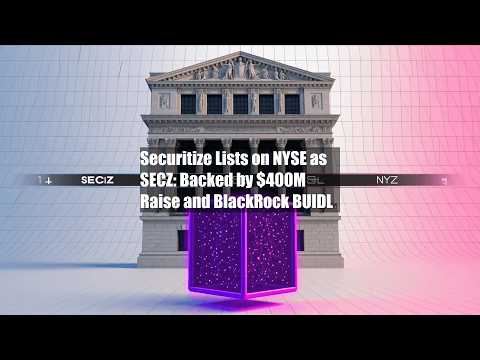
The BlackRock-backed tokenization platform closes a $400 million deal and lists under the ticker SECZ

Today: Merger closes, clearing the way for NYSE debut

Overview

Securitize turns funds and bonds into tokens that live on a blockchain. On July 1, 2026, it closed a merger with a shell company backed by Cantor Fitzgerald and cleared the way to trade on the New York Stock Exchange under the ticker SECZ.

The deal raised about $400 million and puts a price on a business most people have never heard of. Securitize runs the plumbing for BlackRock's largest tokenized fund and works with Apollo and KKR. Its listing is the first real public test of whether turning traditional assets into tokens is a business Wall Street will pay for.

Why it matters

For the first time, public investors can bet directly on tokenization, the effort to move stocks, bonds, and funds onto blockchains that settle in seconds.

Questions about this story

No questions yet — be the first to ask.

Key Indicators

$400M
Gross proceeds
Cash raised from the merger, combining trust-account money and a private placement.
$1.25B
Pre-money valuation
The price set on Securitize when the deal was announced in October 2025.
$4B
Assets tokenized
Value of real-world assets Securitize has put on-chain to date.
$225M
Private placement
Oversubscribed investment from backers including Borderless Capital and Hanwha.
$35B
Tokenized asset market
Size of the real-world asset tokenization market when the deal was struck, up 135% in a year.

Voices

Curated perspectives — historical figures and your fellow readers.

Ever wondered what historical figures would say about today's headlines?

Sign up to generate historical perspectives on this story.

Play

Exploring all sides of a story is often best achieved with Play.

Log in to play. Track your picks, climb the leaderboards. Log in Sign Up
Predict 3 ways this could play out. Contrarian picks score more — points lock when the scenario resolves. Log in to play
Higher or Lower Two numbers from this story. Guess which is bigger. 5 rounds to set a streak. Log in to play
Connections Sixteen names from the news. Find the four hidden groups of four. Log in to play

People Involved

Organizations Involved

Timeline

October 2025 July 2026

4 events Latest: Today
Tap a bar to jump to that date
  1. Merger closes, clearing the way for NYSE debut

    Today Deal

    Securitize completes the merger, raising about $400 million and setting up its New York Stock Exchange debut under the ticker SECZ.

  2. Shareholders approve the merger

    Corporate

    CEPT shareholders vote in favor. Fewer than 30% redeem, leaving most of the trust cash in the deal.

  3. SEC clears the deal's paperwork

    Regulatory

    The Securities and Exchange Commission declares the merger's registration statement effective, moving Securitize close to a public listing.

  4. Securitize agrees to go public via Cantor SPAC

    Deal

    Securitize signs a business combination agreement with Cantor Equity Partners II, valuing the firm at $1.25 billion before new cash.

Historical Context

2 moments from history that rhyme with this story — and how they unfolded.

April 2021

Coinbase direct listing (2021)

Coinbase, the largest U.S. crypto exchange, went public through a direct listing on the Nasdaq. It opened near a $100 billion valuation, the first big crypto-native firm to trade on a major U.S. exchange.

Then

The stock spiked on debut, then fell sharply as crypto prices dropped later that year.

Now

Coinbase became a proxy for the whole crypto market, its shares swinging with token prices rather than its own fundamentals.

Why this matters now

Securitize is the first tokenization firm to list, and like Coinbase its stock may be read as a bet on an entire sector, not one company.

2020-2022

SPAC boom and bust (2020-2022)

Hundreds of companies went public by merging with blank-check firms during a SPAC frenzy. Many were early-stage businesses with thin revenue that used SPACs to reach markets fast.

Then

A wave of deals closed at high valuations through 2021.

Now

Most SPAC stocks fell well below their $10 starting price, and regulators tightened the rules around the structure.

Why this matters now

Securitize chose the same SPAC route. Its low redemption rate stands out against a structure that burned many earlier investors.

Sources

(6)