
Pull to refresh
Logo
Daily Brief
Following
Why Ranks Sign Up
OpenAI's path to a public listing

OpenAI's path to a public listing

Money Moves

From nonprofit research lab to potential record-setting IPO

2 days ago: Confidential IPO filing submitted to SEC

Overview

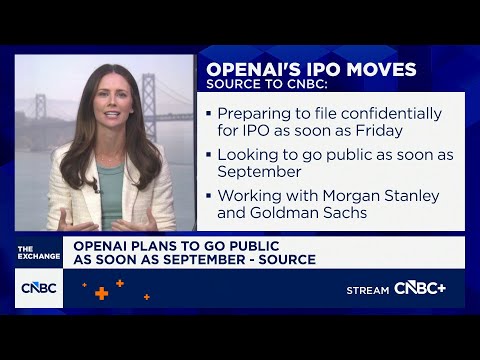
OpenAI filed a confidential draft registration with the Securities and Exchange Commission (SEC) on Friday, May 22, 2026. The filing is the first formal step toward a public listing that could value the ChatGPT maker above $1 trillion.

Goldman Sachs, Morgan Stanley, and JPMorgan Chase will lead the offering, targeting a debut between September and November. The filing follows a March private round at $852 billion and the dismissal four days earlier of Elon Musk's federal lawsuit against the company.

Why it matters

A $1 trillion price tag would make this the biggest IPO ever and put every public-market investor on the hook for AI's profitability question.

Key Indicators

$1T+
Target IPO valuation
Above any prior U.S. listing on record.
$852B
March 2026 private valuation
Set by the largest private funding round ever closed.
$20B
Annualized revenue, end of 2025
Disclosed by CFO Sarah Friar; full-year revenue was about $13 billion.
27%
Microsoft ownership stake
Worth roughly $228 billion at the March 2026 round price.
Sep-Nov 2026
Target listing window
Between Labor Day and Thanksgiving, per underwriter sources.

Voices

Curated perspectives — historical figures and your fellow readers.

Ever wondered what historical figures would say about today's headlines?

Sign up to generate historical perspectives on this story.

Play

Exploring all sides of a story is often best achieved with Play.

Log in to play. Track your picks, climb the leaderboards. Log in Sign Up
Predict 4 ways this could play out. Contrarian picks score more — points lock when the scenario resolves. Log in to play
Higher or Lower Two numbers from this story. Guess which is bigger. 5 rounds to set a streak. Log in to play
Timeline Five events from this story — drag them oldest to newest. Log in to play
Connections Sixteen names from the news. Find the four hidden groups of four. Log in to play

People Involved

Organizations Involved

Timeline

December 2015 May 2026

13 events Latest: 2 days ago Showing 8 of 13
Tap a bar to jump to that date
  1. Confidential IPO filing submitted to SEC

    Latest Filing

    OpenAI files a draft S-1 with Goldman Sachs, Morgan Stanley, and JPMorgan Chase as joint lead underwriters. Target listing window is September to November 2026.

  2. Round expanded to $122 billion

    Funding

    The February round is reopened and closes at a post-money valuation of $852 billion.

  3. Largest private funding round in history

    Funding

    OpenAI raises $110 billion at a $730 billion pre-money valuation, with SoftBank, Nvidia, and Amazon as lead investors.

  4. Restructuring as Public Benefit Corporation completes

    Structure

    OpenAI converts its operating entity to a Delaware PBC. The nonprofit keeps equity worth tens of billions but loses operational control.

  5. Altman returns; board reshuffled

    Governance

    After 97% of staff threaten to resign, Altman is reinstated and the board is rebuilt around Bret Taylor.

  6. Board fires Sam Altman

    Governance

    The OpenAI nonprofit board removes Altman as CEO, citing a loss of trust without offering specifics.

  7. ChatGPT launches publicly

    Product

    Free ChatGPT release hits one million users in five days, turning OpenAI into a consumer product company overnight.

  8. Microsoft commits first $1 billion

    Investment

    Microsoft becomes OpenAI's exclusive cloud provider and lead investor, beginning a partnership that now exceeds $13 billion in committed capital.

  9. Capped-profit subsidiary created

    Structure

    OpenAI sets up a for-profit arm capped at 100x investor returns to attract outside capital while keeping nonprofit control.

  10. Musk leaves the board

    Governance

    Elon Musk resigns from the OpenAI board, citing conflicts with Tesla's AI work and disputes over direction.

  11. OpenAI founded as nonprofit

    Origin

    Altman, Musk, Brockman, Sutskever, and others launch OpenAI with $1 billion in pledges and a charter to build safe artificial general intelligence.

Historical Context

3 moments from history that rhyme with this story — and how they unfolded.

December 2019

Saudi Aramco IPO (2019)

Saudi Arabia listed 1.5% of state oil company Aramco on the Tadawul exchange at a $1.7 trillion valuation, raising $25.6 billion. The company had been pitching a $2 trillion price for three years; international investors balked, and the Saudis listed mostly to domestic and Gulf buyers.

Then

Shares popped 10% on debut and briefly pushed Aramco's market cap above $2 trillion. International institutions stayed on the sidelines.

Now

Aramco remains the largest IPO on record by money raised, but the foreign-investor gap meant the deal never delivered the global financial-center status Riyadh wanted.

Why this matters now

Aramco shows that a trillion-dollar headline number depends on which buyers actually show up. OpenAI's underwriters need U.S. institutions, not just AI enthusiasts, to anchor a $1T+ book.

September 2014

Alibaba IPO (2014)

Chinese e-commerce company Alibaba listed in New York at $68 per share, valuing the company at $231 billion. It raised $25 billion, then the largest U.S. IPO ever. The deal closed at $93.89 on day one, up 38%.

Then

Alibaba briefly became one of the ten most valuable companies in the world. Founder Jack Ma's stake was worth roughly $18 billion.

Now

The stock spent years trading below its IPO peak as Beijing tightened control over its tech sector. The deal still anchors how mega-cap tech IPOs are syndicated and priced.

Why this matters now

Alibaba is the modern template for an IPO this large: same Goldman-Morgan Stanley axis, same trillion-dollar ambitions, and the same risk that regulatory headlines can crater the multiple.

May 2012

Facebook IPO (2012)

Facebook went public at $38 per share, valuing the company at $104 billion. Trading on Nasdaq opened 30 minutes late because of system failures, and the stock closed flat after underwriters intervened to defend the price. Within months it had lost half its value.

Then

Class-action suits over disclosure of mobile-ad weakness flooded the courts. Morgan Stanley paid a $5 million fine for its role.

Now

Facebook (later Meta) recovered to trade above $300, but the IPO became the standard cautionary tale for mega-cap tech listings. Underwriters now build in more conservative allocations and price discovery.

Why this matters now

Facebook is the warning label for OpenAI's bankers: a generational tech IPO can still misprice on day one if late-stage private rounds set a number the public market won't pay.

Sources

(6)