
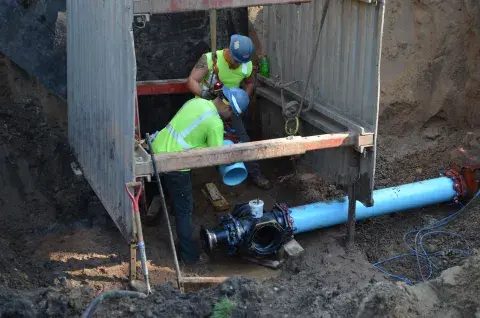

Saint Paul weighs special assessments on Gold Line corridor homeowners
Built WorldProperty owners say they got no notice of sewer work and no proof it was done
August 12th, 2026: Council to vote on ratifying assessmentsNew here? Follow stories to track developments over time. Create a free account to get updates when stories you care about change.
Overview
Updated 2 hours agoTonya Mages owns property on Saint Paul's East Side, along the route of the new Gold Line bus rapid transit line. The city says she owes for a sanitary sewer replacement done during construction, charged to her property tax bill based on the length of her sewer frontage. She says she never received notice and has never seen proof the work was done.
The city council was set to ratify the assessment roll at its August 12, 2026 meeting. Ratification makes the charges a lien on hundreds of properties along Hudson Road and Euclid Street. For homeowners, the question is how much notice and evidence a city must provide before billing them for infrastructure tied to a transit line they may never use.
Why it matters
Gold Line homeowners may pay for sewer work they say they never authorized. The vote tests how cities fund transit infrastructure.
Questions about this story
Free account needed to ask — your question is kept and asked for you right after sign-up. Answers are public.
No questions yet — be the first to ask.
Key Indicators
Voices
Curated perspectives — historical figures and your fellow readers.
Play
Exploring all sides of a story is often best achieved with Play.
Higher or Lower
A number from this story, against one from elsewhere in the news — guess which is bigger, then keep the chain going. 5 rounds, 3 strikes; a miss costs a strike and resets your streak.
Keyboard: ↓/L lower · ↑/H higher
0 points — sign up to put that on the leaderboard.
Connections
Sixteen names from the news. Find the four hidden groups of four. Four mistakes max.
Sign up to keep a daily streak — a new puzzle lands every day.
Exit debate?
Your progress in this debate will be lost.
- 1 Two AI personas square off on this story.
- 2 You predict who'll win each round — correct picks earn XP.
- 3 One crossfire question is yours to fire. Pick it carefully.
Couldn't generate a topic
Select Your Champions
Choose one persona for each side of the debate
DEBATE TOPIC
Choose personas with different perspectives for a more dynamic debate.
Select debater for this side:
No debate personas available right now.
Select debater for this side:
No debate personas available right now.
Who's Got This Round?
Make your prediction before the referee scores
The referee scores both sides on
Round Results
Set the Crossfire
Pick the question both personas must answer in the final round
Debate Oracle! You called every round!
Sharp Instincts! You know your debaters!
The Coin Flip Strategist! Perfectly balanced!
The Contrarian! Bold predictions!
Inverse Genius! Try betting the opposite next time!
XP Breakdown
Prediction History
People Involved
Organizations Involved
Saint Paul is a partner agency on the Gold Line project and the authority levying the sewer assessments.
Metro Transit, a division of the Metropolitan Council, built and operates the Gold Line.
The city water utility, whose assessment program shows how Saint Paul recovers utility costs from property owners.
Timeline
January 2013 August 2026
-
Council to vote on ratifying assessments
Latest DecisionHomeowner Tonya Mages objects in writing; council scheduled to act on the assessment roll.
-
Sewer special assessment roll prepared
AssessmentCity lists charges for Hudson Road and Euclid Street properties based on sewer service length.
-
Gold Line opens to riders
MilestoneBus rapid transit route begins service between downtown Saint Paul and Woodbury.
-
Gold Line construction begins
ConstructionBuildout starts; sanitary sewer and street work begins along Hudson Road and Euclid Street.
-
Environmental analysis completed
PlanningEnvironmental review finished for the 10-mile corridor, clearing the way for design.
-
Federal agency approves project development
PlanningFederal Transit Administration approves the Gold Line's entry into project development.
-
Gold Line alternatives analysis released
PlanningStudy identifies a bus rapid transit route through the east metro.
Historical Context
3 moments from history that rhyme with this story — and how they unfolded.
Portland Streetcar Local Improvement District (2001)
Portland funded part of its first modern streetcar line through a local improvement district charging property owners within roughly 400 feet of the route, based on land value and distance from the line. The assessments were paid over 20 years.
The line opened in 2001 and is credited with spurring billions in private development along the route.
The district became the model for transit-supportive special assessments, and also a cautionary tale about shifting infrastructure costs onto property owners.
It is the clearest US precedent for charging adjacent property owners for transit infrastructure, the mechanism Saint Paul is applying to sewer work on the Gold Line.
Central Corridor (Green Line) special assessments, Twin Cities (2007-2014)
When Minneapolis and Saint Paul built the Green Line light rail along University Avenue, Saint Paul levied special assessments on commercial and residential properties to help pay for street and utility improvements. Dozens of property owners protested, arguing the charges were disproportionate and mostly served the transit line.
Some assessments were reduced through negotiations and appeals while the corridor was rebuilt with new utilities.
The episode became a standing Twin Cities example of the friction that transit corridor assessments generate.
The Gold Line sewer assessments use the same mechanism in the same city a decade later, raising the same questions about notice, proof, and who should pay for transit-adjacent infrastructure.
Saint Paul lead service line assessment program (2022-present)
Saint Paul Regional Water Services is replacing lead service lines at no cost, but separately lets property owners who replace their own lines spread the cost through a property tax assessment. The city has replaced nearly 4,500 lines since 2022 and targets completing the program by 2032.
The free program is removing lead lines across the city while the assessment option remains for self-funded replacements.
It codifies the city's standard mechanism for recovering utility infrastructure costs from property owners through liens paid over time.
The same assessment mechanism is at issue in the Gold Line sewer charges, and Mages' objection tests how much notice and proof the city must provide before it liens a home.
