
Pull to refresh
Logo
Indian startup SUK-M raises first institutional funding for thorium micro-reactor

Indian startup SUK-M raises first institutional funding for thorium micro-reactor

New Capabilities

Speciale Invest and Navam Capital back a 10-megawatt molten-salt design, moving it from computer simulations to laboratory testing.

Overview

Updated 37 minutes ago

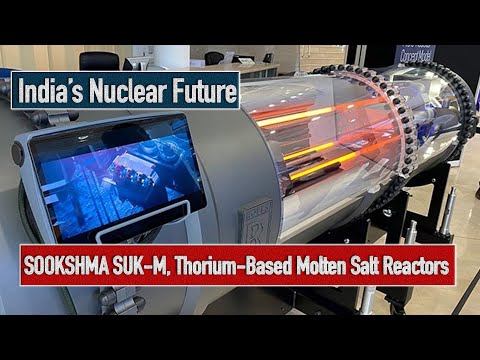
SUK-M has designed a nuclear reactor compact enough to move by road or rail and, until this week, had only run it in software. On November 25 the Indian startup closed its first institutional funding round, led by Speciale Invest and co-led by Navam Capital, with BYT Capital and two angel investors joining.

The reactor is a Generation IV molten-salt design rated at 10 megawatts of electricity or 30 megawatts of heat per unit, running on a uranium-thorium fuel mix. The round's purpose is narrower than building one: pay for laboratory measurements that test whether the design behaves the way simulations say it will.

Why it matters

India wants five home-built small reactors by 2033. Whether SUK-M's design leaves the lab shows if private firms can carry part of that load.

Questions about this story

Free account needed to ask — your question is kept and asked for you right after sign-up. Answers are public.

No questions yet — be the first to ask.

Key Indicators

10 MW
Electric output per reactor unit
Each unit is designed to produce 10 megawatts of electricity or 30 megawatts of heat.
30 MW
Heat output per reactor unit
The heat side targets industrial users such as steel plants, data centres and hydrogen production.
~25%
India's share of known world thorium deposits
Cited by Speciale Invest as the case for building reactors around thorium rather than imported fuel.
5
Indigenous small modular reactors India targets by 2033
A goal of the country's Nuclear Energy Mission, alongside a 100 gigawatt nuclear capacity target for 2047.
100 GW
India's nuclear capacity target for 2047
The upper end of the government's stated nuclear build-out plan.

Voices

Curated perspectives — historical figures and your fellow readers.

Sign up to generate historical perspectives on this story.

People Involved

Organizations Involved

Timeline

April 2021 November 2026

2 events Latest: Today
  1. SUK-M closes first institutional round

    Today Funding

    Speciale Invest leads a pre-seed round co-led by Navam Capital, with BYT Capital and two angels. The undisclosed sum pays for lab testing, hiring and an experimental facility.

  2. SUK-M founded on founder money

    Founding

    Nitendra Singh and Samyak Munot start the company to design an Indian thorium-fuelled micro-reactor. Early work is funded by the founders themselves.

Scenarios

1

SUK-M opens its test facility and reports first lab measurements

Likely Resolves by End of 2027

Discussed by: Business Standard and ET Entrepreneur both report the company's stated plan to establish a facility and run laboratory measurements; no timeline has been published.

The round's stated purpose is to move the design from software to hardware. A working facility plus published measurement data would show the molten-salt and fuel-handling assumptions survive contact with equipment. Trigger: a company announcement of a site and a first experimental campaign.

2

SUK-M raises a seed round on the back of lab results

Possible Resolves by Q2 2028

Discussed by: VCCircle and StopDown, which both frame this as a first step in a staged financing path rather than a one-off grant.

Pre-seed money usually lasts 12 to 24 months for a hardware company. If lab work produces data that outside engineers can assess, a larger round follows. If it produces delays, the company returns to its founders and angels.

3

A regulator licenses a SUK-M test reactor

Unlikely Resolves by End of 2029

Discussed by: No coverage reports a regulatory filing. This scenario tests whether the company reaches the stage where licensing becomes relevant.

Testing reactor components eventually requires approval from India's nuclear regulator, not just a laboratory lease. A licence application or grant would mark the transition from experiment to regulated facility.

4

SUK-M winds down before building hardware

Unlikely Resolves by End of 2028

Discussed by: Not predicted in any coverage. Included because most pre-seed hardware ventures fail before a prototype.

Thorium molten-salt work is capital-intensive and slow, and the company has not disclosed how much it raised. If the pre-seed sum cannot cover a facility, hiring and safety analysis, the team could stall or dissolve.

Historical Context

3 moments from history that rhyme with this story — and how they unfolded.

1950s

India's three-stage nuclear programme (1950s)

Homi Bhabha laid out a plan to stretch India's limited uranium by building pressurised heavy water reactors first, then fast breeder reactors using plutonium, then a final stage of thorium-fuelled reactors breeding uranium-233. The stages depended on each other in sequence, and thorium sat at the end of the queue.

Then

India built heavy water reactors and a fast breeder programme, but the thorium stage stayed theoretical.

Now

Thorium remained a national ambition without a commercial reactor, which is the gap startups now claim they can close.

Why this matters now

SUK-M's pitch is that a single uranium-thorium reactor design can pull thorium forward, skipping the decades-long wait the sequential plan implies.

1965-1969

Molten-Salt Reactor Experiment at Oak Ridge (1965-1969)

American engineers at Oak Ridge National Laboratory ran a small experimental reactor with molten salt as both fuel carrier and coolant, using uranium-233 bred from thorium. It operated for thousands of hours, then the programme was cut.

Then

The experiment proved the chemistry could work in a running reactor but produced no commercial design.

Now

Molten salt became a standard reference point for reactor designs that avoid high-pressure containment.

Why this matters now

SUK-M's design is a Generation IV molten-salt reactor, the same family the Oak Ridge experiment established, and it claims the same advantage: no high-pressure containment vessel.

November 2023

NuScale's first US small modular reactor project cancelled (2023)

A consortium of Utah utilities pulled out of the Carbon Free Power Project, the furthest-along small modular reactor plan in the United States, after cost estimates rose sharply and too few subscribers signed up.

Then

The project was terminated before construction, and NuScale cut staff.

Now

It became the standard cautionary case for small reactor economics: small size does not by itself make nuclear power cheap.

Why this matters now

India's five-reactor target by 2033 depends on designs that can be built at lower cost than large plants. SUK-M's micro-reactor is one bet on that, and the NuScale outcome is the risk it faces.

Sources

(7)