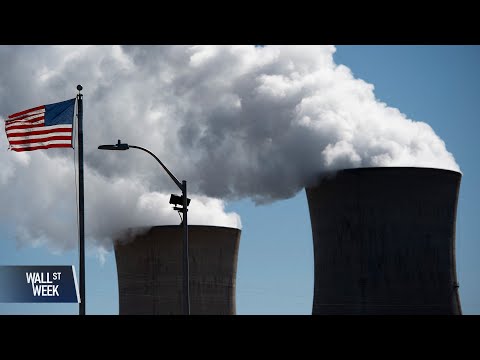
No US utility has ordered a newly designed commercial reactor and seen it come online since the 1970s. On April 24, 2026, the first company trying to break that drought rang the Nasdaq bell. X-energy priced its IPO at $23 a share ($4 above its marketed range) and raised $1.02 billion, the largest US nuclear public offering in years. Shares closed their first day up 27%, giving the company a market valuation of roughly $11.9 billion. The offering was oversubscribed more than 15 times.
X-energy has not yet poured concrete on a single reactor, but has major orders. Amazon committed to 5 gigawatts by 2039 and Dow Chemical wants one beside a Texas petrochemical plant. Eleven more gigawatts sit in the order book.
In the weeks before the IPO, engineering firm Fluor signed on to manage pre-construction planning at the Seadrift site. Power generator Talen Energy agreed to evaluate deploying additional Xe-100 plants in the PJM grid.
The IPO tests a simple question: will public markets fund the decade-long gap between a reactor deal and delivered electrons? If they do, AI data centers finally get the firm carbon-free power they've been promised.
Why it matters
If small modular reactors deliver on time, AI data centers get 24/7 carbon-free power; if they slip, that demand falls onto natural gas.
Questions about this story
Free account needed to ask — your question is kept and asked for you right after sign-up. Answers are public.
0
Q
What is the earliest date it can deliver power?
A
The earliest X-energy can deliver power is the early 2030s, anchored by the Cascade project in Washington — four Xe-100 reactors targeting construction start by 2030 and first electrons shortly after.
Amazon needs that power for AWS data centers, but 'early 2030s' is still the best case, not the base case — no concrete has been poured and NRC licensing is still underway.
More: 4 details, 3 sources, 2 points of disagreement
—Cascade (Amazon + Energy Northwest, Richland WA): construction targeted by 2030, first power in the early 2030s — the furthest-along project and most likely to be first.
—Seadrift (Dow, Texas): NRC construction permit filed March 2025; NRC review alone takes up to 30 months; Dow won't make a final investment decision before 2028, pushing first power into the mid-2030s at the earliest.
—Amazon's supply deal with X-energy commits to 5 GW of capacity by 2039 — the contract endpoint signals the market's real expectation of when meaningful output arrives.
—No NRC construction license has been issued yet for any X-energy site, so any date before the early 2030s would require regulatory speed that has no precedent in US nuclear history.
X-energy and Amazon call out 'early 2030s' for Cascade; independent analysts and the NRC's own permitting track record suggest mid-2030s is more realistic — the agency has never licensed an advanced reactor design at this pace before.
Some coverage describes Cascade's first-power target as 'early 2030s' while other outlets use 'mid-2030s,' reflecting genuine uncertainty about whether NRC licensing and construction can stay on schedule.
AI answer with web search. May be wrong.
0
Q
iPO, and they have never sold anything?
A
X-energy has earned revenue — about $94 million in 2025 — but almost entirely from government grants and engineering contracts, not reactor sales; it has never delivered a commercial kilowatt-hour.
The IPO is essentially asking public markets to fund a decade-long gap between signed contracts and actual power generation, a bet with no modern US precedent.
More: 4 details, 3 sources, 1 point of disagreement
—Revenue was ~$94M in 2025, up 12% year-over-year, but it comes from DOE cost-share agreements and government R&D contracts — not paying customers buying electricity.
—Operating loss was $170M in 2025; net losses ballooned to roughly $390M, more than double the prior year, as spending on licensing and fuel facilities accelerated.
—X-energy does have an 11 GW order book — Amazon (5 GW), Talen (1+ GW), Dow (4 units at Seadrift) — but these are commitments and letters of intent, not delivered product. No concrete has been poured.
—Its TRISO-X fuel facility in Oak Ridge got an NRC license in February 2026 and is the one tangible near-term asset; the Seadrift construction permit application filed March 2025 is still under the NRC's 18-month review.
Bulls argue the order book and Amazon's anchor position make this a long-lead infrastructure play, not a speculative startup — comparable to funding a highway before tolls are collected. Bears point to NuScale, which went public pre-revenue in 2022, saw costs balloon past $9B, and collapsed entirely by late 2023 — proof that a signed order book does not survive contact with actual construction.
AI answer with web search. May be wrong.
Key Indicators
$1.02B
X-energy IPO proceeds
Gross proceeds from the April 2026 Nasdaq debut, the largest US nuclear listing in years.
5 GW
Amazon's X-energy commitment
Gigawatts of Xe-100 capacity Amazon has agreed to buy by 2039 to power data centers.
11 GW
X-energy order pipeline
Gigawatts of reactor orders across Amazon, Dow, Centrica and others — none yet built.
80 MW
Per Xe-100 reactor
Each unit generates 80 megawatts; plants can stack up to twelve units for 960 MW.
2030s
First commercial operation
X-energy's first Xe-100 is targeted to start generating power in the early 2030s.
Images from Openverse under Creative Commons licenses.
Videos from YouTube.
Voices
Curated perspectives — historical figures and your fellow readers.
Andrew Carnegie
(1835-1919) ·Gilded Age · industry
Fictional AI pastiche — not real quote.
"The men who built Pittsburgh's furnaces also worked a decade before the first ton of steel proved the venture sound — that Amazon and Dow have signed their names to X-energy's order book tells me the *real* capital has already voted, and the public markets are merely catching the last train out of the station."
0% found this insightful
Ever wondered what historical figures would say about today's headlines?
Sign up to generate historical perspectives on this story.
19 events
Latest: April 24th, 2026 · 6 months ago
Showing 8 of 19
JK to step
Tap a bar to jump to that date
Jump to
April 2026
X-energy begins trading on Nasdaq under XE
LatestFinancial
Shares debut on the Nasdaq Global Select Market and jump roughly 26% on the first day, delivering paper gains to Amazon, Ken Griffin, and Kam Ghaffarian.
NRC proposes Part 57 streamlined microreactor licensing rule
Regulatory
On the same day X-energy began trading on Nasdaq, the Nuclear Regulatory Commission published proposed Part 57 — a new risk-informed licensing pathway for microreactors that targets permitting timelines of 6 to 12 months and is projected to save the industry $3.76 to $11.84 billion. The rule would allow fleet approvals of identical reactor designs and limited pre-permit construction.
X-energy upsizes and prices IPO at $23
Financial
X-energy prices 44.25 million shares at $23 — $4 above the top of its range — raising $1.02 billion, the largest US nuclear IPO in years.
X-energy files S-1 for up to $800M IPO
Filing
The company formally files to go public on Nasdaq, initially targeting $16–$19 per share and about $800 million in proceeds.
Fluor signs project management contract for X-energy's Seadrift project
Deal
Engineering and construction firm Fluor agreed to provide Front-End Loading Stage 2 (FEL-2) project management services for the four-unit Xe-100 plant at Dow's Seadrift, Texas petrochemical site — the first major outside contractor formally attached to X-energy's construction team ahead of the IPO.
March 2026
X-energy and Talen Energy sign LOI for gigawatt-scale Xe-100 deployment
Deal
X-energy and power generator Talen Energy signed a Letter of Intent to evaluate deploying three or more four-unit Xe-100 plants — adding at least 1 gigawatt of capacity — across the PJM interconnection grid in Pennsylvania, leveraging Talen's existing nuclear operating experience and transmission assets.
January 2026
Meta signs 16-reactor Oklo deal for Ohio AI campus
Deal
Meta partners with Oklo to build a 1.2 gigawatt campus in Pike County, Ohio using 16 Aurora Powerhouse microreactors, with prepayments to secure HALEU fuel.
November 2025
X-energy closes oversubscribed $700M Series D
Investment
Private-round fundraising aimed at reactor licensing and scaling the TRISO-X fuel plant in Oak Ridge, Tennessee.
October 2025
Amazon unveils 'Cascade' Xe-100 project
Deal
Amazon, X-energy and Energy Northwest name their Washington project Cascade — a 320 MW four-unit build targeting construction by 2030 and first power in the early 2030s.
June 2025
AWS signs 17-year PPA with Talen for Susquehanna
Deal
Amazon agrees to buy 1.92 gigawatts from Talen Energy's existing Susquehanna nuclear plant, committing $20 billion in Pennsylvania data-center investment.
May 2025
NRC caps advanced reactor review at 18 months
Regulatory
Under guidelines prompted by the 2024 ADVANCE Act, the NRC commits to completing qualifying advanced reactor reviews within 18 months, down from a historical 5 to 7 years.
March 2025
X-energy and Dow file NRC construction permit
Regulatory
The companies submit a construction permit application for four Xe-100 reactors at Seadrift — the first NRC application to build an advanced reactor at an industrial site.
October 2024
Amazon leads $500M Series C-1 into X-energy
Investment
Amazon anchors a $500 million round with Ken Griffin, Ares, NGP, and the University of Michigan. Amazon separately commits to buy up to 5 gigawatts of X-energy capacity by 2039.
September 2024
Microsoft signs 20-year PPA to restart Three Mile Island
Deal
Constellation Energy agrees to restart the retired Three Mile Island Unit 1 to sell all its output to Microsoft for AI data centers — reopening a reactor is easier than building one.
March 2024
Amazon buys Talen's nuclear-adjacent Cumulus data center
Deal
AWS purchases the Cumulus data center campus attached to Talen's Susquehanna nuclear plant in Pennsylvania, signalling hyperscaler appetite for directly co-located nuclear power.
November 2023
NuScale's UAMPS project collapses over cost
Setback
The Utah Associated Municipal Power Systems cancels the Carbon Free Power Project after cost estimates rise to $9.3 billion. The first US SMR deal fails before construction.
March 2023
Dow and X-energy partner on first industrial-site SMR
Deal
Dow Inc. and X-energy agree to develop an Xe-100 reactor at Dow's Seadrift, Texas petrochemical complex, the first plan to site an advanced reactor at a commercial industrial facility.
January 2023
NRC certifies NuScale's SMR, the first US approval
Regulatory
The Nuclear Regulatory Commission certifies NuScale Power's small modular reactor design, making it the only SMR cleared for US deployment.
October 2020
DOE picks X-energy and TerraPower for Advanced Reactor Demonstration Program
Policy
The Department of Energy awards X-energy and TerraPower $80 million each in initial funding, with up to $1.2 billion apiece in cost-share support to demonstrate advanced reactors by 2027.
Scenarios
1
First Xe-100 comes online by 2031, order book doubles
Possible
Discussed by: X-energy S-1 filing; Bank of America nuclear analysts; Amazon sustainability disclosures
The NRC clears Dow's Seadrift permit within its new 18-month window, Oak Ridge fuel production ramps on schedule, and first power flows from a Texas Xe-100 before 2031. Commercial proof drives new hyperscaler, industrial, and allied-country orders, pushing X-energy's 11-gigawatt pipeline past 20 gigawatts and validating the SMR thesis for the rest of the sector.
2
Construction slips to late 2030s, hyperscalers default to gas
Possible
Discussed by: Skeptical nuclear analysts; past NuScale and Vogtle cost-overrun post-mortems
Licensing, HALEU fuel supply, or construction hits the same cost spiral that sank NuScale's Utah project and ballooned Vogtle 3 and 4 by $20 billion. Xe-100 first power slides to the late 2030s. To meet AI demand on time, Amazon, Meta, and peers sign more natural-gas and on-site generation deals; SMR equity values compress.
3
HALEU shortage bottlenecks the whole sector
Likely
Discussed by: US Department of Energy; Centrus Energy analysts; IAEA fuel-cycle reports
X-energy, Oklo, and TerraPower all rely on high-assay low-enriched uranium. The US only recently restarted domestic enrichment after decades of Russian dependence. If HALEU production scales slower than reactor demand, first cores arrive late even for well-licensed projects. X-energy's Oak Ridge TRISO-X plant becomes the most important node in the sector.
Discussed by: Industry M&A bankers; Reuters energy desk
Not every SMR startup survives. As public-market discipline arrives via IPO, weaker designs lose funding and get bought by GE-Hitachi, Westinghouse, or cash-rich hyperscalers. X-energy either consolidates peers or is itself absorbed by a large utility seeking vertical integration. Three-to-five designs survive globally by 2030.
Historical Context
3 moments from history that rhyme with this story — and how they unfolded.
1 of 3
2015–November 2023
NuScale UAMPS Carbon Free Power Project (2015–2023)
Utah Associated Municipal Power Systems and NuScale Power spent eight years developing what was meant to be the first commercial US small modular reactor — a six-module plant at Idaho National Laboratory. After repeated redesigns, rising interest rates, and cost estimates that climbed from $3 billion to $9.3 billion, the project was cancelled in November 2023. Target power prices had risen to $89 per megawatt-hour.
Then
NuScale's share price collapsed, workforce was cut sharply, and the company pivoted toward marketing its NRC-certified design to new customers.
Now
The cancellation reset expectations that small reactors would be cheap, and reinforced the view that SMR projects only work with deep-pocketed anchor offtakers rather than small public utilities.
Why this matters now
X-energy's economics only close because Amazon, Dow, and Energy Northwest are pre-committed to buying the power. The UAMPS failure is exactly the kind of outcome hyperscaler offtake is meant to prevent.
2 of 3
August 2009–April 2024
Vogtle Units 3 and 4 construction (2009–2024)
Georgia Power began building two Westinghouse AP1000 reactors at Plant Vogtle in 2009, with original cost estimates near $14 billion and a first-power target of 2016. Unit 3 entered commercial operation in July 2023 and Unit 4 in April 2024. The final cost exceeded $35 billion — more than double the budget and roughly seven years late.
Then
Georgia ratepayers absorbed billions in cost-recovery charges, and no other US utility ordered a large reactor.
Now
Vogtle became the reference case against which any new nuclear project is judged, and a key reason investors now prefer smaller, factory-built reactor designs.
Why this matters now
X-energy's pitch to the market — factory manufacturing, smaller modules, industrial or data-center offtake — is explicitly engineered to avoid a Vogtle-style cost spiral.
3 of 3
March–July 2017
Westinghouse bankruptcy and V.C. Summer cancellation (2017)
Westinghouse Electric Company filed Chapter 11 bankruptcy in March 2017, crushed by roughly $9 billion in construction losses on Vogtle and on two AP1000 units at South Carolina's V.C. Summer site. In July 2017, SCANA and Santee Cooper abandoned V.C. Summer entirely after spending about $9 billion with nothing to show.
Then
Toshiba, Westinghouse's parent, took multibillion-dollar writedowns; Westinghouse was later sold to Brookfield. Thousands of construction workers were laid off in South Carolina.
Now
The collapse functionally ended the large-reactor business model in the United States and opened the door for smaller reactor designs that could be financed and built in smaller chunks.
Why this matters now
The SMR thesis X-energy is monetising was born from this failure. Public markets backing a reactor developer again — a decade after Westinghouse broke — is the clearest sign that investor memory is shifting.