
Pull to refresh
Logo
Queensland awards SunLinQ design contract for Sunshine Coast rail Stage 2

Queensland awards SunLinQ design contract for Sunshine Coast rail Stage 2

Built World

Design work starts on a 7km rail leg with a tunnel under Little Mountain, but Canberra has not committed construction money

Overview

Updated 21 minutes ago

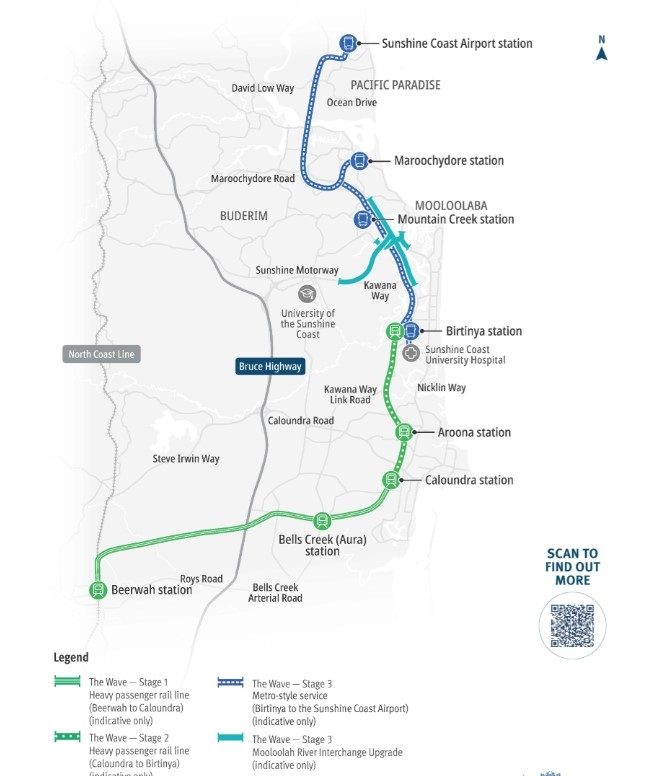
Queensland has picked a designer for the second stage of The Wave, the heavy rail line it is building along the Sunshine Coast. The SunLinQ consortium, made up of BMD Constructions, CPB Contractors, GS Engineering and Construction Australia and UGL Engineering, will develop the design and carry out pre-construction work on 7km of dual track between Caloundra and Birtinya, including a tunnel of about 1km beneath Little Mountain.

The award covers design, not construction; the main build contract has not been let. Stage 1, the 19km Beerwah to Caloundra section, is jointly funded with A$2.75 billion each from the Queensland and Australian governments. Canberra has committed nothing to Stage 2, and the state is targeting a 2027 construction start subject to federal environmental approval.

Why it matters

Stage 2 has a designer but no federal money, so the 7km link to Birtinya may wait on a funding decision rather than engineering.

Questions about this story

Free account needed to ask — your question is kept and asked for you right after sign-up. Answers are public.

No questions yet — be the first to ask.

Key Indicators

7 km
Length of Stage 2
Dual-track line from Caloundra to Birtinya.
1 km
Tunnel beneath Little Mountain
Mined tunnel between Caloundra and Aroona stations; excavation methods not yet confirmed.
19 km
Length of Stage 1
Beerwah to Caloundra, under construction design.
A$2.75bn
Queensland funding for Stage 1
Matched by the same amount from the Australian government; no federal commitment exists for Stage 2.
3,300
Jobs projected across Stages 1 and 2
Queensland government estimate for the two funded-or-planned stages.
3,000+
Homes planned near new stations
Housing the state expects the line to unlock around station precincts.

Voices

Curated perspectives — historical figures and your fellow readers.

Sign up to generate historical perspectives on this story.

People Involved

Organizations Involved

Timeline

June 2026 November 2026

2 events Latest: 3 days ago
  1. SunLinQ wins Stage 2 design and pre-construction contract

    Latest Procurement

    Queensland names the SunLinQ consortium to design 7km of dual track from Caloundra to Birtinya, including a tunnel beneath Little Mountain and stations at Aroona and Birtinya. The award was announced on 18 November; site investigations are under way and major construction is targeted for 2027, subject to federal environmental approval and funding.

  2. Stage 1 design contracts awarded

    Procurement

    Queensland and the Australian government issue design and pre-construction contracts for the 19km Beerwah to Caloundra section, with A$2.75 billion committed by each government.

Scenarios

1

Canberra commits money to Stage 2

Possible Resolves by Q2 2027

Discussed by: Queensland government statements and trade press coverage, which repeatedly flag the missing federal contribution

The state has funded Stage 1 jointly with Canberra but has no federal commitment for Caloundra to Birtinya. A federal budget line or a joint announcement would close that gap and let the department convert SunLinQ's design into a construction contract. Without it, the state would have to carry the section alone or stage the work.

2

Major construction begins in 2027 as targeted

Uncertain Resolves by End of 2027

Discussed by: Queensland Department of Transport and Main Roads project documentation

The department's published programme has construction starting in 2027, conditional on federal environmental approval and construction funding for Stage 2. Meeting it would require the environmental referral to clear and the build contract to be let within roughly a year of the design award.

3

Main build contract goes to market as a separate award

Likely Resolves by Q2 2028

Discussed by: Procurement records and the terms of the SunLinQ design award, which excludes construction

Design and pre-construction is a separate package from the build, so the government must still tender and award the construction contract. SunLinQ can bid, but the appointment gives it no automatic claim. A single design-and-construct award to SunLinQ and a split package to another contractor are both live outcomes.

Historical Context

3 moments from history that rhyme with this story — and how they unfolded.

2017–present

Cross River Rail, Brisbane (2017–)

Queensland committed to a new rail line under central Brisbane with twin tunnels and new underground stations, the state's largest transport build of the past decade. It became the reference case for how Queensland prices, sequences and defends big rail work.

Then

Construction began years after the business case, with property acquisition, utility clashes and ground conditions absorbing schedule.

Now

Its opening has moved more than once and its budget has grown, which shapes how Treasury and the transport department now stage major projects.

Why this matters now

The Wave sits in the same 2032 Delivery Plan and the same delivery department, and its staged contracting mirrors the approach used on Cross River Rail.

2014–2019

Sydney Metro Northwest (2014–2019)

New South Wales built Australia's first metro-style railway from Rouse Hill to Chatswood, letting design and construction as separate packages and running the line as an extension of the existing rail network.

Then

The line opened in 2019 and carried its first passengers without the service disruptions that had been predicted for a new operating model.

Now

It became the template for later Australian metro extensions, including the practice of splitting design, tunnelling and systems into separate contracts.

Why this matters now

The Wave is being procured the same way, with a design and pre-construction contract now and construction to follow separately.

2009–2022

Crossrail / Elizabeth line, London (2009–2022)

London built a new tunnelled east-west rail line under the city centre, with stations dug out beneath dense urban ground and complex signalling integration.

Then

Opening slipped by more than three years past the original date and the cost estimate rose by billions of pounds.

Now

The project reset expectations for tunnelled rail: ground conditions, station fit-out and signalling integration, not tunnelling itself, drive the overruns.

Why this matters now

The Wave's mined tunnel under Little Mountain is the highest-risk element of Stage 2, and its excavation method has not been fixed.

Sources

(7)