


Pull to refresh
Logo
Gulf states sign legal framework for regional railway network

Gulf states sign legal framework for regional railway network

Built World

Six GCC members agreed each will fund and build its own segment, with full operation targeted for December 2030

Overview

Updated 1 hour ago

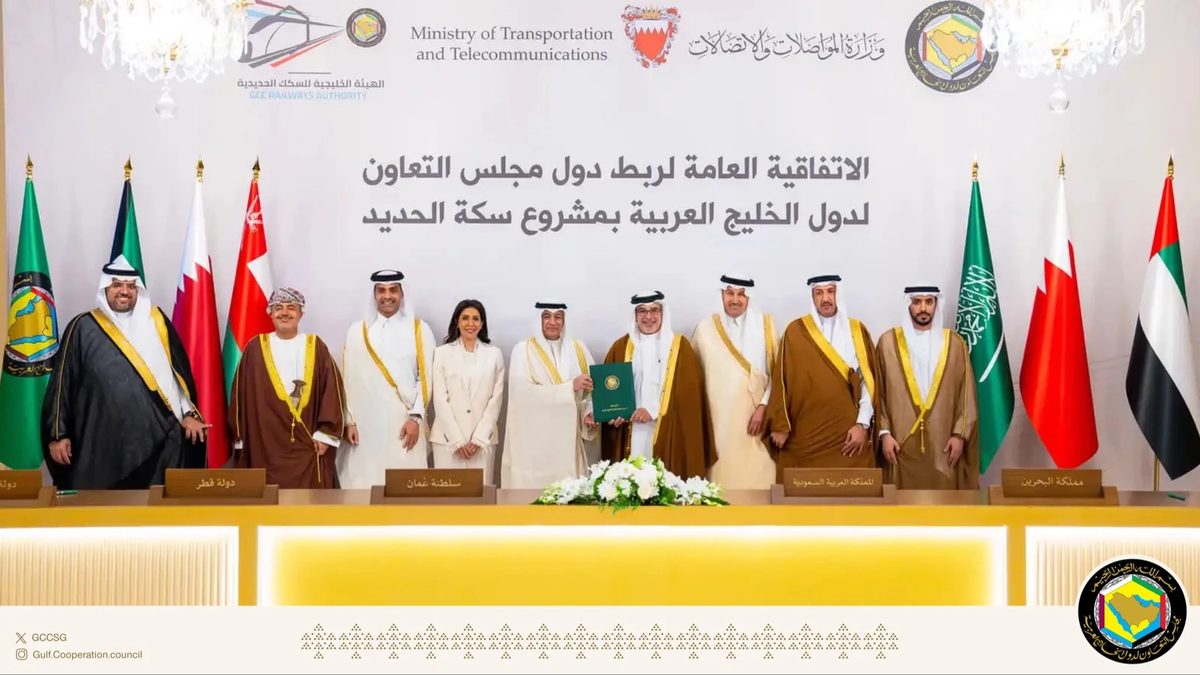
Gulf Cooperation Council transport ministers signed the general agreement for a 2,117-kilometre railway in Manama on November 8. The line is meant to run from Kuwait through Saudi Arabia, Bahrain, Qatar and the United Arab Emirates to Oman.

The agreement is the legal scaffolding, not the track. It sets who builds and pays for what, how the six national networks connect, and a target of full operation by December 2030. Each country finances the segment inside its own borders; shared cross-border components are costed jointly.

Why it matters

Freight could eventually move from Kuwait to Muscat by rail, giving Gulf ports a route that avoids the Strait of Hormuz.

Questions about this story

Free account needed to ask — your question is kept and asked for you right after sign-up. Answers are public.

No questions yet — be the first to ask.

Key Indicators

2,117 km
Length of planned network
Kuwait to Oman, through Saudi Arabia, Bahrain, Qatar and the UAE.
$16B
Estimated core infrastructure cost
A range of $15.4–16 billion reported by Al Jazeera; the GCC says cost estimates are being revised.
55.9%
Reported overall project completion
Average progress across member states, according to GCC Secretary-General Jasem AlBudaiwi; Bahrain's minister says it is not a share of total construction.
6M
Projected annual passengers by 2030
GCC target, rising to more than 8 million by 2045.
200M tonnes
Projected annual freight by 2030
GCC target, rising to 271 million tonnes by 2045.

Voices

Curated perspectives — historical figures and your fellow readers.

Sign up to generate historical perspectives on this story.

People Involved

Organizations Involved

Timeline

December 2009 November 2026

5 events Latest: Today
Tap a bar to jump to that date
  1. Transport ministers sign the general agreement

    Today Agreement

    Six GCC states sign the legal and regulatory framework for the railway in Manama.

  2. GCC puts overall completion at 55.9%

    Today Statement

    AlBudaiwi says the network is 55.9% complete, with full operation set for December 2030.

  3. Iran war disrupts Gulf shipping

    Conflict

    Strikes on Iran trigger attacks on Gulf states and a de facto blockade of Hormuz.

  4. GCC Railways Authority created

    Institution

    The Supreme Council decides to set up a body to coordinate construction and compatibility.

  5. GCC approves a six-state railway

    Policy

    The GCC Supreme Council backs a network linking all six member states.

Scenarios

1

Full network opens on the December 2030 target

Possible Resolves by Q2 2031

Discussed by: GCC Secretary-General Jasem AlBudaiwi and Bahrain's transport minister, both of whom named December 2030 as the operating date

Every member state finishes its own segment and the cross-border links are commissioned, giving a continuous line from Kuwait to Oman. The Bahraini minister has said interconnection lines between neighboring countries can open as soon as their components are done, so the network could fill in piece by piece rather than all at once. The risk sits in the shared components, especially the Bahrain–Saudi crossing.

2

Bahrain joins late as the King Hamad Causeway slips

Possible Resolves by End of 2030

Discussed by: Bahrain's Minister of Transportation and Telecommunications, who tied the December 2030 target to the new causeway

The other five states connect by land. Bahrain is an island, and its only rail route into the network is the proposed King Hamad Causeway to Saudi Arabia, which also carries road traffic. The minister said studies and the privatization of the existing King Fahd Causeway Authority are still in progress. If the new crossing is not built, Bahrain's station sits outside the operating network.

3

UAE–Oman line runs first, ahead of the full network

Likely Resolves by Q2 2028

Discussed by: The National, citing the 238km Hafeet Rail project and its planned 2027 trial operations

Hafeet Rail links Sohar port in Oman to Abu Dhabi through Al Buraimi and Al Ain, using the UAE's existing national network. It is the most advanced cross-border piece and does not depend on the causeway or on the eastern Saudi links. Trial operations are expected in 2027, which would make it the first segment of the Gulf system to carry traffic.

Historical Context

2 moments from history that rhyme with this story — and how they unfolded.

1986-1994

Channel Tunnel (1986–1994)

Britain and France signed the Treaty of Canterbury in 1986, authorizing a privately financed rail tunnel under the English Channel. Boring began in 1988 and the link opened in 1994, connecting two national rail systems that used different operating rules and safety regimes.

Then

Construction ran years late and costs came in far above the original estimate, forcing a financial restructuring.

Now

It became the reference model for cross-border rail: a bilateral treaty, national financing shares, and a jointly owned operator.

Why this matters now

The GCC agreement copies that structure, including the choice to let each state fund its own territory. The Bahrain–Saudi causeway is the Gulf's version of the same fixed-link problem.

1862-1869

US First Transcontinental Railroad (1862–1869)

The Pacific Railroad Acts set federal land grants and loan guarantees behind two private companies, the Union Pacific and the Central Pacific, building toward a meeting point in Utah. They joined 1,912 miles of track at Promontory Summit in 1869.

Then

The line cut a months-long overland journey to about a week and moved freight that had gone by sea around South America.

Now

It set the pattern for state-backed rail construction and showed how freight economics, not passenger demand, decide whether a long line pays.

Why this matters now

Gulf planners are making the same bet: the project's case rests on 200 million tonnes of freight a year by 2030, with passenger service as a secondary revenue line.

Sources

(6)