


Pull to refresh
Logo
Supermassive black hole winds are 100 times more powerful than thought

Supermassive black hole winds are 100 times more powerful than thought

New Capabilities

XRISM satellite data shows quasar H1821+643's winds churning gas 300,000 light-years out, rivaling billions of supernovae

July 28th, 2026: Nature Astronomy publishes findings

Overview

Updated 5 hours ago

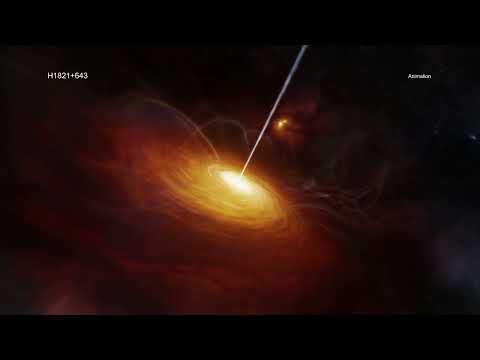
Astronomers have known black holes launch winds for decades. New X-ray data shows one quasar's winds churn hot gas across 300,000 light-years, three times the width of the Milky Way, with roughly 100 times more energy than earlier estimates.

The measurement comes from XRISM, Japan's X-ray astronomy satellite, which watched the quasar H1821+643 for a week in September 2024. The energy involved equals several billion supernovae, suggesting black holes shape cosmic structure far beyond the galaxies they inhabit.

Why it matters

If black hole winds routinely push this much energy into surrounding space, astronomers may be underestimating how black holes shape galaxies and clusters.

Questions about this story

Free account needed to ask — your question is kept and asked for you right after sign-up. Answers are public.

No questions yet — be the first to ask.

Key Indicators

100×
Turbulence energy vs earlier estimates
Energy in the churning gas is roughly 100 times greater than previous estimates for similar systems.
300,000
Light-years the winds reach
Turbulence detected out to about 300,000 light-years, well beyond the host galaxy.
2.6 billion
Solar masses of the black hole
The supermassive black hole at the core of quasar H1821+643.
300 km/s
Speed of churning gas
Nearly double the 164 km/s measured in the Perseus cluster, the prior benchmark.
79 hours
X-ray observation time
XRISM's Resolve instrument collected data over a weeklong campaign in September 2024.

Voices

Curated perspectives — historical figures and your fellow readers.

Ever wondered what historical figures would say about today's headlines?

Sign up to generate historical perspectives on this story.

People Involved

Organizations Involved

Timeline

September 2024 July 2026

2 events Latest: July 28th, 2026 · 2 months ago
  1. Nature Astronomy publishes findings

    Latest Publication

    Paper reports winds carrying 100 times more energy than estimated, churning gas across 300,000 light-years beyond the host galaxy.

  2. XRISM observes quasar H1821+643

    Observation

    XRISM records 79 hours of X-ray data on the quasar during a weeklong campaign. It was the satellite's first guest-observer target.

Scenarios

1

Follow-up observations confirm extended turbulence in a second quasar

Likely Resolves by Q2 2028

Discussed by: XRISM science team and the wider X-ray astronomy community

XRISM is currently the only instrument that can measure gas motion this precisely in distant galaxy clusters. If the collaboration observes other quasars and finds similar turbulence extending well beyond host galaxies, the H1821+643 result becomes a general mechanism rather than a single odd case.

2

Galaxy formation simulations adopt the higher feedback energy

Possible Resolves by End of 2028

Discussed by: Astrophysics modeling community (COLIBRE and related projects)

The team estimates 1 to 10 percent of the quasar's radiated energy ends up stirring gas beyond its galaxy, versus 0.01 percent or less in earlier estimates for similar systems. Current galaxy formation simulations like COLIBRE assume 5 to 10 percent, so this measurement could validate that choice or push modelers to revise their feedback parameters.

3

Alternative explanation offered for the measured gas motion

Unlikely Resolves by End of 2027

Discussed by: Independent astrophysics researchers

The team attributed the churning to a shock wave from black hole winds, ruling out bulk motion of large gas clouds. An independent analysis might propose another mechanism, such as cluster merger activity, that produces the same spectral line broadening.

Historical Context

2 moments from history that rhyme with this story — and how they unfolded.

2003

Chandra X-ray Observatory, Perseus Cluster (2003)

Chandra found giant cavities and bubbles in the hot X-ray gas of the Perseus cluster, carved by jets from the central supermassive black hole. The cavities showed the black hole mechanically pushing gas around, not just absorbing it.

Then

This was the first direct evidence that black holes inject energy into surrounding cluster gas, establishing the concept of active galactic nucleus feedback.

Now

It reshaped how astronomers understand galaxy and cluster evolution, linking black hole activity to the fate of gas in their surroundings.

Why this matters now

The Perseus discovery established the feedback framework; the H1821+643 result dramatically extends the reach of that feedback beyond the host galaxy.

2016

Hitomi satellite, Perseus Cluster (2016)

The Japanese Hitomi X-ray satellite measured gas motion in the Perseus cluster at about 164 km/s before the satellite lost attitude control and was destroyed. It was the first precise measurement of intracluster gas velocities.

Then

The measurement became the reference baseline for how much gas churns in cluster cores.

Now

Perseus remains the benchmark for cluster gas dynamics; more than 90 percent of follow-up work compares results to it.

Why this matters now

The H1821+643 gas moves at about 300 km/s, nearly double the Perseus baseline, showing a central quasar drives far more violent motion than a typical cluster core.

Sources

(7)