
Pull to refresh
Logo
Three supermassive black holes found in a single early-universe galaxy

Three supermassive black holes found in a single early-universe galaxy

New Capabilities

JWST observations reveal three feeding black holes in galaxy J0148-4214, seen 12.5 billion light-years away

Today: Discovery reported to wide audiences

Overview

Updated 1 hour ago

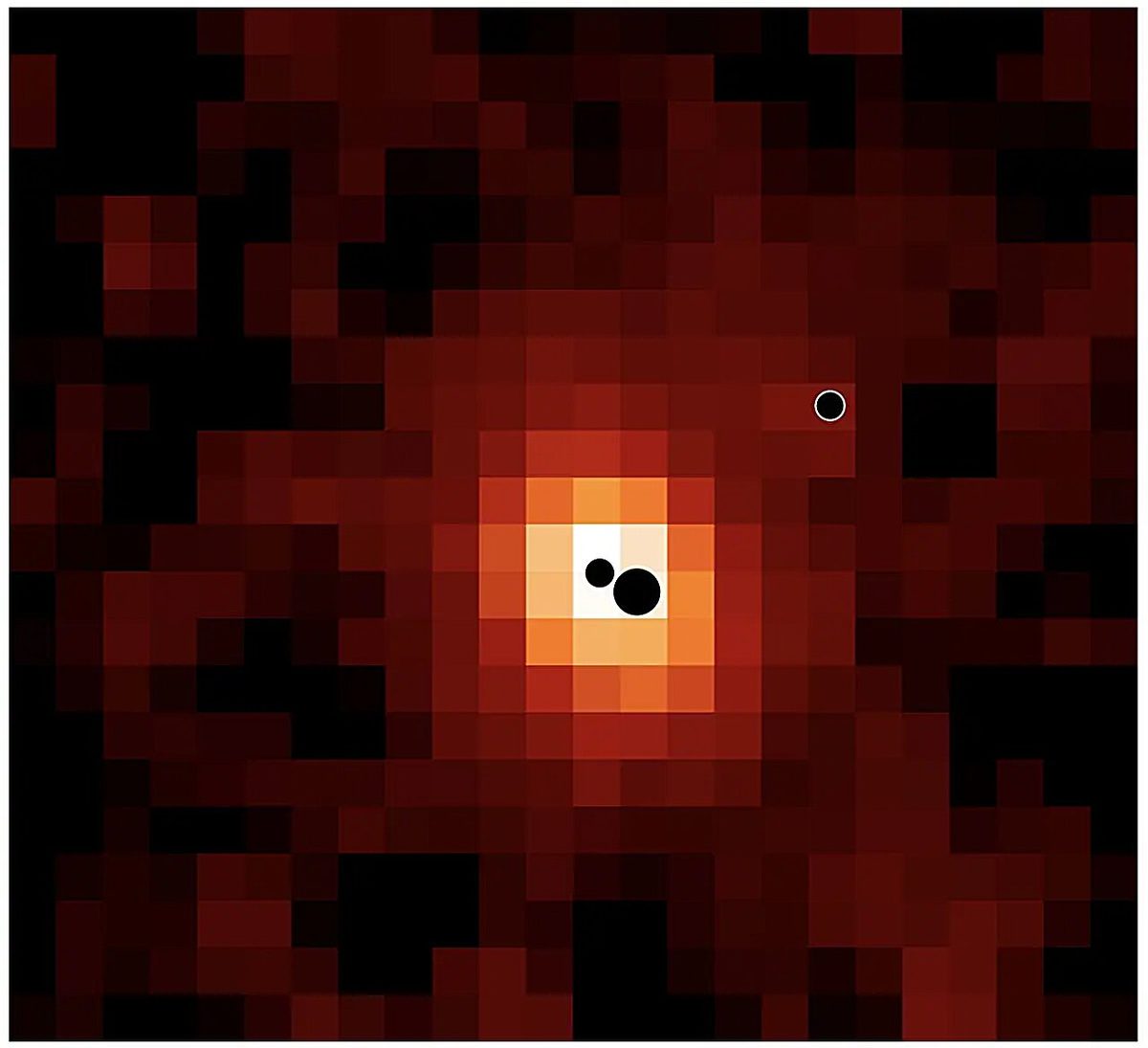
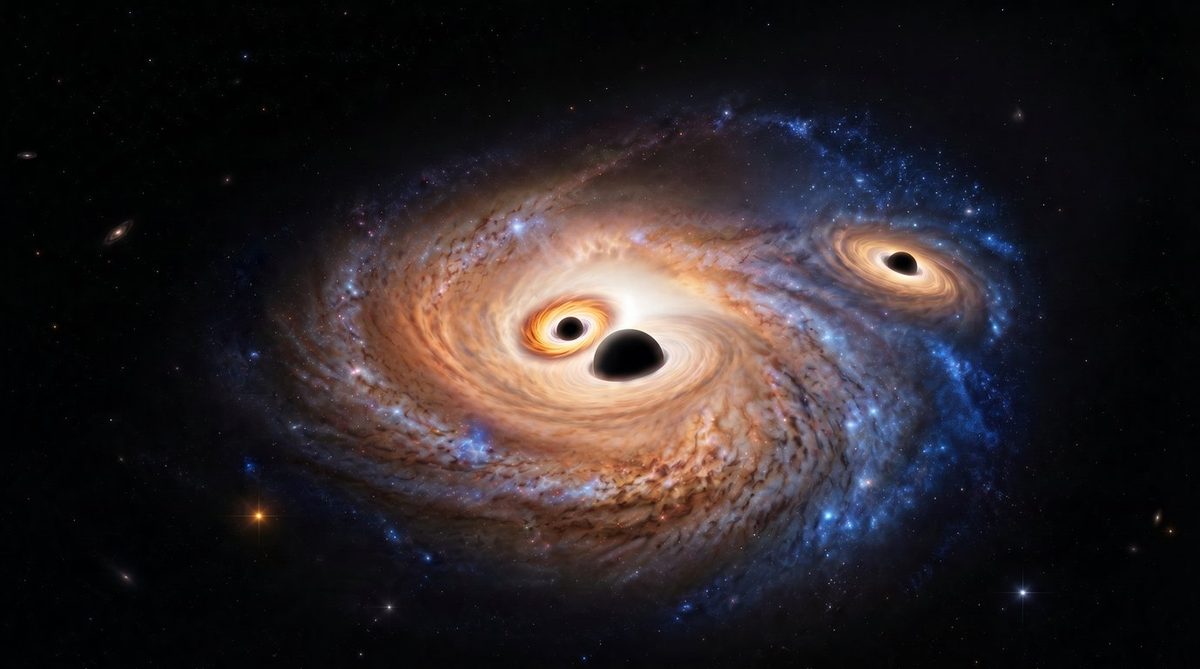
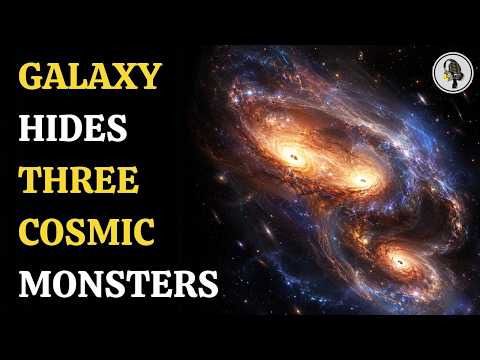
Astronomers have found three actively feeding supermassive black holes in a single galaxy 12.5 billion light-years away. It's the first time three active black holes have been seen together in the early universe.

The galaxy, J0148-4214, is seen as it existed just 1.2 billion years after the Big Bang. Two of its black holes sit only 620 light-years apart at the center and are expected to merge within a few hundred million years. A third lurks roughly 5,500 light-years from the center.

The discovery, made with the James Webb Space Telescope, shows how early black holes may have grown so fast: through mergers and feeding that exceeds theoretical limits. One black hole of 600,000 solar masses is growing faster than the Eddington limit predicts.

Why it matters

The discovery reveals how the early universe built billion-solar-mass black holes: through mergers and feeding that exceeds theoretical limits.

Questions about this story

Free account needed to ask — your question is kept and asked for you right after sign-up. Answers are public.

No questions yet — be the first to ask.

Key Indicators

3
Actively feeding supermassive black holes in one galaxy
First time three active black holes have been found together in the early universe.
80M / 0.6M / 2M solar masses
Masses of the three black holes
The most massive is 80 million suns; the smallest is feeding the fastest.
620 light-years
Separation of the two central black holes
The pair is expected to merge within a few hundred million years.
z = 5.02
Galaxy redshift
The galaxy is seen as it appeared 1.2 billion years after the Big Bang.

Voices

Curated perspectives — historical figures and your fellow readers.

Ever wondered what historical figures would say about today's headlines?

Sign up to generate historical perspectives on this story.

People Involved

Organizations Involved

Timeline

August 2026 October 2026

2 events Latest: Today
  1. Discovery reported to wide audiences

    Today Announcement

    ScienceDaily publishes the Max Planck Institute's report on the three black holes, highlighting the 620-light-year separation of the central pair and the super-Eddington accretion of the smallest black hole.

  2. Study reports three active black holes in galaxy J0148-4214

    Research publication

    An international team led by the Max Planck Institute for Extraterrestrial Physics publishes findings from JWST showing three actively accreting supermassive black holes in the distant galaxy.

Scenarios

1

JWST finds more galaxies with twin and triple black holes

Likely Resolves by Oct 25, 2028

Discussed by: The MPE team, including lead author Hannah Übler

The same technique — spatially resolved spectroscopy with JWST's near-infrared spectrograph — is applied to other distant galaxies. The team says such systems likely exist but went undetected without high-resolution spectral mapping. Finding more would confirm that mergers drove early black hole growth.

2

Third black hole's fate determined: escaping or migrating inward

Uncertain Resolves by Oct 25, 2029

Discussed by: The MPE team, which offers two possible explanations

Targeted follow-up observations measure the third black hole's motion. If it moves outward at high velocity, a recoil kick from an earlier merger ejected it — the same mechanism that flings hypervelocity stars out of the Milky Way. If it drifts inward, it is migrating toward the center for a future merger.

3

Super-Eddington growth confirmed as an engine of early giants

Possible Resolves by Oct 25, 2028

Discussed by: The MPE team and theorists studying early black hole growth

The 600,000-solar-mass black hole feeds faster than the Eddington limit, the theoretical maximum for steady accretion, predicts. Follow-up observations and modeling test whether super-Eddington accretion lets black holes grow this fast, which would help explain billion-solar-mass black holes in the early universe.

Historical Context

3 moments from history that rhyme with this story — and how they unfolded.

September 2015

First gravitational wave detection (2015)

On September 14, 2015, the Laser Interferometer Gravitational-Wave Observatory (LIGO) detected GW150914, the ripple from two black holes — about 29 and 36 solar masses — merging 1.3 billion light-years away. It was the first direct evidence that black holes collide and merge.

Then

LIGO's detection opened gravitational-wave astronomy, adding a new way to observe the universe.

Now

It confirmed binary black hole mergers as a real phenomenon and set up studies of them at every scale.

Why this matters now

J0148-4214's central pair will merge within a few hundred million years, producing the kind of gravitational waves that future space-based observatories are built to catch.

December 2017

ULAS J1342+0928 (2017)

Astronomers announced the most distant known quasar at the time, hosting a supermassive black hole of about 780 million solar masses seen just 690 million years after the Big Bang. Its existence strained models of how black holes grow.

Then

The find sharpened the puzzle of early black hole growth.

Now

It pushed theorists to propose faster growth routes, including super-Eddington accretion and mergers.

Why this matters now

J0148-4214 now shows both mechanisms playing out in one galaxy, offering a concrete path from seed black holes to billion-solar-mass giants.

2003

NGC 6240's dual black holes (2003)

X-ray observations of NGC 6240, a nearby merging galaxy about 400 million light-years away, revealed two active supermassive black holes roughly 3,000 light-years apart. The galaxy is the product of two galaxies colliding, each contributing its own black hole.

Then

NGC 6240 became a benchmark target for studying dual black hole systems.

Now

It demonstrated that galaxy mergers bring supermassive black holes together — a process J0148-4214 shows happening in the early universe.

Why this matters now

Where NGC 6240 shows two black holes merging nearby, J0148-4214 shows three in the early universe, including two separated by just 620 light-years and on track to merge.

Sources

(7)