



Pull to refresh
Logo
Diskless white dwarf powers 1,000-year shock wave that shouldn't exist

Diskless white dwarf powers 1,000-year shock wave that shouldn't exist

New Capabilities

Astronomers trace a persistent outflow to a 'mystery engine' that magnetic fields alone can't explain

Today: Shock wave around diskless white dwarf reported in Nature Astronomy

Overview

Updated 1 hour ago

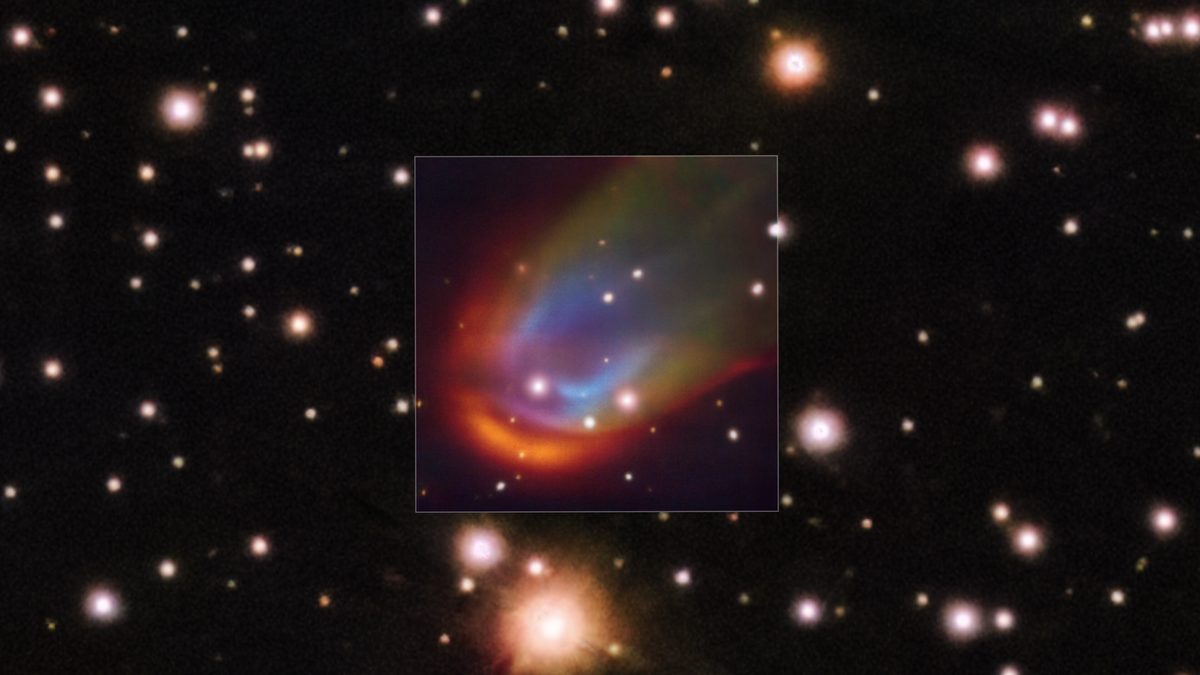
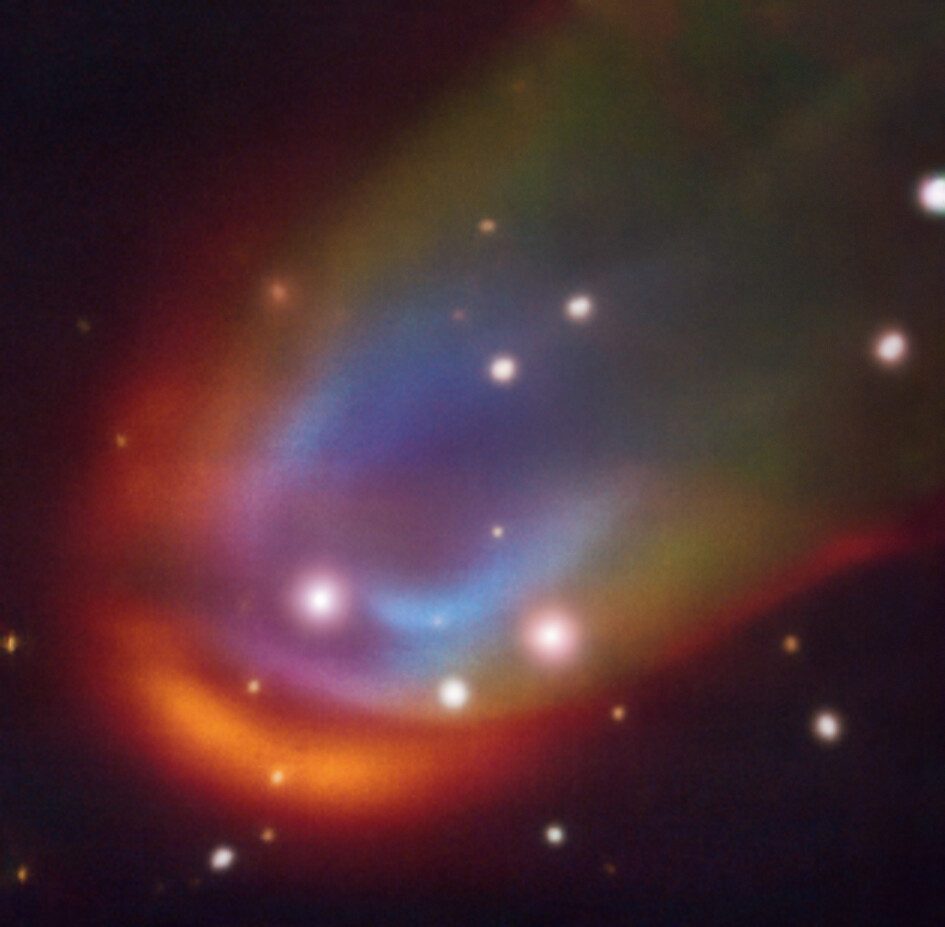
A dead star 730 light-years away is producing a shock wave it has no business making. The white dwarf RXJ0528+2838 has been ejecting material for at least 1,000 years, yet it lacks the accretion disk that normally drives such outflows.

The star's magnetic field can explain only a few hundred years of activity. The shock needs about three times more power than the system releases, so astronomers have named the unknown source a 'mystery engine.' The finding challenges how researchers understand dead stars interacting with their surroundings.

Why it matters

A diskless dead star sustaining a 1,000-year outflow means astronomers' models of stellar death and binary evolution are incomplete.

Questions about this story

Free account needed to ask — your question is kept and asked for you right after sign-up. Answers are public.

No questions yet — be the first to ask.

Key Indicators

1,000+ years
Outflow duration
The bow shock's size implies the white dwarf has ejected material for at least a millennium.
3,800 AU
Bow shock size
Roughly 3,800 times the Earth-Sun distance, about 568 billion km.
42-45 megagauss
Magnetic field strength
The field steers infalling gas but can sustain the shock for only a few hundred years.
~3×
Missing power
The shock requires about three times more power than the system normally releases.

Voices

Curated perspectives — historical figures and your fellow readers.

Ever wondered what historical figures would say about today's headlines?

Sign up to generate historical perspectives on this story.

People Involved

Organizations Involved

Timeline

1 event Latest: Today
  1. Shock wave around diskless white dwarf reported in Nature Astronomy

    Today Publication

    Team reports persistent bow shock around diskless magnetic white dwarf RXJ0528+2838.

Scenarios

1

ELT uncovers more diskless dwarf outflows

Possible Resolves by End of 2029

Discussed by: Simone Scaringi, study co-lead

Scaringi expects the Extremely Large Telescope, due for first light in the late 2020s, to map more of these systems and detect fainter examples. Confirming a second diskless white dwarf with a persistent bow shock would show the phenomenon is widespread, not a one-off.

2

New mechanism closes the energy gap

Possible Resolves by End of 2027

Discussed by: Study team (Durham University, Nicolaus Copernicus Astronomical Center)

The team has no full explanation for the 1,000-year outflow. A follow-up theoretical paper or new measurement could pin it to a stronger magnetic field, magnetic reconnection, or another hidden source.

3

Magnetic field found far stronger than estimated

Unlikely Resolves by End of 2028

Discussed by: Earth.com science desk

Current field estimates (42-45 megagauss) come from spectral clues, and direct measurement might reveal a far stronger field able to sustain the outflow. If so, the 'mystery engine' may simply be magnetism.

Historical Context

2 moments from history that rhyme with this story — and how they unfolded.

August 1967

Discovery of pulsars (1967)

Jocelyn Bell Burnell, a graduate student at Cambridge, detected regular radio pulses arriving every 1.337 seconds from a single point in the sky. The signal was so precise that she and her supervisor briefly considered an artificial source, joking about 'little green men.'

Then

The signal was identified as a rotating neutron star, now called a pulsar. The discovery won the 1974 Nobel Prize, awarded to her supervisor.

Now

Pulsars became a cornerstone of astrophysics, used to test general relativity and later to detect gravitational waves.

Why this matters now

Like the pulsar signal, the RXJ0528+2838 shock wave appeared to defy known physics; both pushed researchers to find a mechanism rather than dismiss the observation.

April 2020

Fast radio burst traced to a magnetar (2020)

On April 28, 2020, telescopes detected a fast radio burst from SGR 1935+2154, a magnetar in our own galaxy. It was the first fast radio burst traced to a known object.

Then

The burst confirmed magnetars as a source of at least some fast radio bursts.

Now

It anchored the study of these millisecond flashes to observable magnetic stars.

Why this matters now

If the 'mystery engine' is magnetism, the white dwarf shock could follow the same path: an unexplained energy source traced to a magnetic object.

Sources

(6)