

Pull to refresh
Logo
Supreme Court agrees to hear Kentucky church's fight over Virgin Mary shrine

Supreme Court agrees to hear Kentucky church's fight over Virgin Mary shrine

Rule Changes

The case tests whether a zoning denial violates the 2000 Religious Land Use and Institutionalized Persons Act

Yesterday: Supreme Court grants review

Overview

Updated 1 hour ago

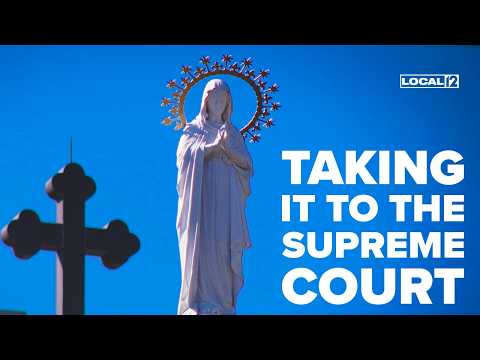
A Catholic church north of Cincinnati wants to build a 600-square-foot grotto to the Virgin Mary on the residential lot next to its building. On Thursday the U.S. Supreme Court agreed to decide whether a local zoning board can stop it.

The case turns on the Religious Land Use and Institutionalized Persons Act of 2000, which bars zoning rules that put a substantial burden on religious exercise. The court limited its review to one question: whether this denial is such a burden.

Why it matters

The ruling sets the national standard for when local zoning can block religious buildings, affecting churches, synagogues, and ministries in every state.

Questions about this story

Free account needed to ask — your question is kept and asked for you right after sign-up. Answers are public.

No questions yet — be the first to ask.

Key Indicators

600 sq ft
Proposed grotto footprint
Roughly the size of a swimming pool, per the church's attorneys.
1 of 2
Questions the Supreme Court agreed to review
The court took only the 'substantial burden' question, not the second issue the church raised.
Nearly 100 years
Age of the church building
Our Lady of Lourdes predates Park Hills' 1974 zoning ordinance.
Dec 2025
Kentucky Supreme Court ruled against the church
Held the grotto ban did not violate RLUIPA because a smaller shrine could be built on church land.

Voices

Curated perspectives — historical figures and your fellow readers.

Ever wondered what historical figures would say about today's headlines?

Sign up to generate historical perspectives on this story.

People Involved

Organizations Involved

Timeline

March 2021 October 2026

5 events Latest: Yesterday
Tap a bar to jump to that date
  1. Park Hills board approves the grotto

    Decision

    The Board of Adjustment grants the permit despite a city ordinance restricting land use on certain streets.

  2. Church applies for grotto permit

    Application

    Missionaries of Saint John the Baptist seek a conditional use permit and variance for a grotto behind its church.

Scenarios

1

Supreme Court rules against the church — grotto blocked

Possible Resolves by Q2 2027

Discussed by: The Frederics and the Kentucky state courts, which held the rules apply equally to religious and nonreligious projects

The Court could agree that the denial imposes no substantial burden because the church bought the lot knowing it was zoned residential and could build a smaller shrine on its existing property. That reading would leave the grotto blocked and set a narrower national standard for religious land-use claims.

2

Supreme Court sides with the church — grotto moves toward approval

Possible Resolves by Q2 2027

Discussed by: First Liberty Institute, which cites a split among federal and state appellate courts on the substantial burden standard

If the Court holds the denial is a substantial burden, it would reverse and send the case back to Kentucky with a clarified standard. The grotto could then proceed, potentially after further state proceedings on the permit.

3

Parties settle before argument — case dismissed

Unlikely Resolves by Q1 2027

Discussed by: Rare; neither side has signaled interest after years of state litigation

A settlement or withdrawal would moot the case. Both sides fought through Kentucky courts for nearly five years, so a last-minute deal is unlikely but possible before oral arguments early next year.

Historical Context

3 moments from history that rhyme with this story — and how they unfolded.

June 1997

City of Boerne v. Flores (1997)

A Catholic church in Boerne, Texas, was denied a permit to expand its aging mission under the city's historic preservation rules. The church sued under the 1993 Religious Freedom Restoration Act (RFRA), which barred governments from substantially burdening religious exercise.

Then

The Supreme Court struck down RFRA as applied to states, ruling Congress exceeded its power under the Fourteenth Amendment's Section 5.

Now

The decision pushed Congress to pass RLUIPA in 2000 on a narrower constitutional footing.

Why this matters now

Like today's case, Boerne pitted a Catholic church's expansion against local zoning rules. The current dispute tests the statute that Boerne's aftermath created.

September 2000

Religious Land Use and Institutionalized Persons Act (2000)

Congress passed RLUIPA to protect religious land use and prisoners' worship after Boerne. It barred zoning rules that impose a substantial burden on religious exercise unless the government has a compelling reason.

Then

The law gave religious groups a federal remedy against local zoning decisions.

Now

It has shaped thousands of zoning disputes, with courts split on what counts as a substantial burden.

Why this matters now

RLUIPA is the statute at issue here; the Supreme Court will clarify the meaning of its central test for land use.

May 2005

Cutter v. Wilkinson (2005)

The Supreme Court unanimously upheld RLUIPA's prison-accommodation provision against an Establishment Clause challenge from Ohio corrections officials.

Then

RLUIPA survived its first Supreme Court test intact.

Now

The ruling reinforced the law's legitimacy but left the land-use 'substantial burden' question unresolved.

Why this matters now

The Court has upheld RLUIPA before, but never settled what substantial burden means in a zoning dispute. This case could do so.

Sources

(7)