

Pull to refresh
Logo
Daily Brief
Following
Why Sign Up
TESS reveals the universe's tightest-packed quadruple star system

TESS reveals the universe's tightest-packed quadruple star system

New Capabilities
By Newzino Staff |

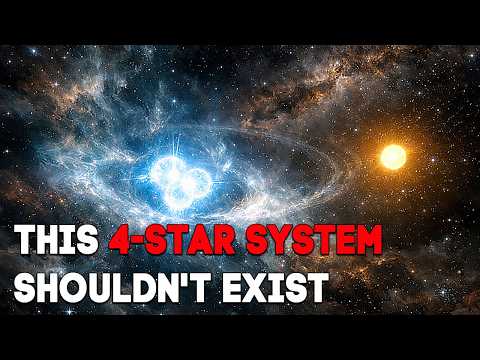
Four stars crammed into a space smaller than Jupiter's orbit challenge models of how multi-star systems form and survive

March 10th, 2026: Most compact 3+1 quadruple star system announced

Overview

For centuries, astronomers assumed most stars were loners like our Sun. Over the past decade, space telescopes have steadily revealed that multi-star systems are not only common but can be packed together in arrangements that strain the limits of gravitational stability. Now a Hungarian-led team has found the most extreme example yet: four stars orbiting within a region that would fit between our Sun and Jupiter, the tightest '3+1'-type quadruple system ever recorded.

Key Indicators

1,046 days
Outer orbital period
The fourth star's orbit around the inner trioβ€”the shortest ever measured for a 3+1 quadruple system.
3.3 days
Inner binary period
The two closest stars complete a full orbit around each other in just over three days.
~1,900 ly
Distance from Earth
The system sits in a region surveyed by TESS's wide-field cameras.
7,821
TESS candidate objects
Total candidate exoplanets identified by TESS as of early 2026, alongside hundreds of multi-star discoveries.

Interactive

Exploring all sides of a story is often best achieved with Play.

Ever wondered what historical figures would say about today's headlines?

Sign up to generate historical perspectives on this story.

Sign Up

Debate Arena

Two rounds, two personas, one winner. You set the crossfire.

People Involved

Organizations Involved

Timeline

  1. Most compact 3+1 quadruple star system announced

    Discovery

    Researchers led by TamΓ‘s Borkovits publish the discovery of TIC 120362137 in Nature Communications, identifying it as the most compact 3+1-type quadruple system ever found, with the fourth star's 1,046-day orbit far shorter than any previous example.

  2. Record-breaking triple system found with 24.5-day outer orbit

    Discovery

    TIC 290061484, a triply eclipsing triple with an outer period of just 24.5 days, shatters a 68-year-old recordβ€”showing TESS continues to find increasingly extreme compact systems.

  3. BU Canis Minoris confirmed as tightest known 2+2 quadruple

    Discovery

    Astronomers establish BU Canis Minoris as the most compact '2+2'-type quadruple system, with an outer period of just 121 days. TIC 120362137 would later claim the record for the separate '3+1' architecture.

  4. Six compact triply eclipsing triples found with TESS

    Discovery

    A systematic search of TESS data yields six new compact triple-star systems exhibiting third-body eclipses, expanding the known population of tightly packed stellar hierarchies.

  5. TESS data reveals first sextuply eclipsing sextuple star system

    Discovery

    Astronomers announce TIC 168789840, a system of six stars arranged as three eclipsing binary pairsβ€”the first of its kindβ€”demonstrating TESS's power for multi-star science.

  6. TESS launches, beginning all-sky brightness survey

    Mission

    NASA's Transiting Exoplanet Survey Satellite launches aboard a SpaceX Falcon 9 rocket, beginning a mission to monitor the brightness of hundreds of thousands of stars.

Scenarios

1

TESS and follow-up surveys reveal even tighter multi-star configurations

Discussed by: Borkovits group and TESS science team; implied by the accelerating pace of record-breaking discoveries (triple record in 2024, quadruple in 2026)

With over 100 triply eclipsing triples already catalogued and new algorithmic tools like QUADCOR now available, the same pipelines that found TIC 120362137 could identify still more compact systems in unprocessed TESS sectors or future missions like the European Space Agency's PLATO. Each new record further constrains formation models and tests the boundary between stable hierarchical orbits and systems that merge or eject members.

2

TIC 120362137 becomes a benchmark system for gravitational dynamics simulations

Discussed by: Nature Communications paper; researchers in n-body dynamics and stellar evolution modeling

Because all four stellar spectra can be individually resolvedβ€”unique among known 3+1 systemsβ€”TIC 120362137 provides unusually precise masses, radii, and orbital parameters. Theorists modeling the Kozai-Lidov mechanism, tidal dissipation, and long-term orbital stability are likely to adopt it as a standard test case, similar to how Algol became the textbook eclipsing binary.

3

Inner triple stars confirmed on track to merge into a single white dwarf

Discussed by: Mitnyan and Borkovits evolutionary modeling; referenced in press coverage of the Nature Communications paper

The team's models suggest the three tightly bound inner stars will evolve through red-giant phases and eventually merge into a single white dwarf within roughly 300 million years. Continued spectroscopic monitoring could refine this timeline and test whether the system is losing angular momentum faster than models predict, potentially through magnetic braking or tidal effects not yet fully captured in simulations.

4

Discovery prompts new constraints on how quadruple systems form

Discussed by: Multiple stellar evolution modelers and star formation theorists referenced in the Nature Communications paper

The extreme compactness of TIC 120362137 poses a puzzle: standard models of disk fragmentation and dynamical capture struggle to place four stars this close without triggering mergers early in the system's life. If theorists cannot reproduce the system's current architecture from plausible initial conditions, it may force revisions to models of how young stellar systems dissipate angular momentum during formation.

Historical Context

Castor revealed as a sextuple system (1719–1920)

1719–1920

What Happened

In 1719, James Pound resolved Castorβ€”one of the brightest stars in the northern skyβ€”into two components. By 1905, spectroscopy showed each component was itself a tight binary. In 1920, a third faint pair was found orbiting the inner four, making Castor a sextuple system. Each revelation took decades and a new instrument.

Outcome

Short Term

Castor became the prototype for understanding hierarchical multi-star architectures, proving that gravitationally bound systems can nest multiple orbits within orbits.

Long Term

The two-century unfolding of Castor's complexity established that the apparent simplicity of a star is often an observational limitation, not a physical realityβ€”a lesson that TESS is now confirming at industrial scale.

Why It's Relevant Today

TIC 120362137's discovery mirrors the Castor story compressed into months instead of centuries: TESS photometry first showed a binary, then a triple, then spectroscopy revealed the fourth star. Modern instruments are collapsing discovery timelines from centuries to single observing campaigns.

TIC 168789840: first sextuply eclipsing sextuple system (2021)

January 2021

What Happened

Astronomers announced that TESS data had revealed TIC 168789840, a system of six stars arranged as three eclipsing binary pairsβ€”the first system of its kind where all six eclipses were observable. Located 1,428 light-years away, its inner four stars complete orbits in under two days each.

Outcome

Short Term

The discovery demonstrated that TESS's continuous monitoring could reveal stellar architectures invisible to snapshot surveys, spurring systematic searches for compact multi-star systems.

Long Term

It catalyzed a wave of multi-star discoveries from TESS data, growing the known population of triply eclipsing triples from Kepler's 13 to over 100, and setting the stage for the quadruple-system records now being broken.

Why It's Relevant Today

TIC 168789840 proved TESS could find complex multi-star systems at scale. TIC 120362137 extends this capability to the most extreme compact quadruples, showing the discovery pipeline is still finding configurations that push theoretical limits.

TIC 290061484: shortest-period triply eclipsing triple (2024)

October 2024

What Happened

A team using TESS data and citizen-scientist filtering announced TIC 290061484, a triple-star system with an outer orbital period of just 24.5 daysβ€”shattering a 68-year-old record held by Lambda Tauri. Its three massive stars (6–8 solar masses each) are predicted to merge and produce a supernova within 20 million years.

Outcome

Short Term

The discovery proved that compact multi-star records were not approaching a physical floor but still had room to fall, and demonstrated the value of human-AI collaboration in filtering TESS data.

Long Term

It established that TESS is systematically revealing a population of ultra-compact stellar systems whose existence was only theoretical, setting expectations for further records.

Why It's Relevant Today

TIC 290061484 broke the triple-system compactness record 18 months before TIC 120362137 broke the quadruple record, showing a pattern: each new TESS data release is yielding progressively more extreme multi-star configurations.

Sources

(8)