

Logo
Daily Brief
Following
Why
Saturn's Moon Empire: 128 New Worlds in a Single Day

Saturn's Moon Empire: 128 New Worlds in a Single Day

Astronomers push telescopes to their limits, finding Saturn now has more moons than all other planets combined

Overview

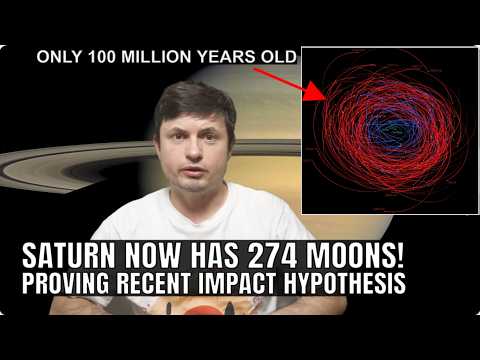
On March 11, 2025, the International Astronomical Union dropped a bombshell: 128 new moons orbiting Saturn. Not over a year. Not over a decade. All at once. A team led by Edward Ashton stacked thousands of telescope images from 2019 to 2023, revealing a swarm of tiny irregular satellites—each just a few kilometers across—that had been hiding in plain sight. Saturn now has 274 confirmed moons, more than all other planets in the solar system combined.

This isn't just cosmic bookkeeping. These fragments tell a violent story. Astronomers believe a moderate-sized moon orbiting Saturn backwards was blown apart roughly 100 million years ago, scattering debris that still orbits the ringed giant today. The discovery marks the practical limit of current telescope technology—our best instruments can't detect Saturnian moons smaller than three miles across. Jupiter, with 95 moons, has no hope of catching up.

Key Indicators

274
Saturn's Total Moons
More than all other planets combined
128
Moons Found in Single Announcement
Largest batch discovery in history
192
Moons Found by Ashton's Team
70% of Saturn's known satellites
~3 miles
Detection Limit
Smallest detectable moon around Saturn

People Involved

Edward Ashton
Edward Ashton
Postdoctoral Fellow, Academia Sinica Institute of Astronomy and Astrophysics (Lead discoverer of 192 Saturn moons)
Brett Gladman
Brett Gladman
Professor of Astronomy, University of British Columbia; Canada Research Chair in Planetary Astronomy (Co-discoverer, has found more moons than anyone in human history)
Christiaan Huygens
Christiaan Huygens
Dutch Astronomer and Physicist (Deceased (1629-1695))

Organizations Involved

IN
International Astronomical Union Minor Planet Center
Scientific Organization
Status: Official body for designating moons and minor planets

The single worldwide authority for receiving and distributing positional measurements of minor planets, comets, and irregular moons.

Canada-France-Hawaii Telescope
Observatory
Status: Operational on Mauna Kea

A 3.6-meter optical/infrared telescope on Mauna Kea equipped with MegaCam, a 340-megapixel camera covering one square degree of sky.

Academia Sinica Institute of Astronomy and Astrophysics
Research Institution
Status: Leading planetary astronomy research

Taiwan's premier astronomy research institute, home to Edward Ashton's postdoctoral work on Saturn's irregular satellites.

Timeline

  1. IAU Announces 128 New Saturn Moons

    Announcement

    Largest single batch of moon discoveries in history brings Saturn's total to 274—more than all other planets combined.

  2. Follow-Up Campaign Confirms More Moons

    Research

    Team revisits same sky fields for three consecutive months, bringing total new discoveries to 128.

  3. Initial CFHT Observations

    Research

    Ashton and Gladman conduct observations revealing 64 new moons using shift-and-stack technique.

  4. Ashton Begins PhD Moon Hunt

    Research

    Edward Ashton starts systematic search for Saturn's irregular satellites at University of British Columbia.

  5. Huygens Lands on Titan

    Mission

    First successful landing on an outer solar system moon reveals methane lakes and hydrocarbon weather.

  6. Cassini Enters Saturn Orbit

    Mission

    Cassini-Huygens mission begins 13-year study of Saturn system, discovering numerous small moons.

  7. Ground-Based Irregular Moon Hunt Begins

    Discovery

    Brett Gladman's team discovers twelve irregular moons using large CCDs and modern telescopes.

  8. Voyager 2 Saturn Encounter

    Mission

    Voyager 2 discovers additional moons and provides first evidence Enceladus might still be geologically active.

  9. Voyager 1 Saturn Flyby

    Mission

    Voyager 1 reveals shepherd moons and transforms Saturn's satellites from points of light into worlds.

  10. Cassini Finds Four More Moons

    Discovery

    Jean-Dominique Cassini discovers Iapetus, Rhea, Tethys, and Dione.

  11. First Saturn Moon Discovered

    Discovery

    Christiaan Huygens spots Titan using his 50-power refracting telescope.

Scenarios

1

Detection Limits Reached, Moon Count Plateaus

Discussed by: Edward Ashton, astronomical technology experts

Current telescopes have hit their practical limits for detecting moons around Saturn smaller than three miles across. Without significant technological advances—next-generation space telescopes or novel detection methods—Saturn's official count will remain near 274. Astronomers estimate they've surveyed most of the gravitationally-dominated region, though only 2.2 of 26 square degrees were covered. Future discoveries may add dozens more fragments, but not hundreds. The moon race between Jupiter and Saturn effectively ends here.

2

Future Mission Discovers Moonlets Inside Rings

Discussed by: Planetary scientists, mission planners

A dedicated Saturn orbiter equipped with high-resolution imaging could detect embedded moonlets within the ring system itself—objects that create gaps and waves but remain invisible from Earth. Cassini hinted at these "propeller moons," but a future mission with better instruments might find hundreds of kilometer-sized objects shepherding ring particles. These would technically count as moons but represent a different class of object: rubble embedded in a debris disk rather than independent satellites.

3

Revised Definition Shrinks Moon Count

Discussed by: International Astronomical Union working groups, planetary dynamics researchers

Growing unease about what constitutes a "moon" versus "ring debris" could trigger an IAU reclassification. If the union establishes minimum size thresholds—say, 10 kilometers in diameter—or requires moons to be dynamically independent from ring systems, Saturn's count could drop dramatically. This mirrors the 2006 Pluto controversy: as detection improves and populations explode, authorities sometimes tighten definitions rather than accept exponential growth in recognized objects.

Historical Context

Pluto's Demotion and the Definition Crisis (2006)

2006

What Happened

As astronomers discovered hundreds of Pluto-sized objects in the Kuiper Belt, the IAU faced a choice: accept dozens of new planets or redefine what "planet" means. They chose the latter, demoting Pluto to "dwarf planet" and establishing size, orbit-clearing criteria. The decision sparked public outcry but prevented the solar system from having 50+ planets.

Outcome

Short term: Pluto lost planetary status; IAU established clear classification framework.

Long term: Astronomy shifted toward population-based thinking rather than expanding traditional categories indefinitely.

Why It's Relevant

Saturn's exploding moon count raises similar questions: when does a debris fragment become a moon? The IAU may eventually impose size limits to prevent the count from reaching thousands.

Jupiter's Moon Race Lead (2023)

2023

What Happened

In February 2023, Jupiter briefly reclaimed the "moon king" title with 95 confirmed satellites, surpassing Saturn's then-count of 83. Astronomers celebrated Jupiter's return to dominance. The lead lasted mere months before Saturn's team announced 62 new moons in May 2023, then 128 more in 2025.

Outcome

Short term: Jupiter held the title for less than three months.

Long term: Saturn's irregular moon population proved far larger; experts now say Jupiter has no chance of catching up.

Why It's Relevant

The back-and-forth demonstrated how rapidly improving detection capabilities can reshape our understanding of planetary systems. Saturn's decisive victory reflects fundamental differences in how the gas giants captured debris.

Asteroid Belt Population Explosion (1990s-2000s)

1990-2010

What Happened

Automated sky surveys like LINEAR and Catalina discovered asteroids at exponential rates—from a few thousand known asteroids in 1990 to over 500,000 by 2010. The flood of data required new computational techniques to process observations and automated systems to assign provisional designations. Scientists stopped trying to name every asteroid individually.

Outcome

Short term: Naming conventions shifted to alphanumeric codes; provisional designations became permanent for most objects.

Long term: Astronomy embraced statistical approaches to studying populations rather than cataloging individual objects.

Why It's Relevant

Saturn's irregular moons follow this pattern: modern instruments reveal vast populations of small objects, forcing astronomers to think statistically about debris fields rather than treating each fragment as a unique world.