
Pull to refresh
Logo
Senate passes college sports regulation bill; House path uncertain

Senate passes college sports regulation bill; House path uncertain

Rule Changes

Protect College Sports Act would cap athlete pay and transfers, but the House is in recess until November

Yesterday: Senate passes bill 77-22

Overview

Updated 1 hour ago

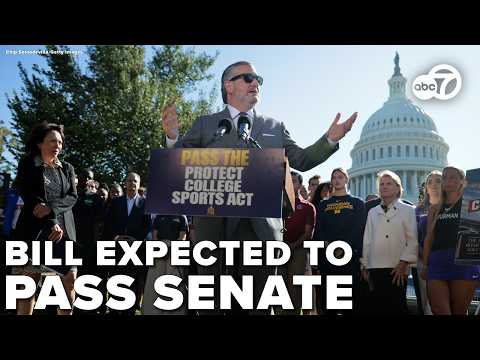
The Senate voted 77-22 Monday to pass the Protect College Sports Act, the first federal bill to regulate how college athletes earn from their name, image, and likeness (NIL) and how often they transfer. It would let schools pay players up to roughly $50 million a year and give the NCAA an antitrust exemption it has sought for a decade.

The bill now goes to the House, which is in recess until after the November midterms and has let its own version sit for a year. The Congressional Black Caucus opposes both versions, saying they do not protect Black athletes enough. House conservatives also want changes, including a ban on classifying college athletes as employees.

Why it matters

If the bill dies, the NCAA keeps getting sued in court, players keep jumping schools, and states keep writing conflicting NIL laws.

Questions about this story

Free account needed to ask — your question is kept and asked for you right after sign-up. Answers are public.

No questions yet — be the first to ask.

Key Indicators

77-22
Senate vote margin
The bill passed the Senate on September 28, 2026, with support from both parties.
$50M
Maximum annual athlete payments per school
Combines a $21.6 million revenue-sharing cap, a $22.5 million retention fund, and $5 million for women's and Olympic sports.
20
Conference membership cap
Power Four conferences can grow to 20 schools under an amendment adopted by voice vote.

Voices

Curated perspectives — historical figures and your fellow readers.

Ever wondered what historical figures would say about today's headlines?

Sign up to generate historical perspectives on this story.

People Involved

Organizations Involved

Timeline

2025 September 2026

4 events Latest: Yesterday
Tap a bar to jump to that date
  1. Senate passes bill 77-22

    Latest Vote

    Senate votes 77-22 to pass the act after adopting a 20-school conference cap.

  2. Committee advances the bill

    Legislation

    Senate Commerce Committee advances the bill; floor action stalls for months.

  3. Cruz and Cantwell introduce Protect College Sports Act

    Legislation

    Senate Commerce leaders introduce the bipartisan bill to regulate athlete pay and transfers.

Scenarios

1

Protect College Sports Act signed into law

Possible Resolves by Jan 3, 2027

Discussed by: White House, which endorsed the bill in August; sponsors Ted Cruz and Maria Cantwell

The House returns November 9 and holds a rapid floor vote on the Senate bill during the lame-duck session. Bipartisan support carries it, and Trump signs before the 119th Congress ends January 3. The law would not take effect for the current college sports season even if passed this fall.

2

Bill dies in the House, Congress starts over

Likely Resolves by Jan 3, 2027

Discussed by: CBS Sports, NBC News

House leaders decline to bring the bill to the floor during the short lame-duck session after the November midterms. The bill dies when the 119th Congress adjourns, and lawmakers reintroduce the legislation in the 120th Congress, losing all progress. CBS Sports called it unlikely to reach the floor.

3

House passes modified version, forcing new negotiations

Possible Resolves by Jan 3, 2027

Discussed by: House Majority Leader Steve Scalise

Scalise pushes the House version to the floor with its prohibition on athlete employee status and other changes. The House passes it, sending a modified bill back to the Senate. Conferees or renewed Senate consideration extend the fight into 2027, beyond the current Congress.

Historical Context

2 moments from history that rhyme with this story — and how they unfolded.

June 1984

NCAA v. Board of Regents (1984)

The Supreme Court struck down NCAA rules limiting how often football games could be televised, ruling the organization's control ran afoul of federal antitrust law. The decision let schools negotiate their own broadcast deals.

Then

Big-conference schools quickly signed lucrative television contracts, widening the gap between wealthy and poor programs.

Now

Established that NCAA rules face antitrust scrutiny, setting the pattern for later challenges to its amateurism model.

Why this matters now

The current bill's antitrust exemption is Congress's attempt to reverse four decades of court rulings that chipped away at NCAA authority.

June 2021

Alston v. NCAA (2021)

The Supreme Court unanimously ruled the NCAA could not cap education-related benefits for athletes. Justice Brett Kavanaugh wrote separately that the NCAA's amateurism rules may violate antitrust law and lack a clear legal basis.

Then

The ruling accelerated the push for name, image, and likeness rights, which the NCAA adopted later that year under pressure from state laws.

Now

Set off the current era of NIL deals, the transfer portal, and the House v. NCAA settlement that lets schools pay athletes directly.

Why this matters now

This bill is the direct legislative response to the chaos the Alston ruling and its aftermath created.

Sources

(11)