


Pull to refresh
Logo
Carbon-capturing concrete proves stronger than conventional mixes

Carbon-capturing concrete proves stronger than conventional mixes

New Capabilities

Zeolite and bamboo biochar blend absorbs CO2 while boosting structural performance

Today: Findings reported by ScienceDaily and other outlets

Overview

Updated 1 hour ago

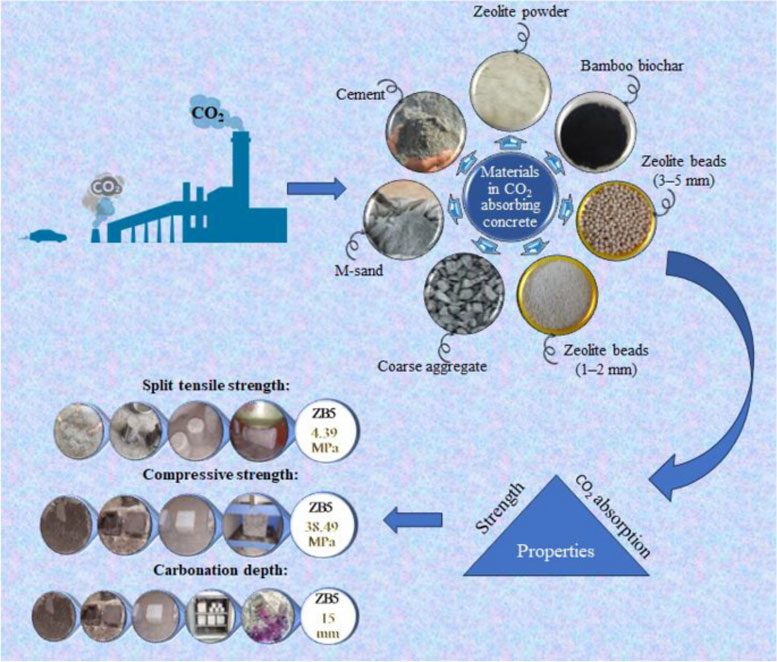
Researchers at Mepco Schlenk Engineering College in India have formulated a concrete mix that absorbs carbon dioxide from the air while proving stronger than standard concrete. The blend replaces part of the fine aggregate with porous zeolite and part of the cement with bamboo biochar — two naturally derived materials that trap CO2 molecules in microscopic pores.

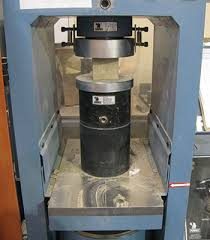
The best formulation, called ZB5, achieved a compressive strength of 38.49 megapascals (5,582 psi), a 7.48% improvement over conventional concrete, and a split tensile strength 15% higher. In controlled carbonation chamber tests, it absorbed about 1.2 grams of CO2 per day, with gas penetration reaching 15 millimeters over a week. The results were published in the journal Carbon Research.

Why it matters

Cement production alone accounts for roughly 8% of global CO2 emissions — if concrete can absorb carbon during its service life, the built environment becomes part of the climate solution rather than merely a source of the problem.

Questions about this story

Free account needed to ask — your question is kept and asked for you right after sign-up. Answers are public.

No questions yet — be the first to ask.

Key Indicators

+7.48%
Compressive strength vs. conventional concrete
ZB5 mix reached 38.49 MPa, exceeding standard M35 grade concrete.
+15%
Split tensile strength improvement
ZB5 reached 4.39 MPa compared to standard mixtures.
1.2 g/day
CO2 absorbed per day in lab testing
Measured in controlled carbonation chamber conditions.
15 mm
Carbonation depth after 7 days
Gas penetration into the material over one week.
50% zeolite / 1% biochar
Optimal ZB5 formulation
Fine aggregate replaced with 50% zeolite; cement with 1% bamboo biochar.

Voices

Curated perspectives — historical figures and your fellow readers.

Ever wondered what historical figures would say about today's headlines?

Sign up to generate historical perspectives on this story.

People Involved

Organizations Involved

Timeline

2 events Latest: Today
  1. Findings reported by ScienceDaily and other outlets

    Today Media Coverage

    Laboratory results reach wider audiences, highlighting the dual structural and environmental potential.

  2. Zeolite-biochar concrete study published

    Research Publication

    Mepco Schlenk Engineering College published results in Carbon Research showing ZB5 mix exceeds conventional concrete strength while absorbing CO2.

Scenarios

1

Laboratory formula scales to commercial production

Possible Resolves by Q3 2028

Discussed by: The research team at Mepco Schlenk Engineering College

Following additional testing on alternative biochar types, different concrete grades, and pre-soaked biochar, the ZB5 formulation is adopted by concrete producers for pavements, highway parapet walls, and sewer pipelines. Commercial adoption depends on confirming performance under real-world weather, moisture, and traffic conditions.

2

Long-term durability concerns limit adoption to niche uses

Possible Resolves by End of 2027

Discussed by: Researchers noting carbonation reduces concrete alkalinity

Carbonation lowers pH in concrete, which can increase corrosion risk for embedded steel reinforcement. This constraint limits the material to non-reinforced or lightly reinforced precast elements, as noted in similar carbonation-curing research. The team acknowledges that questions remain about performance under changing temperatures, moisture, and traffic loads.

3

Carbon capture performance proves too small for meaningful climate impact

Unlikely Resolves by Q1 2028

Discussed by: Researchers noting lab results don't establish real-world decades-long absorption

The 1.2 grams per day measured in a carbonation chamber may not translate to meaningful atmospheric CO2 removal over decades of outdoor use. The team's own estimates suggest only 9–17% of concrete production emissions could be re-adsorbed during use and end of life, based on broader industry research. The finding becomes academic rather than transformative.

Historical Context

2 moments from history that rhyme with this story — and how they unfolded.

1990s-present

Perpetual concrete carbonation research (1990s-present)

Researchers have long known that hydrated cement in concrete naturally reacts with atmospheric CO2 to form carbonate minerals. This natural carbonation process is slow but measurable, and engineering interventions like crushing concrete after demolition accelerate it.

Then

Industry research focused on accelerating carbonation for carbon removal credit schemes.

Now

Current estimates suggest 9–17% of concrete production emissions could be re-absorbed during use and end of life, informing lifecycle emission calculations for the built environment.

Why this matters now

The zeolite-biochar concrete builds on this known carbonation mechanism but embeds the capture capacity directly into the material mix rather than relying on slow natural reactions.

2010s-present

CO2 curing of concrete (2010s-present)

Researchers developed methods to cure concrete in sealed CO2-rich chambers or inject CO2 during batching, mineralizing the gas into the material. Early studies showed CO2 injection can improve early strength and partially replace Portland cement.

Then

CO2-cured concrete gained traction for precast, non-reinforced elements where carbonation depth risks are manageable.

Now

Carbonation curing remains limited by corrosion concerns for reinforced concrete but is used in niche applications like masonry blocks.

Why this matters now

The zeolite-biochar approach works differently — the additives pull CO2 from ambient air rather than requiring active CO2 injection during manufacturing, which could enable passive capture across broader applications.

Sources

(8)