

Pull to refresh
Logo
Daily Brief
Following
Why Ranks Sign Up
Trump administration ends in-country green card path for most applicants

Trump administration ends in-country green card path for most applicants

Rule Changes

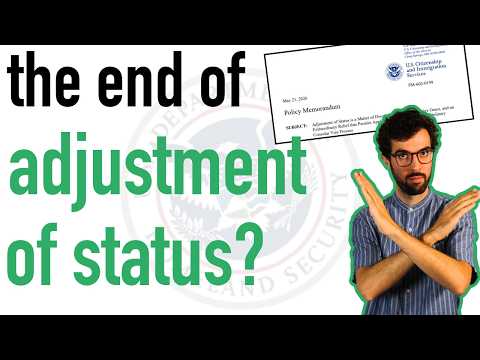
USCIS will require foreign nationals to apply for permanent residence from their home countries, reversing a pathway in place since 1952.

Yesterday: USCIS ends in-country adjustment for most applicants

Overview

Since 1952, foreign nationals living legally in the United States could apply for a green card without leaving. On Friday, U.S. Citizenship and Immigration Services closed that route for most applicants.

The change takes effect immediately and affects roughly 600,000 people per year, including spouses of U.S. citizens and many work and student visa holders. USCIS named H-1B 'dual-intent' workers, refugees, and asylees as exceptions, but did not say how applications already in progress will be handled.

Why it matters

Roughly 600,000 people a year must now leave the U.S. to apply for permanent residence, with no guarantee of timely return.

Key Indicators

600K
Affected per year
USCIS estimate of annual applicants who would now have to process abroad instead of inside the United States.
Since 1952
Adjustment of status created
Year Congress added Section 245 to the Immigration and Nationality Act, creating the in-country adjustment pathway.
3
Named exemptions
H-1B dual-intent workers, refugees, and asylees can still adjust status from inside the country, per USCIS.

Voices

Curated perspectives — historical figures and your fellow readers.

Ever wondered what historical figures would say about today's headlines?

Sign up to generate historical perspectives on this story.

Play

Exploring all sides of a story is often best achieved with Play.

Log in to play. Track your picks, climb the leaderboards. Log in Sign Up
Predict 3 ways this could play out. Contrarian picks score more — points lock when the scenario resolves. Log in to play
Higher or Lower Two numbers from this story. Guess which is bigger. 5 rounds to set a streak. Log in to play
Timeline Five events from this story — drag them oldest to newest. Log in to play
Connections Sixteen names from the news. Find the four hidden groups of four. Log in to play

People Involved

Organizations Involved

Timeline

June 1952 May 2026

5 events Latest: Yesterday
Tap a bar to jump to that date
  1. USCIS ends in-country adjustment for most applicants

    Latest Policy

    USCIS announces that most foreign nationals in the U.S. legally must return home to apply for a green card. Roughly 600,000 people a year are affected.

  2. Trump returns to office

    Political

    Trump is inaugurated for a second term and signs early executive orders tightening both legal and illegal immigration channels.

  3. First Trump 'public charge' rule

    Rulemaking

    USCIS rewrites the public charge test to let officers deny green cards to immigrants likely to use public benefits. Courts later block parts of it.

  4. IIRIRA creates the 3- and 10-year bars

    Legislation

    President Clinton signs a law penalizing anyone who leaves the U.S. after accumulating unlawful presence, blocking reentry for 3 or 10 years.

  5. Congress creates adjustment of status

    Legislation

    The Immigration and Nationality Act adds Section 245, letting foreign nationals already in the U.S. apply for a green card without leaving.

Historical Context

3 moments from history that rhyme with this story — and how they unfolded.

September 1996

IIRIRA 3- and 10-year bars (1996)

President Bill Clinton signed the Illegal Immigration Reform and Immigrant Responsibility Act in September 1996. It created the 3- and 10-year bars: anyone in the U.S. unlawfully for more than 180 days triggers a 3-year reentry ban when they leave, and more than a year triggers a 10-year ban.

Then

The bars discouraged unlawful immigrants from leaving voluntarily to apply for legal status. Family-based applicants sponsored by U.S.-citizen relatives faced impossible choices.

Now

Congress later added narrow waivers, and the Obama administration created a provisional waiver in 2013. The bars still apply when someone leaves with accumulated unlawful presence to apply at a consulate.

Why this matters now

The new USCIS policy forces many applicants out of the country to apply. Anyone with prior unlawful presence who leaves to comply will trigger the 1996 bars and may not be able to return.

August 2019

Trump public charge rule (2019)

The first Trump administration rewrote the 'public charge' rule in August 2019. The change let officers deny green cards to immigrants deemed likely to use Medicaid, food stamps, or housing aid.

Then

Federal courts issued multiple injunctions before the rule briefly took effect in February 2020. Adjustment-of-status filings dropped during the period it was enforced.

Now

The Biden administration rescinded the rule in 2022. Researchers later documented a chilling effect on legal immigrants enrolling children in public benefits.

Why this matters now

The 2019 rule used similar administrative tools to restrict adjustment of status without new legislation. It drew heavy legal resistance and offers a template for what the new policy will face in court.

January 2017

Trump travel ban rollout (2017)

On January 27, 2017, the first Trump administration issued an executive order barring entry from seven Muslim-majority countries. Implementation began within hours, stranding travelers at U.S. airports.

Then

A federal judge in Seattle blocked the order on February 3, 2017. The administration issued two narrower revisions over the following months.

Now

The Supreme Court upheld a third version in June 2018 in Trump v. Hawaii. President Biden rescinded it on his first day in office.

Why this matters now

The new green card policy also takes effect immediately, with little guidance for cases already in motion. The 2017 rollout shows how rapid implementation invites rapid court challenges and prolonged uncertainty for affected applicants.

Sources

(4)