



Pull to refresh
Logo
UCIe 4.0 moves the chiplet standard from wiring to system management

UCIe 4.0 moves the chiplet standard from wiring to system management

New Capabilities

The open interconnect spec adds a standardized memory link, chiplet state reporting and a power-saving profile

Overview

Updated 44 minutes ago

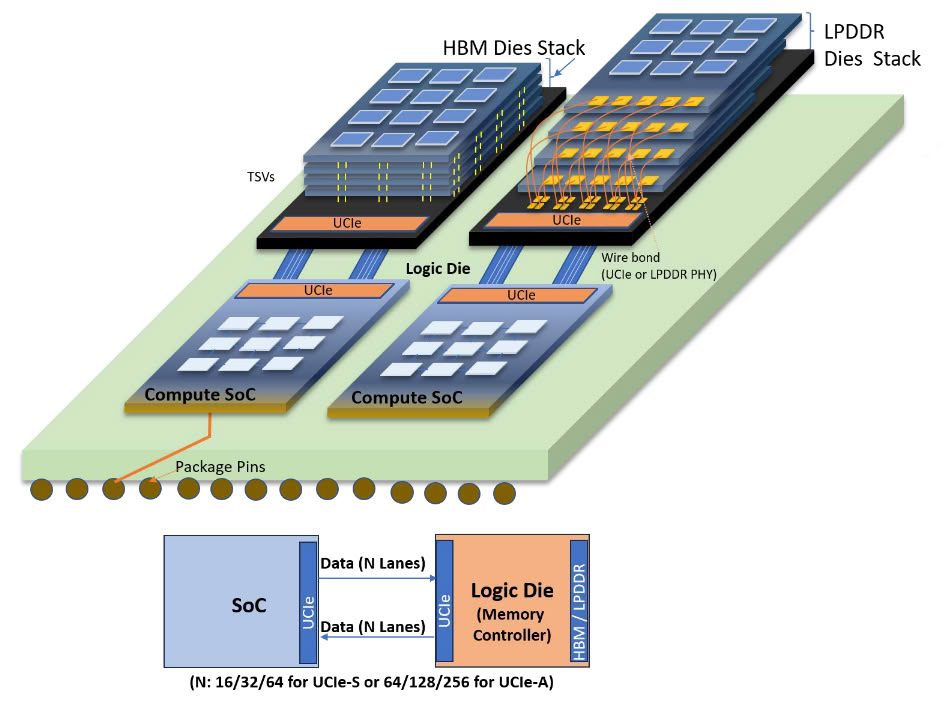
UCIe 4.0, released Nov. 12, 2026, specifies how separate chiplets behave as one system, not just how they connect. The Universal Chiplet Interconnect Express standard adds a memory link called UCIe.mem, a way for dies to report their security state, and an optional power profile the consortium says cuts link energy use by 30% to 80% at 64 gigatransfers per second.

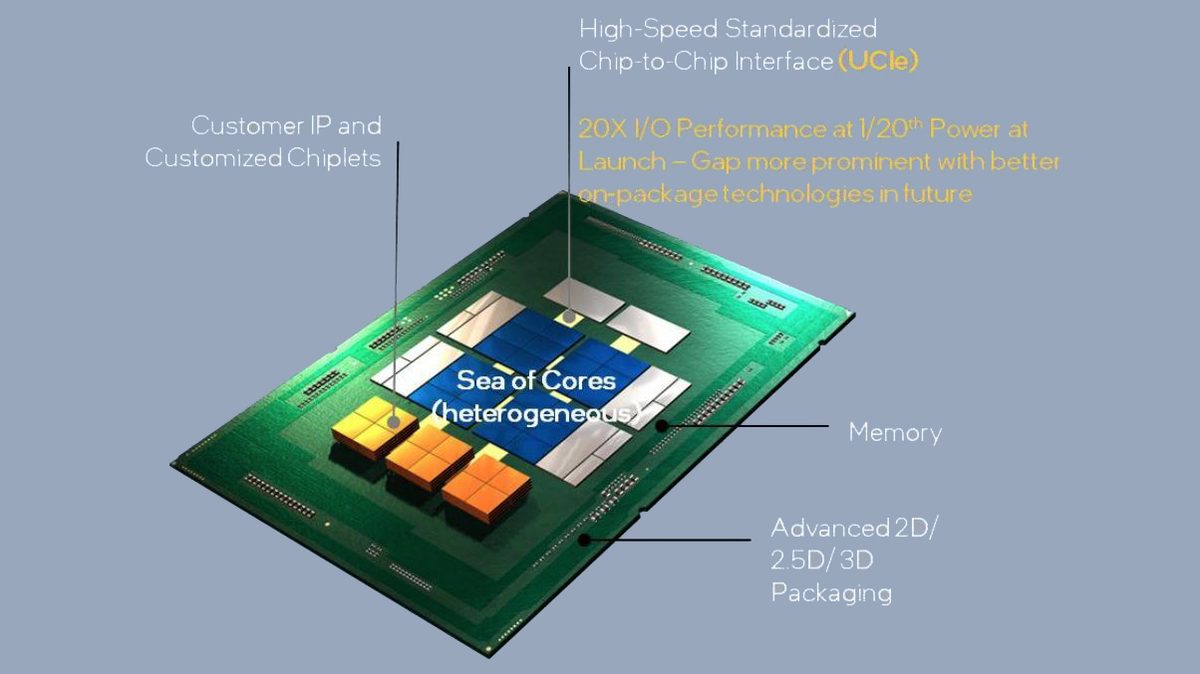
Chiplets are becoming the default way to build high-performance processors. Companies mix compute, memory and accelerator dies from different vendors in one package, but only if they agree on management and memory protocols. UCIe 4.0 is the consortium's attempt to write those rules before proprietary alternatives harden.

Why it matters

If UCIe 4.0 sticks, chipmakers can buy memory chiplets from a second vendor instead of building a memory controller into every processor.

Questions about this story

Free account needed to ask — your question is kept and asked for you right after sign-up. Answers are public.

No questions yet — be the first to ask.

Key Indicators

93.75%
UCIe.mem data efficiency
Share of a memory-link transfer that carries payload rather than headers and acknowledgements.
2.5 TB/s/mm
UCIe.mem die-edge bandwidth density
Bandwidth per millimeter of die edge, a measure of how much memory traffic fits along a chip's side.
80%
Peak link energy-efficiency gain
Upper end of the 30% to 80% range for the optional power-optimized profile at 64 GT/s.
20%
Shoreline bandwidth density gain
Improvement from the enhanced bump map for UCIe-S at 48 and 64 GT/s.
10%
Area bandwidth density gain
Improvement from the same enhanced bump map, measured per unit of package area.
64 GT/s
Top link speed
Gigatransfers per second, carried over from UCIe 3.0; 4.0 improves density and power at that speed.

Voices

Curated perspectives — historical figures and your fellow readers.

Sign up to generate historical perspectives on this story.

People Involved

Organizations Involved

Timeline

August 2025 November 2026

2 events Latest: Yesterday
  1. UCIe 4.0 released with memory and security features

    Latest Standard release

    Adds UCIe.mem, chiplet state reporting, protected management channels and link-health monitoring.

  2. UCIe 3.0 raises link speeds to 64 GT/s

    Standard release

    The consortium adds 48 and 64 gigatransfer-per-second rates and runtime recalibration.

Scenarios

1

Memory chiplets using UCIe.mem reach commercial products

Possible Resolves by End of 2028

Discussed by: UCIe Consortium technical materials and trade coverage

A chipmaker or memory vendor announces a shipping product that puts a memory controller on a separate logic die and links it to a compute die over UCIe.mem. The trigger is a product announcement naming the protocol, not a consortium demo.

2

A major foundry adds UCIe 4.0 to a production design kit

Likely Resolves by End of 2027

Discussed by: Foundry roadmap watchers and packaging analysts

TSMC, Samsung Foundry or Intel lists UCIe 4.0-compatible IP in a process design kit that customers can use for production tape-outs. This is the step that turns a specification into silicon designers can actually order.

3

Automotive chiplet designs adopt UCIe 4.0 link-health monitoring

Uncertain Resolves by Q2 2029

Discussed by: Automotive semiconductor suppliers and functional-safety standards groups

An automaker or Tier 1 supplier announces a production design that uses UCIe 4.0 error notification or link-health monitoring as part of a vehicle safety case. The consortium explicitly aimed these features at automotive reliability requirements.

Historical Context

3 moments from history that rhyme with this story — and how they unfolded.

2003

PCI Express (2003)

Intel and the PCI Special Interest Group published PCI Express, a serial link meant to replace the shared parallel buses inside computers. It was an open specification any vendor could build against.

Then

Motherboard and chipset makers adopted it over several years as graphics and storage moved onto the new link.

Now

PCIe became the default internal expansion bus, and the same pattern of an open link displacing proprietary wiring is what UCIe is attempting between dies.

Why this matters now

UCIe borrows PCIe's physical-layer approach and its consortium model, betting that an open die-to-die link wins the way an open board-level link did.

1996

USB (1996)

A group of computer and telecom companies released the Universal Serial Bus to replace a tangle of proprietary ports with one connector and one protocol.

Then

Adoption was slow until peripherals and operating-system support arrived.

Now

USB became the standard external connection for consumer electronics, and the consortium kept revising it without breaking older devices.

Why this matters now

UCIe 4.0 stresses backward compatibility with every earlier version, the same promise that let USB revisions spread without stranding existing hardware.

2011

Open Compute Project (2011)

Facebook published designs for its data-center servers and asked others to contribute, creating an open hardware specification group for equipment that had been proprietary.

Then

Hyperscale operators joined and contributed designs; traditional server vendors were slower to adopt.

Now

Open hardware specifications became a normal way for large buyers to shape the equipment they purchase.

Why this matters now

UCIe is a similar bet that shared specifications can move a market faster than any one company's proprietary design, this time at the level of the chip package.

Sources

(6)