Anchor

UK sanctions Israeli West Bank settlements; Israel closes UK consulate
Rule ChangesBritain joins France and Canada in banning settlement goods, accusing settlers of 'ethnic cleansing'
Yesterday: UK announces settlement sanctionsNew here? Follow stories to track developments over time. Create a free account to get updates when stories you care about change.
Overview
Updated 1 hour agoBritain announced Tuesday it will ban imports from Israeli settlements in the occupied West Bank and begin a comprehensive sanctions regime against settlement activity over the next six to nine months. Foreign Secretary Ed Miliband told Parliament that settler groups are conducting ethnic cleansing of Palestinians with the tacit backing of Israel's government.
The ban covers settlement goods, property advertising, and gives the government power to designate individuals and companies supporting settlement expansion. Britain now formally accepts the International Court of Justice's finding that Israel's occupation is unlawful. Israel responded by closing the UK's East Jerusalem consulate and banning 11 British MPs from entering the country.
Why it matters
Britain's ban turns settlement expansion into an economic cost, forcing other Western allies to pick a side as the two-state solution narrows.
Questions about this story
Free account needed to ask — your question is kept and asked for you right after sign-up. Answers are public.
No questions yet — be the first to ask.
Key Indicators
38
Individuals sanctioned by UK for settler activity
Includes five new designations announced with this package targeting those who supported or incited violence against Palestinian communities.
11
UK MPs banned from entering Israel
Israel barred Jeremy Corbyn, Diane Abbott, and all five sitting Green Party MPs, accusing them of antisemitic and anti-Israel activity.
104
New Israeli settlements approved in past year
The Israeli government also permitted tenders for the E1 mega-settlement, which would cut through the heart of the West Bank.
0.6%
Settlement goods as share of UK-Israel trade
Settlement exports to the UK were about $51 million of $8.1 billion in total UK-Israel trade in 2025.
$51M
Settlement goods imported to UK in 2025
The value of the trade now banned under the new sanctions, per UK parliament records.
Related Media
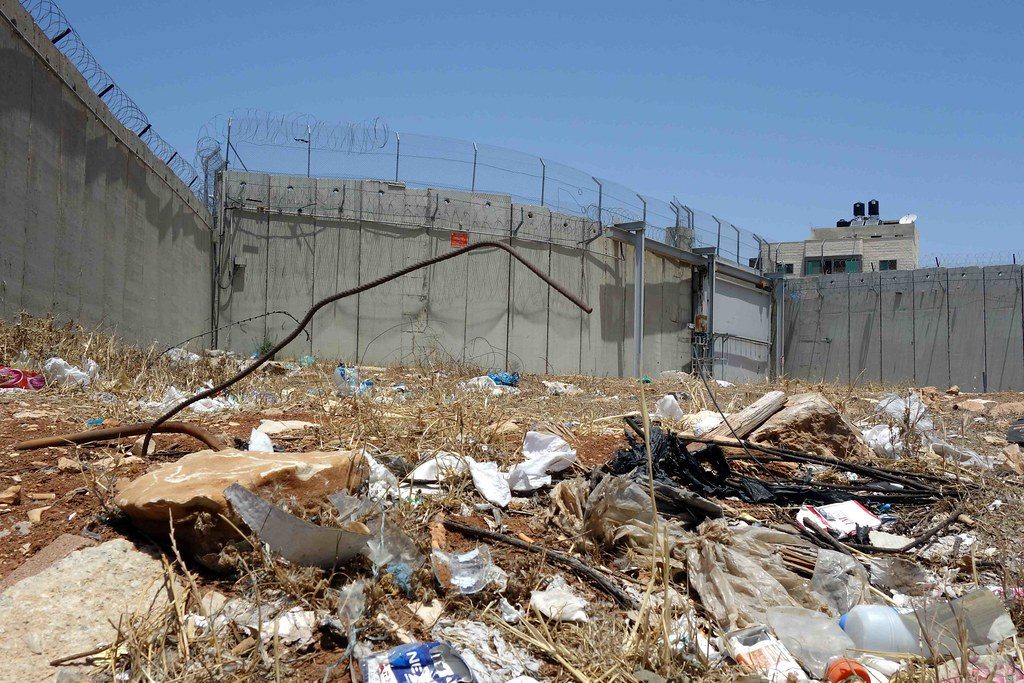
Concrete Walls surrounding West Bank settlements

External Affairs Minister Dr. S. Jaishankar met H.E. Mr. Gideon Sa'ar, Minister of Foreign Affairs of the state of Israel on the sidelines of the 61st Munich Security Conference (MSC,2025) in Germany
6.3K views
2:47
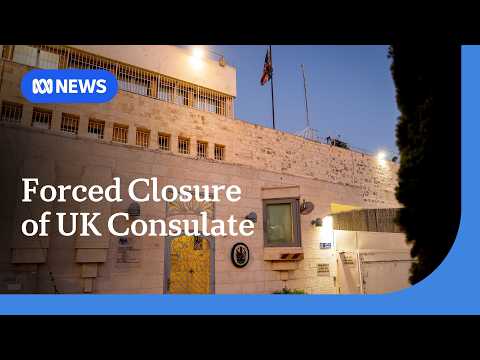
Israel forces UK consulate to close after sanctions against settlers
ABC News (Australia)
27.1K views
2:18
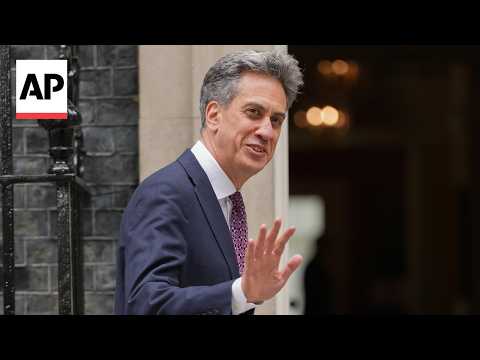
UK bans goods from Israeli settlements in the West Bank
Associated Press
17.2K views
2:15
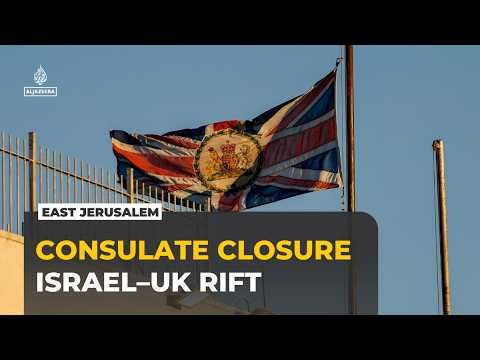
Israel announces British Consulate closure in occupied East ...
Al Jazeera English
Images from Openverse under Creative Commons licenses. Videos from YouTube.
Voices
Curated perspectives — historical figures and your fellow readers.
Play
Exploring all sides of a story is often best achieved with Play.
Most of these play right now — no account needed. Sign up to save scores, keep a streak, and unlock Debate and Predict.
Log in
Sign Up
Higher or Lower
A number from this story, against one from elsewhere in the news — guess which is bigger, then keep the chain going. 5 rounds, 3 strikes; a miss costs a strike and resets your streak.
Example
Anchor
EU tariff revenue
$52B
Big for this kind of number
Mystery
Pentagon AI contract
?
Round 1
Streak: 0
Mystery
?
Keyboard: ↓/L lower · ↑/H higher
0 pts
Best streak: 0 · Rounds: 0
0 points — sign up to put that on the leaderboard.
Now try on this story
Timeline
UK sanctions Israeli West Bank settlements; Israel closes UK consulate
Order five events from this story, oldest at top. Each in the right slot scores 1 — neighbours within one slot count too. Your previous result — green ✓ for exact slots, yellow ~ for off by one. Cards now in true chronological order.
Loading puzzle…
Tap 💡 Free hint to lock the oldest into slot 1 — that leaves just four to order. Type pills are clues.
0/5
Exact slot
0/5
Within 1
Sign up to save your score and track a streak across stories.
Now try on this story
Connections
Sixteen names from the news. Find the four hidden groups of four. Four mistakes max.
Loading today's puzzle…
0/4 groups
Mistakes
Sign up to keep a daily streak — a new puzzle lands every day.
Now try on this story
Exit debate?
Your progress in this debate will be lost.
How it works
- 1 Two AI personas square off on this story.
- 2 You predict who'll win each round — correct picks earn XP.
- 3 One crossfire question is yours to fire. Pick it carefully.
Couldn't generate a topic
Select Your Champions
Choose one persona for each side of the debate
DEBATE TOPIC
Choose personas with different perspectives for a more dynamic debate.
SIDE A (PRO)
Select debater for this side:
No debate personas available right now.
SIDE B (CON)
Select debater for this side:
No debate personas available right now.
VS
Get ready to make your prediction...
Round of
Claim
Evidence
Stakes
Crossfire Answer
Closing Statement
Claim
Evidence
Stakes
Crossfire Answer
Closing Statement
Your Crossfire Question
Generating arguments...
Who's Got This Round?
Make your prediction before the referee scores
The referee scores both sides on
Correct predictions earn +20 XP
· Press 1 or 2 to pick
Evidence
40%
Logic
30%
Detail
20%
Style
10%
Round Results
Your Pick
Not this time
(%)
Overall Score
/10
Your Pick
Not this time
(%)
Overall Score
/10
Set the Crossfire
Pick the question both personas must answer in the final round
Crafting crossfire questions...
Choosing a question earns +10 XP crossfire bonus
🏆
Total XP Earned
Cred Change
Predictions
Debate Oracle! You called every round!
Sharp Instincts! You know your debaters!
The Coin Flip Strategist! Perfectly balanced!
The Contrarian! Bold predictions!
Inverse Genius! Try betting the opposite next time!
XP Breakdown
Base completion
+20 XP
Rounds played ( rounds x 5 XP)
+ XP
Correct predictions ( correct x 20 XP)
+ XP
Crossfire bonus
+10 XP
Accuracy
%
Prediction History
Round
You picked:
✓
✗
Now try on this story
Keep debating to level up your credibility and unlock achievements
People Involved
Ed Miliband
UK Foreign Secretary
Announced settlement sanctions and import ban
Gideon Sa'ar
Israeli Foreign Minister
Ordered UK consulate closed, banned 11 UK MPs
Andy Burnham
UK Prime Minister
Backed the sanctions approach as UK leader
Jeremy Corbyn
UK MP banned from entering Israel
Banned from Israel along with 10 other MPs
Organizations Involved
Foreign, Commonwealth & Development Office (FCDO)
Government ministry
Announced sanctions and settlement import ban
Britain's foreign ministry, which ordered the sanctions package and concluded Israel's occupation is unlawful.
International Court of Justice
UN judicial body
Issued 2024 advisory opinion finding occupation unlawful
The UN's highest court, whose 2024 advisory opinion on Israel's occupation now underpins UK policy.
Israeli Ministry of Foreign Affairs
Government ministry
Ordered UK consulate closure, imposed MP bans
Israel's foreign ministry, which retaliated against the UK sanctions within hours.
Timeline
July 2024 September 2026
5 events
Latest: Yesterday
Tap a bar to jump to that date
-
UK announces settlement sanctions
Latest SanctionsForeign Secretary Ed Miliband told Parliament the UK will ban settlement imports, target settlement supporters, and formally accept the ICJ finding that Israeli occupation is unlawful.
-
France and Canada announce matching bans
SanctionsFrance and Canada separately announced import bans on Israeli settlement goods, coordinating with the UK in a joint Western push to defend the two-state solution.
-
Israel closes UK consulate, bans 11 MPs
DiplomaticForeign Minister Gideon Saar ordered the UK consulate in East Jerusalem closed and banned 11 British MPs from entering Israel, including Jeremy Corbyn and Diane Abbott.
-
US envoy warns of consequences
DiplomaticThe US ambassador to Israel criticised the trade ban and warned that any UK settlement goods ban risks consequences from Washington.
-
ICJ rules Israel's occupation unlawful
LegalThe International Court of Justice issued an advisory opinion finding Israel's presence in occupied Palestinian territories unlawful and settlement expansion a violation of international law.
Historical Context
3 moments from history that rhyme with this story — and how they unfolded.
1985-1990
Apartheid sanctions on South Africa (1980s)
Britain and other Commonwealth members imposed economic sanctions on South Africa in 1985-1986, initially resisted by Prime Minister Margaret Thatcher. Sanctions included trade embargoes and investment freezes that compounded pressure on the apartheid regime.
Then
Sanctions accelerated the end of white minority rule; Nelson Mandela was released from prison in 1990 and free elections followed in 1994.
Now
Established a precedent for Western economic pressure against a state deemed in violation of international norms.
Why this matters now
Shows the UK's prior leadership role in sanctioning a government seen as violating international law, and how economic pressure can reshape a regime's calculations over time.
November 2015
EU settlement goods labeling ruling (2015)
The European Court of Justice ruled that products from Israeli settlements must be labeled with their settlement origin, drawing a legal line between Israel proper and the occupied territories.
Then
The EU began labeling settlement products, which Israel's government criticised as discriminatory but did not overturn.
Now
Opened the door to stronger trade measures, including the import bans now imposed by the UK, France and Canada.
Why this matters now
The UK's ban is the logical escalation beyond labeling, replacing a transparency requirement with an outright prohibition.
May 2018
US Jerusalem embassy move (2018)
The United States moved its embassy from Tel Aviv to Jerusalem under President Donald Trump, recognizing Jerusalem as Israel's capital. Most of the international community rejected the move.
Then
Strengthened US-Israel ties while widening the gap between US and European approaches to the conflict.
Now
Established a pattern where Washington backs Israeli positions while European governments impose sanctions or recognitions the US opposes.
Why this matters now
Illustrates the current West split over Israel-Palestine policy, with the US warning of consequences while Europe tightens economic pressure.
Sources
(10)Related Stories
Israel greenlights 19 more West Bank settlements — a map-drawing move with no peace process left to hide behind
Rule Changes
Updated May 15
France bans Israeli minister Ben-Gvir, pushes EU to follow
Rule Changes
Updated May 24
Britain targets Syria’s post-Assad killers with sanctions—while the West quietly reopens for business
Rule Changes
Updated May 15
European diplomatic ties with Israel fray as Spain leads permanent downgrades
Rule Changes
Updated May 30
Israel denies more U.S. travelers entry over Palestinian ties and views
Rule Changes
Updated 5 days ago
UK courts test boundaries of terrorism law against protest groups
Rule Changes
Updated May 29