

Pull to refresh
Logo
Daily Brief
Following
Why
America's race to mass-produce combat drones

America's race to mass-produce combat drones

New Capabilities
By Newzino Staff |

The Pentagon scrambles to build hundreds of thousands of one-way attack drones after Ukraine exposed a critical capability gap

February 3rd, 2026: Pentagon Selects 25 Vendors for Gauntlet Competition

Overview

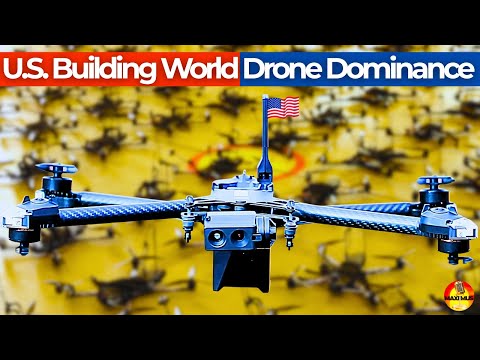
The Pentagon spent $398 million on small drones in 2022. Four years later, as Ukraine demonstrated that $400 drones could destroy $10 million tanks, Congress authorized $1.7 billion—a fourfold increase. Now the Department of Defense has launched its most ambitious small-drone initiative ever: a $1.1 billion program to field more than 300,000 one-way attack drones by 2028, with the first 30,000 expected by mid-2026.

This week, the Pentagon selected 25 companies—including two Ukrainian firms—to compete in what officials call 'the Gauntlet,' beginning February 18 at Fort Benning, Georgia. The winners will receive $150 million in prototype orders, with the goal of driving unit costs from $5,000 down to $2,300 per drone. It marks a fundamental shift: the Pentagon will now treat small drones as consumable munitions, like hand grenades, rather than precious surveillance assets—a doctrine that Ukraine wrote in blood and the United States is racing to adopt.

Key Indicators

25
Vendors Selected
Companies chosen to compete in Phase I of the Drone Dominance Program
$1.1B
Total Program Funding
Allocated across four production phases through 2028
300,000+
Drones Targeted
One-way attack drones to be procured by early 2028
$5,000→$2,300
Unit Cost Goal
Target price reduction from Phase I to Phase IV

Interactive

Exploring all sides of a story is often best achieved with Play.

Albert Einstein

Albert Einstein

(1879-1955) · Modernist · science

Fictional AI pastiche — not real quote.

"Ah, so we have learned to make war more *efficient*—how marvelous that human ingenuity, which could feed millions or heal the sick, instead perfects the art of destruction at wholesale prices. I suspect these flying hand grenades will not discriminate between a tank and a wedding party, but perhaps I am too old-fashioned to appreciate such economies of scale."

Cecil Rhodes

Cecil Rhodes

(1853-1902) · Victorian Era · industry

Fictional AI pastiche — not real quote.

"Ah, what exquisite economy! The Americans have finally grasped what I knew of the Maxim gun—that superiority lies not in the cost of the instrument, but in possessing ten thousand where your enemy has ten. Though I confess, in my day we at least had the decency to recover our weapons from the battlefield for the next campaign; this notion of disposable conquest strikes me as rather wasteful, even for a republic."

Ever wondered what historical figures would say about today's headlines?

Sign up to generate historical perspectives on this story.

Sign Up

Debate Arena

Two rounds, two personas, one winner. You set the crossfire.

People Involved

Pete Hegseth
Pete Hegseth
Secretary of Defense (Leading Pentagon drone transformation)
Emil Michael
Emil Michael
Under Secretary of War for Research and Engineering (Leading technical implementation of drone programs)
Kathleen Hicks
Kathleen Hicks
Former Deputy Secretary of Defense (No longer in government; Replicator architect)

Organizations Involved

U.S. Department of Defense
Federal Agency
Status: Program administrator

The Pentagon is now treating small drones as a top acquisition priority after years of lagging behind adversaries in mass drone production.

Defense Innovation Unit
Pentagon Technology Office
Status: Managing Blue UAS certification

The Defense Innovation Unit certifies commercial drones for military use through its Blue UAS program, which ensures systems are free of Chinese components.

Anduril Industries
Anduril Industries
Defense Technology Company
Status: Major drone contractor; Gauntlet competitor

The Oculus founder's defense startup has become a leading provider of drones and counter-drone systems, winning over $1 billion in Pentagon contracts since 2024.

Red Cat Holdings
Red Cat Holdings
Defense Technology Company
Status: Army Short Range Reconnaissance contractor; Gauntlet competitor

Red Cat's Teal Drones subsidiary won the Army's Short Range Reconnaissance contract in 2024, displacing Skydio with its Black Widow quadcopter.

UK
Ukrainian Defense Drones Tech Corp
Defense Technology Company
Status: Gauntlet competitor

One of two Ukrainian firms selected for the Pentagon's Drone Dominance Program, bringing battlefield-tested drone technology to American procurement.

Timeline

  1. Pentagon Selects 25 Vendors for Gauntlet Competition

    Contract

    The Pentagon announced 25 companies—including Anduril, Red Cat, and two Ukrainian firms—selected for Phase I of the Drone Dominance Program, with evaluations beginning February 18 at Fort Benning.

  2. Drone Dominance Program Formally Launched

    Program

    The Pentagon issued a request for information seeking manufacturers to produce 300,000 drones, marking the formal start of the $1.1 billion Drone Dominance Program.

  3. Replicator 2 Absorbed Into New Task Force

    Reorganization

    Hegseth consolidated the Biden-era Replicator 2 counter-drone program into the newly created Joint Interagency Task Force 401.

  4. Hegseth Issues Drone Dominance Directive

    Policy

    Defense Secretary Hegseth signed the 'Unleashing U.S. Military Drone Dominance' memo, reclassifying small drones as consumable munitions and ordering every Army squad equipped with drones by end of 2026.

  5. Trump Signs Drone Executive Order

    Policy

    President Trump signed an executive order directing improvements to military and commercial drone capabilities, focusing on inexpensive American-made systems.

  6. Red Cat Wins Army Reconnaissance Contract

    Contract

    Red Cat Holdings' Teal Drones subsidiary won the Army's Short Range Reconnaissance program, displacing Skydio with its Black Widow quadcopter.

  7. Anduril Wins $250 Million Interceptor Contract

    Contract

    The Pentagon awarded Anduril a major contract for Roadrunner-M drone interceptors and Pulsar electronic warfare systems.

  8. Replicator Initiative Announced

    Program

    Deputy Secretary Kathleen Hicks launched Replicator with $1 billion to field thousands of autonomous systems by August 2025, aiming to counter China's numerical advantage.

  9. Russia Invades Ukraine

    Conflict

    Russia's full-scale invasion of Ukraine began demonstrating the transformative role of low-cost drones in modern warfare.

  10. Blue UAS Program Launches

    Program

    The Defense Innovation Unit established the Blue UAS program to certify American-made drones free of Chinese components for military use.

  11. Army Bans DJI Drones Over Security Concerns

    Policy

    The U.S. Army ordered personnel to cease using Chinese-made DJI drones due to cybersecurity vulnerabilities, marking the first major military action against foreign drone technology.

Scenarios

1

Pentagon Achieves Drone Dominance Goals by 2027

Discussed by: Defense Department officials, defense industry analysts at Breaking Defense and Defense News

The Gauntlet competition successfully identifies reliable vendors who scale production to meet targets. By late 2027, more than 200,000 one-way attack drones are fielded to combat units, with unit costs driven below $2,500. The U.S. narrows the production gap with China and demonstrates credible mass-drone capability in Indo-Pacific exercises.

2

Program Delivers Drones But Misses Scale Targets

Discussed by: Congressional Research Service, defense procurement analysts at Responsible Statecraft

The program delivers tens of thousands of drones—a meaningful improvement—but falls short of the 300,000 target due to supply chain constraints, manufacturing bottlenecks, or vendor consolidation issues. This mirrors the Replicator experience, where 'hundreds' materialized instead of 'thousands.' The capability gap with China persists but narrows.

3

Industrial Base Struggles to Scale Production

Discussed by: CSIS analysts, industry executives concerned about Chinese component dependencies

American drone manufacturers struggle to source motors and components domestically, as China controls much of the global supply chain for drone-critical parts. High production costs—nearly three times Chinese levels—prevent achieving the target unit prices. The program succeeds technically but fails economically, leading to reduced procurement quantities.

4

Technology Rapidly Outpaces Procurement

Discussed by: Modern War Institute analysts, Ukrainian military technology observers

By the time the Pentagon fields its drones at scale, battlefield conditions have shifted. Fiber-optic drones immune to jamming, AI-enabled swarms, and improved counter-drone systems have changed the calculus. The procured systems, designed to 2025-2026 specifications, require immediate modernization. The Pentagon learns that drone warfare demands continuous iteration, not batch procurement.

Historical Context

DARPA Grand Challenge (2004-2005)

March 2004 - October 2005

What Happened

The Defense Advanced Research Projects Agency offered a $1 million prize for the first autonomous vehicle to complete a 150-mile desert course. In March 2004, the best performer traveled just 7.32 miles before failing. Eighteen months later, five vehicles completed a 132-mile course, with Stanford's 'Stanley' winning the $2 million prize.

Outcome

Short Term

The competition demonstrated that prize-based challenges could rapidly accelerate autonomous vehicle development, attracting university teams and commercial innovators who had never worked with the Pentagon.

Long Term

The challenge spawned the self-driving car industry—Stanley's team leader Sebastian Thrun later led Google's autonomous vehicle project, which became Waymo. Global investment in autonomous vehicles has exceeded $200 billion since 2004.

Why It's Relevant Today

The Drone Dominance Program's Gauntlet competition uses a similar approach: attracting non-traditional vendors through competition rather than traditional procurement. Just as DARPA accepted that most 2004 entries would fail to prove the concept could work, the Pentagon expects the Gauntlet to winnow 25 vendors down to 12 high-volume producers.

Army Future Combat System Cancellation (2009)

2003-2009

What Happened

The Army's $160 billion Future Combat System—the largest modernization program in service history—promised networked ground robots, unmanned aerial vehicles, and digitally connected manned vehicles. After six years and $18 billion spent, Defense Secretary Robert Gates cancelled the program, citing cost overruns, technical problems, and changing battlefield requirements.

Outcome

Short Term

The cancellation shocked the defense industry and led to congressional investigations into acquisition reform.

Long Term

The failure reinforced skepticism of large, integrated 'system of systems' programs. The Pentagon shifted toward smaller, incremental programs—though critics argue it then overcorrected by avoiding ambitious technology integration.

Why It's Relevant Today

The Drone Dominance Program explicitly rejects the Future Combat System approach. Instead of a decade-long development program seeking perfect integration, it emphasizes buying existing commercial technology 'fast, at scale, and without bureaucratic delay.' The program's four-phase gauntlet structure allows rapid course correction.

U.S. Predator Drone Introduction (1995-2001)

1995-2001

What Happened

The CIA deployed the RQ-1 Predator drone for reconnaissance in the Balkans in 1995. After the September 11 attacks, the Air Force armed Predators with Hellfire missiles. In October 2001, a Predator killed Mohammed Atef, al-Qaeda's military chief—the first drone strike in history.

Outcome

Short Term

The armed Predator revolutionized counterterrorism, enabling strikes in denied areas without risking pilots.

Long Term

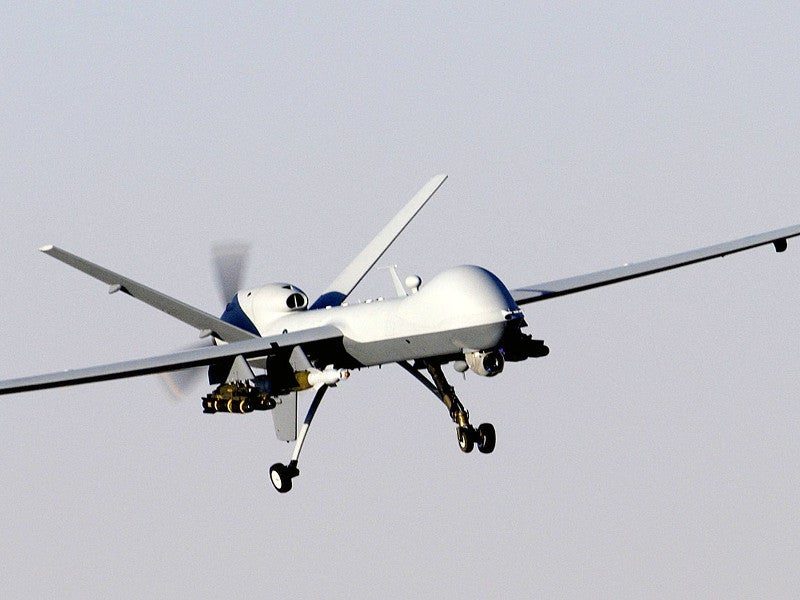
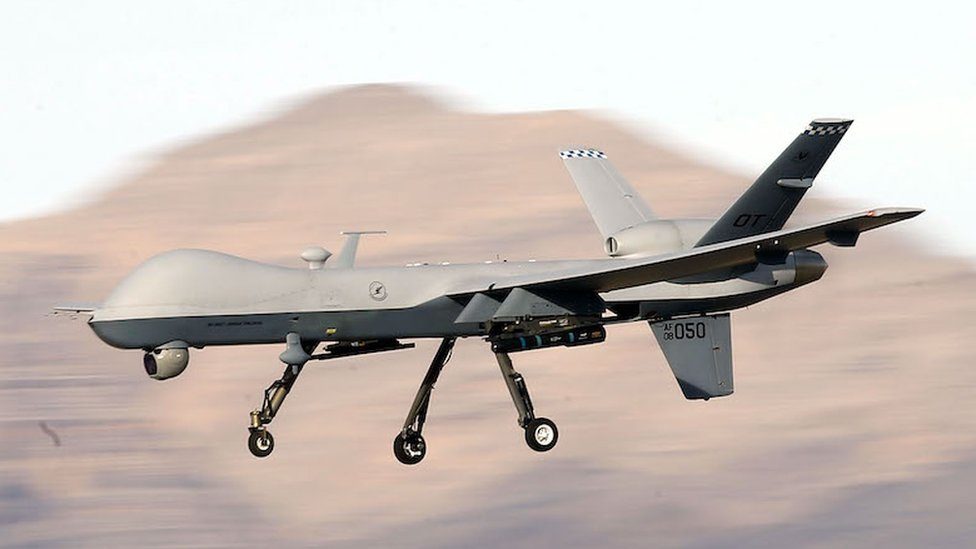
Predator spawned the Reaper, Global Hawk, and a generation of high-end military drones. But the emphasis on precision, persistence, and cost per platform—Reapers cost $32 million each—created a procurement culture that struggled to adapt when Ukraine proved cheap drones could be decisive.

Why It's Relevant Today

The Predator's success created assumptions about drone warfare that Ukraine overturned. The Pentagon optimized for expensive, reusable systems operated by specialists. Ukraine showed that wars could be shaped by $400 first-person-view drones operated by infantry. The Drone Dominance Program represents a doctrinal reversal: from few and precious to many and expendable.

12 Sources: