

Pull to refresh
Logo
Astronomers find the first genuinely green star

Astronomers find the first genuinely green star

New Capabilities

Survey of nearby white dwarfs shows one in thirty glow in unusual colors

Yesterday: Study reveals white dwarfs come in varied colors, including the first green star

Overview

Updated 1 hour ago

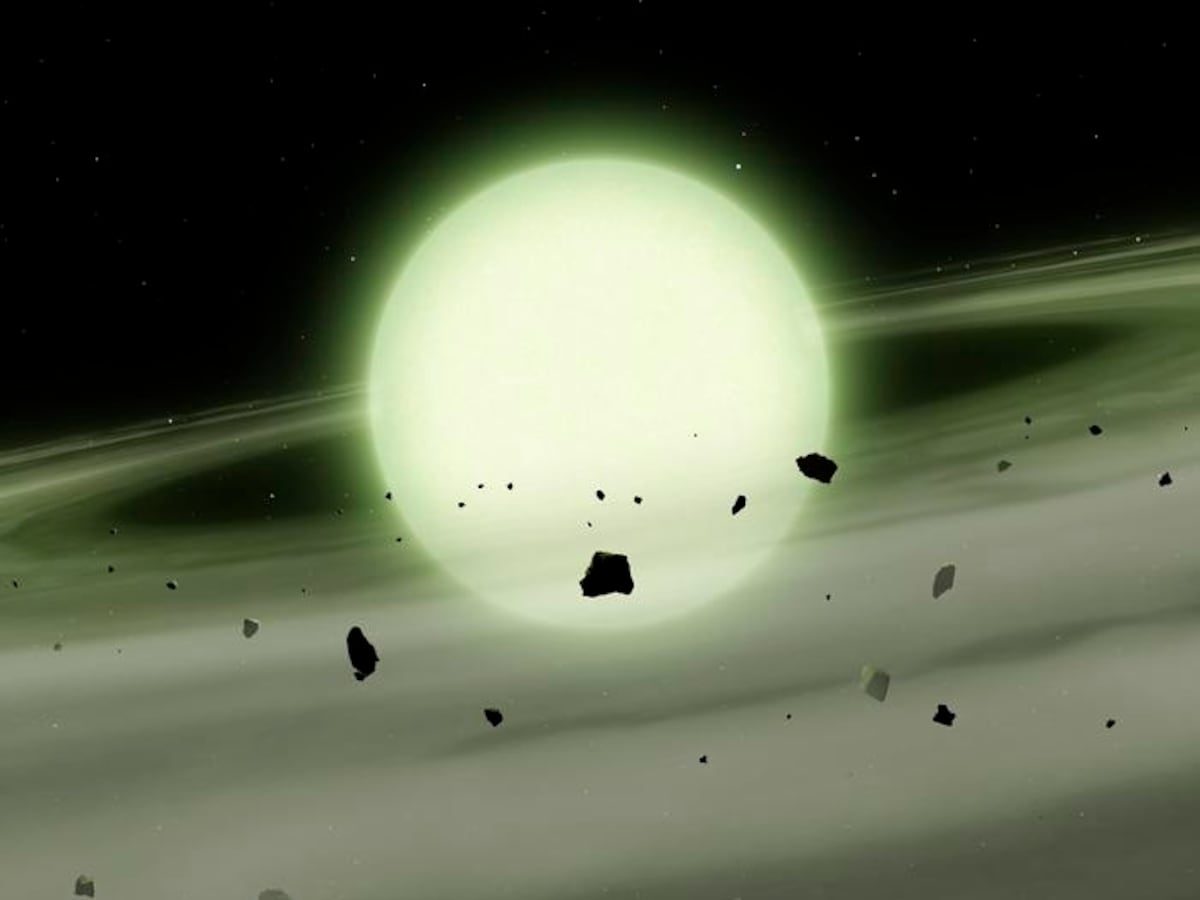
Astronomers at the University of Warwick have identified the first star ever credibly reported as green: WD J1330+6435, a white dwarf their models place at about 4,000°C that would glow chartreuse to the human eye.

The study, published in RAS Techniques and Instruments, also overturns the idea that white dwarfs are white or blue. Trace elements in their ultra-dense atmospheres shift the colors: carbon makes some pink or purple, planetary debris makes others yellow, and sodium leaves this one green. About one in thirty white dwarfs shines in an unusual color, while the median across the local population comes out white.

Why it matters

White dwarfs record what they swallowed from dead planetary systems, and their colors offer a new way to read that wreckage.

Questions about this story

Free account needed to ask — your question is kept and asked for you right after sign-up. Answers are public.

No questions yet — be the first to ask.

Key Indicators

1 in 30
White dwarfs with unusual colors
Five of 151 nearby white dwarfs showed yellow or pink coloring.
151
White dwarfs in local sample
All white dwarfs within about 65 light-years of Earth.
4,000°C
Temperature of green star WD J1330+6435
The chartreuse star sits at the cool end of white dwarf temperatures.
48 light-years
Distance to reddest star WD J1011+2845
The carbon-rich white dwarf with the reddest color ever recorded.
6,800 K
Median color temperature of white dwarfs
Roughly the color of a perfect radiator, which the eye reads as white.

Voices

Curated perspectives — historical figures and your fellow readers.

Ever wondered what historical figures would say about today's headlines?

Sign up to generate historical perspectives on this story.

People Involved

Organizations Involved

Timeline

1 event Latest: Yesterday
  1. Study reveals white dwarfs come in varied colors, including the first green star

    Latest Publication

    The RAS Techniques and Instruments paper computed colors for 151 nearby white dwarfs, found the first genuinely green star (WD J1330+6435), and showed 1 in 30 white dwarfs is unusually colored.

Scenarios

1

More colored white dwarfs surface as surveys widen

Likely Resolves by Oct 15, 2028

Discussed by: The Warwick team, whose 1-in-30 fraction implies many colored white dwarfs exist

Brighter, bluer white dwarfs dominated past brightness-limited surveys, masking the colored ones. Larger spectroscopic surveys should now turn up additional pink, yellow, cyan, and green dwarfs, confirming the team's ratio across a bigger sample.

2

Independent teams test whether the green star is really green

Possible Resolves by Oct 15, 2027

Discussed by: White dwarf researchers reviewing atmosphere models

The green color comes from modeling spectra through human color vision, not from direct imaging. Other groups may re-derive the atmosphere of WD J1330+6435 or dispute the result, testing how robust the classification is.

3

White dwarf colors become a scout for dead planetary systems

Possible Resolves by Jun 15, 2028

Discussed by: Planetary science astronomers

Yellow-tinted dwarfs trace debris from shattered asteroids and comets, the remains of old planetary systems. If the pattern holds, color surveys could flag new white dwarfs with planetary debris before direct spectral analysis confirms it.

Historical Context

3 moments from history that rhyme with this story — and how they unfolded.

1915

Sirius B: the first white dwarf understood (1910s)

In 1915, Walter Adams photographed the spectrum of Sirius B and found a hot star far too faint for its temperature. Astronomers realized a white dwarf packs roughly a solar mass into an Earth-sized volume.

Then

Established the white dwarf class and forced a reckoning with extreme stellar density.

Now

Led to the physics of degenerate matter and a fuller theory of stellar endpoints.

Why this matters now

White dwarfs have a pattern of overturning assumptions about stars. The color study is the latest instance.

1890s–1920s

Annie Jump Cannon's spectral classification (1890s–1920s)

Annie Jump Cannon sorted hundreds of thousands of stars by spectral lines into the OBAFGKM sequence, turning starlight into a classification system.

Then

Gave astronomers a common language for stellar spectra.

Now

Became the backbone of stellar evolution studies.

Why this matters now

The Warwick study extends the principle that a spectrum encodes more than temperature, now including color and atmospheric composition.

1987

G29-38 and the first white dwarf debris disk (1987)

Zuckerman and Becklin found infrared excess around the white dwarf G29-38, evidence of a disk of shredded asteroid material.

Then

Showed white dwarfs can preserve the wreckage of old planetary systems.

Now

Opened the field of white dwarf planetary archaeology.

Why this matters now

The green star WD J1330+6435 got its color by accreting rocky debris, the same process seen at G29-38.

Sources

(5)