


Pull to refresh
Logo
JWST survey of 72 young stars shows how planet-forming disks lose their gas

JWST survey of 72 young stars shows how planet-forming disks lose their gas

New Capabilities

Magnetic winds give way to radiation-driven photoevaporation as disks age, setting a deadline for gas giant formation

Today: Survey findings reported, framing planet formation as a race against time

Overview

Updated 50 minutes ago

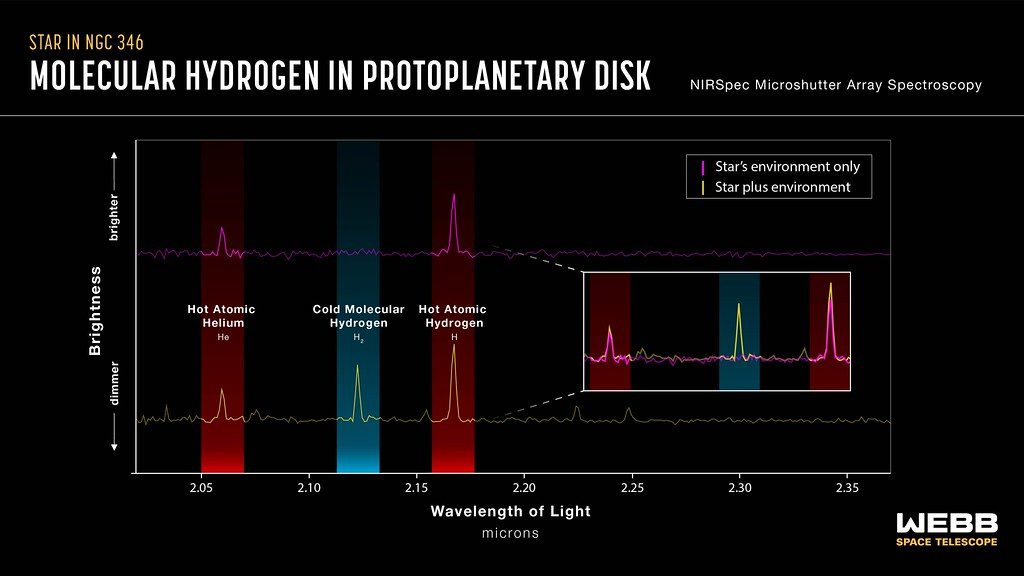
The James Webb Space Telescope surveyed 72 young sun-like stars and found their planet-forming disks lose gas through two distinct wind mechanisms in sequence. Magnetic fields drive strong jets and molecular winds in the youngest systems, then high-energy starlight heats the thinning gas until it escapes in a process called photoevaporation.

That radiation-driven phase empties the disk before gas giants finish growing. Planets like Jupiter need enormous hydrogen atmospheres drawn from the disk, so the survey sets a hard deadline on when they can form. The study appeared in the Astronomical Journal in August 2026.

Why it matters

The survey shows radiation-driven winds empty planet-forming disks, so gas giants must gather hydrogen before the gas runs out.

Questions about this story

Free account needed to ask — your question is kept and asked for you right after sign-up. Answers are public.

No questions yet — be the first to ask.

Key Indicators

72
Young sun-like stars surveyed
One of the largest planet-formation studies conducted with JWST to date.
66
Disks with extended gas emissions
Disks showing extended molecular hydrogen or ionized neon outflows.
46
Systems with conical molecular hydrogen winds
Broad, slow winds likely driven by magnetic fields in the youngest systems.
40
Systems with fast neon jets
Collimated, high-velocity jets; every system with a neon jet also showed a slower wind.

Voices

Curated perspectives — historical figures and your fellow readers.

Ever wondered what historical figures would say about today's headlines?

Sign up to generate historical perspectives on this story.

People Involved

Organizations Involved

Timeline

August 2026 September 2026

2 events Latest: Today
  1. Survey findings reported, framing planet formation as a race against time

    Today Report

    ScienceDaily and other outlets present the survey results, describing how gas giants must form before winds empty their disks.

  2. JWST disk-wind survey published in the Astronomical Journal

    Publication

    Bajaj and colleagues publish the 72-star study tracing how protoplanetary disks shed gas from molecular to atomic outflows.

Scenarios

1

JWST follow-up quantifies how fast disks lose gas

Likely Resolves by Q3 2027

Discussed by: Naman Bajaj and colleagues, in statements to University of Arizona News

The team says its next goal is to measure how much gas mass the winds remove per year and at what distance from the star the gas launches from the disk. Those numbers would turn the qualitative sequence into a timetable: not just how fast the planet-forming window closes, but which orbital neighborhoods can still produce gas giants when the clock runs down.

2

Wider surveys test the two-phase disk dispersal model

Possible Resolves by Q3 2028

Discussed by: Astronomers using ALMA and other ground-based facilities

The 72-star sample leans toward inclined, mostly mature disks, which is a sensible choice for seeing winds edge-on but is not a random census. A broader sample across stellar masses and ages would test whether the magnetic-to-photoevaporative sequence holds generally or applies mainly to sun-like stars.

3

Theoretical disk evolution models get revised around the observed sequence

Possible Resolves by Q1 2028

Discussed by: Theorists including SETI Institute co-author Uma Gorti

A clean observational sequence of magnetic winds followed by photoevaporation gives disk evolution models concrete targets. Models that assumed a single dominant dispersal mechanism may need to incorporate the gradual handover the survey shows, shifting rather than switching at a sharp boundary.

Historical Context

2 moments from history that rhyme with this story — and how they unfolded.

1994-1995

Hubble discovers Orion proplyds (1994-1995)

Hubble imaged dozens of protoplanetary disks, called proplyds, silhouetted against the bright Orion Nebula. They were the first direct census of planet-forming disks around young stars.

Then

The images confirmed that most young stars host disks and established that the disks disperse within roughly 10 million years.

Now

They launched a generation of disk evolution studies that set the timescale for planet formation.

Why this matters now

Just as Hubble showed that disks exist and fade, JWST now shows the specific mechanisms that empty them.

November 2014

ALMA images gaps in the HL Tau disk (2014)

The Atacama Large Millimeter/submillimeter Array released a high-resolution image of the disk around HL Tau showing concentric gaps and rings, likely carved by forming planets embedded in the disk.

Then

The image transformed planet formation studies, revealing small-scale structure in disks that drove new models of planet-disk interaction.

Now

It demonstrated ALMA's power to probe disk architecture and connected disk structure to the presence of young planets.

Why this matters now

ALMA maps the solid material in disks; JWST now traces the gas outflows that remove the disk itself. Together they turn theoretical disk models into observable phenomena.

Sources

(7)