

Pull to refresh
Logo
Daily Brief
Following
Why Ranks Sign Up
Nigeria links national grid to West African power network

Nigeria links national grid to West African power network

Built World

Successful four-hour synchronization on November 8 connects the region's largest economy to a unified electricity market spanning 14 countries.

November 10th, 2025: Minister announces the milestone

Overview

At 5:04 a.m. on November 8, 2025, electricity began flowing across the Nigeria–Niger border at the same frequency as the rest of West Africa's grid. It held that way for four hours. The last time engineers tried this, in 2007, the link collapsed after seven minutes.

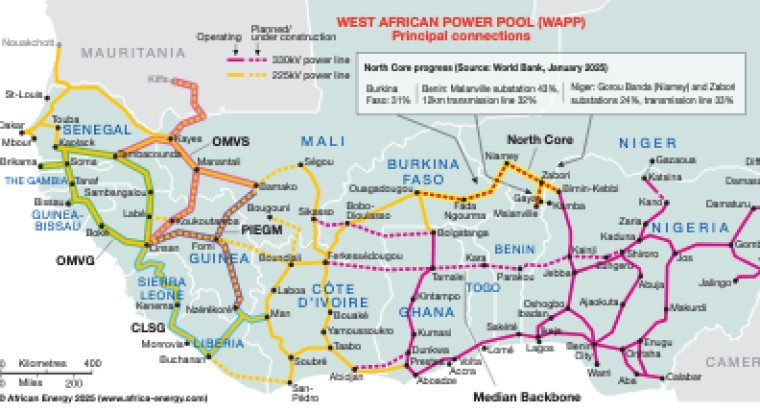
The test connects Nigeria, Africa's largest economy and biggest power producer, to a unified electricity market reaching from Senegal to Benin. Nigerian generators can now sell stranded capacity to neighbors, and a regional pool of about 400 million people gains a deeper market for cross-border trade.

Why it matters

A working regional grid lets surplus power move where it's needed, cutting outages in countries that import it and giving Nigerian generators paying customers for electricity that otherwise goes unused.

Key Indicators

4 hours
Duration of successful test
From 05:04 to 09:04 local time on November 8, 2025, with stable frequency across all participating countries.
7 minutes
Duration of the 2007 attempt
The previous synchronization try collapsed in minutes due to instability and poor coordination.
14
ECOWAS member countries in WAPP
Every mainland member of the Economic Community of West African States participates; only island nation Cape Verde is excluded.
86.8M
Nigerians without electricity access
World Bank's 2025 report puts Nigeria's unconnected population as the largest of any country worldwide.
$600M
Cost of the North Core interconnector
The 913 km transmission line linking Nigeria to Burkina Faso through Niger underpins this synchronization.
26 years
Time since WAPP was founded
ECOWAS heads of state created the power pool in December 1999 with the goal Nigeria just helped deliver.

Voices

Curated perspectives — historical figures and your fellow readers.

Ever wondered what historical figures would say about today's headlines?

Sign up to generate historical perspectives on this story.

Play

Exploring all sides of a story is often best achieved with Play.

Log in to play. Track your picks, climb the leaderboards. Log in Sign Up
Predict 4 ways this could play out. Contrarian picks score more — points lock when the scenario resolves. Log in to play
Higher or Lower Two numbers from this story. Guess which is bigger. 5 rounds to set a streak. Log in to play
Timeline Five events from this story — drag them oldest to newest. Log in to play
Connections Sixteen names from the news. Find the four hidden groups of four. Log in to play

People Involved

Organizations Involved

Timeline

December 1999 November 2025

9 events Latest: November 10th, 2025 · 6 months ago
Tap a bar to jump to that date
  1. Minister announces the milestone

    Latest Statement

    Power Minister Adebayo Adelabu confirms the synchronization and calls it one of WAPP's most significant milestones.

  2. Nigeria grid synchronizes with WAPP

    Technical

    Nigeria, Niger, and parts of Benin and Togo run at a stable shared frequency with the rest of the West African pool for four hours, from 05:04 to 09:04 local time.

  3. Abdu Mohammed appointed NISO CEO

    Leadership

    President Tinubu names Mohammed as the first managing director of the newly independent system operator.

  4. WAPP synchronizes 12 grids

    Technical

    Twelve West African countries' grids are permanently locked at a single frequency. Nigeria, Niger, Benin, and Togo remain the outliers.

  5. North Core 330 kV interconnector launched

    Infrastructure

    Construction begins on the $600M transmission line linking Nigeria, Niger, Benin/Togo, and Burkina Faso. Funded by the World Bank, African Development Bank, EU, and Nigeria.

  6. First Nigeria synchronization attempt fails

    Technical

    A test connecting Nigeria's grid to the regional network collapses after seven minutes from instability and poor coordination.

  7. WAPP articles of agreement adopted

    Institutional

    ECOWAS heads of state in Niamey approve the legal framework that lets WAPP operate as a specialized agency from Cotonou.

  8. ECOWAS creates the West African Power Pool

    Institutional

    The 22nd ECOWAS summit establishes WAPP to integrate national electricity grids across the region.

Historical Context

3 moments from history that rhyme with this story — and how they unfolded.

August 1995

Southern African Power Pool launch (1995)

Twelve member states of the Southern African Development Community signed an Inter-Governmental Memorandum of Understanding creating the Southern African Power Pool. South Africa's Eskom anchored the network, much as Nigeria now anchors WAPP.

Then

By 2000, the pool was trading electricity through bilateral contracts across borders.

Now

A competitive day-ahead market launched in 2009. The pool became the model African regional energy planners cite as proof that cross-border trade can work.

Why this matters now

WAPP has spent two decades trying to match what SAPP built. The Nigeria synchronization is the technical step that lets it begin operating like SAPP rather than like a network of bilateral arrangements.

September 2010

European grid synchronizes with Turkey (2010)

After years of trial runs, Turkey's grid was synchronized with the Continental European network operated by ENTSO-E. The Turkish system had been isolated since the 1960s and ran on its own frequency control.

Then

Test trading began immediately. Turkey gained access to a market of 400 million Europeans.

Now

Turkey now exports billions of kilowatt-hours into Europe each year. The integration survived political tensions including the 2016 attempted coup and disputes over Cyprus.

Why this matters now

The Turkey-Europe link shows that frequency synchronization across a politically heterogeneous region can survive shocks once the engineering works. WAPP faces a similar test as it spans countries inside and outside ECOWAS.

2007

Nigeria's 2007 synchronization failure

Nigeria attempted its first physical synchronization with the embryonic WAPP network. Frequency drift and weak coordination between control centers collapsed the link within seven minutes.

Then

Engineers shut down the interconnection. Both grids reverted to isolated operation.

Now

WAPP shelved further Nigeria-area tests for sixteen years while it built out the North Core transmission line and modernized control systems in member states.

Why this matters now

The 2007 failure is why this month's four-hour test matters. It is the first evidence in nearly two decades that the engineering problems that defeated WAPP's biggest member can be solved.

Sources

(10)