


Logo
Daily Brief
Following
Why
China Commits $574 Billion to Build World's Largest Power Grid Expansion

China Commits $574 Billion to Build World's Largest Power Grid Expansion

State Grid's 2026-2030 Investment Plan Aims to Unlock Stranded Renewables in Western Provinces

Today: State Grid Announces $574 Billion Five-Year Investment Plan

Overview

China installed more wind and solar capacity in 2024 than the United States has ever built—360 gigawatts in a single year. The problem: much of that clean power sits stranded in remote western deserts, thousands of kilometers from the factories and cities that need it. State Grid Corporation of China just announced $574 billion to fix that.

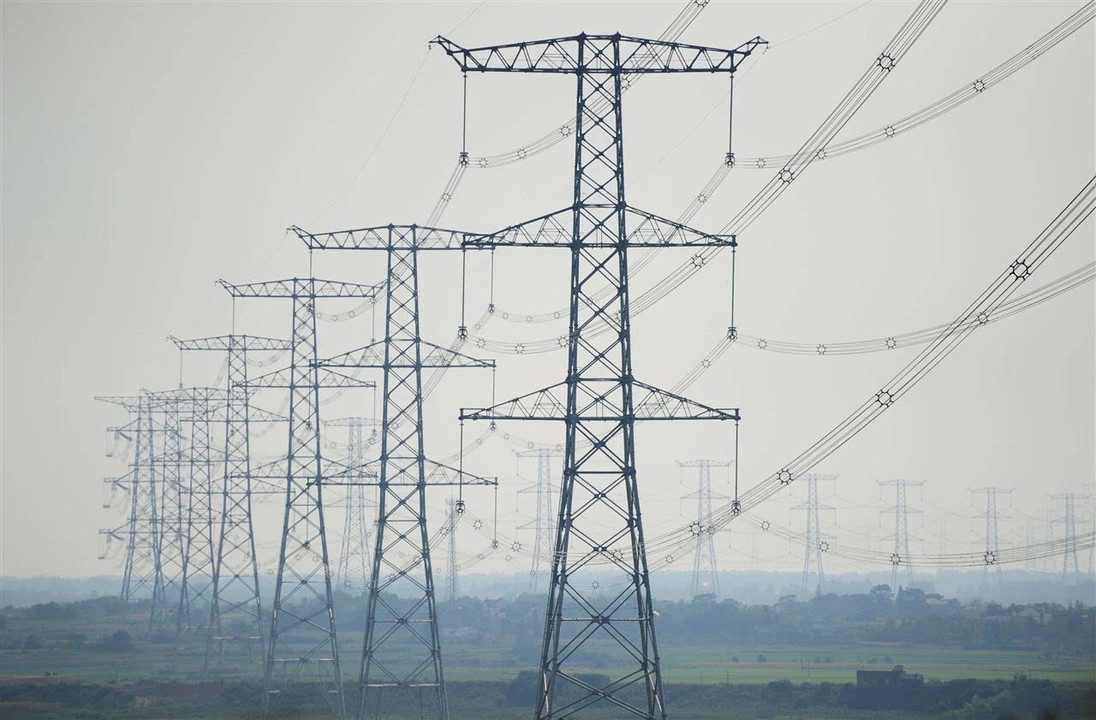
The five-year investment plan, a 40% increase over the previous period, will expand ultra-high-voltage transmission lines capable of moving electricity across continental distances with minimal losses. Cross-provincial transmission capacity will rise 30% by 2030. For China, this is the infrastructure required to make its 2030 carbon-peaking deadline credible. For the global energy transition, it's a test of whether any country can build transmission fast enough to match the pace of renewable deployment.

Key Indicators

$574B
Five-Year Grid Investment
State Grid's 2026-2030 spending plan, averaging 800 billion yuan ($115 billion) annually
40%
Investment Increase
Rise over the 14th Five-Year Plan (2021-2025) spending of roughly $410 billion
30%
Transmission Capacity Growth
Target increase in cross-provincial and cross-regional power transmission by 2030
5.7%
Solar Curtailment Rate
Share of solar generation wasted in H1 2025, up from 3% a year earlier—driving urgency for new lines
1,100 GW
Solar Capacity
China's installed solar capacity as of mid-2025, first country to exceed 1,000 GW
39
UHV Lines Operating
Current count of ultra-high-voltage transmission lines (19 AC, 20 DC) spanning 40,000+ km

People Involved

ZZ
Zhang Zhigang
Chairman, State Grid Corporation of China (Leading implementation of $574B investment plan)
XB
Xin Baoan
Former Chairman, State Grid Corporation of China (2021-2024) (Departed chairmanship in March 2024)

Organizations Involved

State Grid Corporation of China
State-Owned Enterprise
Status: World's largest utility by revenue, implementing record investment program

China's dominant power transmission operator, serving 1.1 billion people across 88% of national territory.

China Southern Power Grid
State-Owned Enterprise
Status: China's second-largest grid operator, expanding storage and transmission

Operates the power grid serving Guangdong, Guangxi, Yunnan, Guizhou, and Hainan provinces.

National Energy Administration
Government Agency
Status: Accelerating transmission line approvals to address curtailment

China's energy regulator responsible for policy, planning, and oversight of power sector development.

Timeline

  1. State Grid Announces $574 Billion Five-Year Investment Plan

    Investment

    State Grid unveils 4 trillion yuan plan for 2026-2030, a 40% increase over the previous period, targeting 30% growth in cross-provincial transmission capacity.

  2. Tibet-to-Guangdong UHV Line Construction Starts

    Infrastructure

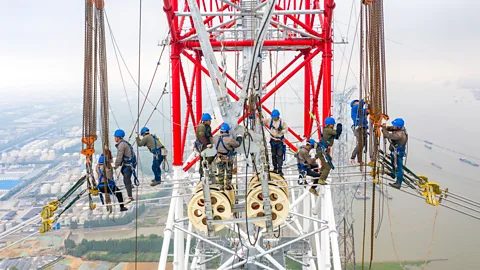
    Work begins on a 53 billion yuan, 2,681 km line—China's first UHV crossing the Qinghai-Tibet Plateau—to deliver clean energy to the Greater Bay Area.

  3. Curtailment Rates Hit Multi-Year Highs

    Challenge

    Solar curtailment reaches 5.7% and wind curtailment 6.6% in H1 2025, with some western provinces exceeding 30%—signaling grid constraints.

  4. China Becomes First Country to Exceed 1,000 GW Solar

    Milestone

    With 210 GW added in H1 2025 alone, China's total solar capacity reaches 1,100 GW—more than the rest of the world combined.

  5. Record Annual Grid Investment Announced for 2025

    Investment

    State Grid commits 650 billion yuan ($91 billion) for 2025—the highest single-year investment in company history.

  6. Inner Mongolia UHV Line Construction Begins

    Infrastructure

    Groundbreaking on a 700 km, 8 GW DC line to deliver desert solar and wind power from western Inner Mongolia to Beijing-Tianjin-Hebei region by 2027.

  7. China Hits 1,200 GW Wind/Solar Target Six Years Early

    Milestone

    Combined wind and solar capacity reaches China's 2030 target of 1,200 GW by mid-2024, intensifying pressure on transmission infrastructure.

  8. Zhang Zhigang Becomes State Grid Chairman

    Leadership

    Zhang Zhigang succeeds Xin Baoan, inheriting responsibility for completing UHV buildout amid rising renewable curtailment.

  9. State Grid Announces $329 Billion for 14th Five-Year Plan

    Investment

    New chairman Xin Baoan commits to major grid expansion, targeting completion of 38 UHV projects by 2025.

  10. World's Highest-Voltage Transmission Line Completed

    Infrastructure

    The Changji-Guquan ±1,100 kV DC line begins full operation—3,324 km long with 12 GW capacity, connecting Xinjiang's coal and wind resources to Anhui province.

  11. UHV Technology Enters National Five-Year Plan

    Policy

    China's 12th Five-Year Plan formally incorporates UHV grid expansion, accelerating construction of cross-regional transmission corridors.

  12. World's First 800 kV DC Line Connects Sichuan to Shanghai

    Infrastructure

    The Xiangjiaba-Shanghai UHV DC line begins transmitting 7 GW of hydropower across 2,000 km, supplying 30% of Shanghai's electricity.

  13. China's First UHV Line Begins Operation

    Infrastructure

    The Jindongnan–Nanyang–Jingmen 1000 kV AC demonstration project becomes operational—the world's first commercial UHV AC transmission line, establishing China's technological lead.

Scenarios

1

China Peaks Emissions Before 2030, Grid Expansion Enables Clean Energy Integration

Discussed by: IEA, Carbon Brief, BloombergNEF analysts covering China's energy transition

State Grid's aggressive buildout succeeds in connecting western renewable capacity to eastern load centers. Curtailment rates fall below 5% by 2028. Coal consumption peaks around 2027 as projected. China meets its 2030 NDC commitment with room to spare, having already exceeded renewable capacity targets six years early. The grid becomes a model for other large developing economies facing similar geographic mismatches between generation and demand.

2

Transmission Lags Renewable Growth, Curtailment Crisis Deepens

Discussed by: Natixis economists, Bloomberg energy reporters, Bruegel Institute researchers

Despite record investment, UHV line construction cannot keep pace with 250-300 GW of annual renewable additions. Curtailment rates rise above 10% nationally, with some provinces exceeding 40%. Provincial governments restrict new renewable installations. China's carbon peaking deadline becomes uncertain. Equipment manufacturers face order backlogs and supply chain bottlenecks. The scenario highlights structural limits of centralized grid planning in a market adding capacity faster than any grid in history.

3

AI and Data Center Demand Overwhelms Grid Capacity Gains

Discussed by: Goldman Sachs, IEA, Fortune magazine technology and energy coverage

Data center electricity consumption triples from 200 TWh to 600 TWh by 2030 as China's AI sector expands. New transmission capacity is absorbed by industrial demand rather than reducing curtailment. Eastern provinces face summer reliability challenges. Grid operators must choose between curtailing renewables in the west or implementing demand-side management in coastal cities. The scenario tests whether grid investment can serve both decarbonization and industrial policy goals simultaneously.

4

China's Grid Model Exported Globally via Belt and Road Infrastructure

Discussed by: Council on Foreign Relations, IRENA, energy sector trade publications

Having proven UHV technology at scale domestically, Chinese grid equipment manufacturers (TBEA, Nari Technology, Pinggao) capture dominant global market share. State Grid signs construction contracts for cross-border transmission in Southeast Asia, Central Asia, and Africa. Chinese technical standards become de facto international norms. Countries with geographic renewable-demand mismatches—Brazil, India, Australia—adopt Chinese UHV technology, accelerating their own transitions while creating long-term equipment dependencies.

Historical Context

US Rural Electrification Administration (1935-1949)

1935-1949

What Happened

When Franklin Roosevelt took office, only 10% of rural American farms had electricity. The Rural Electrification Administration provided low-interest loans to cooperatives, enabling construction of transmission lines into areas private utilities deemed unprofitable. Within 15 years, rural electrification reached 90%.

Outcome

Short Term

Farm productivity increased dramatically as electric motors replaced manual labor. Refrigeration transformed food storage and safety.

Long Term

The program became a template for government-financed infrastructure expansion. Rural electrification enabled the mechanization of American agriculture and laid groundwork for postwar suburbanization.

Why It's Relevant Today

China's west-to-east transmission buildout echoes the REA's challenge: extending grid infrastructure to remote regions where private investment alone would be insufficient, using state capital to solve a geographic mismatch between resources and demand.

Germany's Energiewende Grid Bottleneck (2011-Present)

2011-Present

What Happened

After Fukushima, Germany accelerated renewable deployment, adding over 100 GW of wind and solar by 2024. But north-south transmission lines to connect offshore wind to southern industrial centers faced permitting delays and local opposition. Projects approved in 2015 remained incomplete a decade later.

Outcome

Short Term

Germany experienced negative wholesale power prices during sunny, windy periods while coal plants in the south continued operating.

Long Term

Grid congestion costs exceeded €4 billion annually by 2023. Germany's grid investment needs through 2045 now total €650 billion. The country became a cautionary example of renewable deployment outpacing transmission planning.

Why It's Relevant Today

Germany's experience demonstrates the risk China faces if transmission construction cannot match renewable installation rates. China's centralized planning and state ownership of grid assets may allow faster construction than Germany's federated approval process, but curtailment rates are already rising.

Three Gorges Dam and West-East Power Transmission (2003-2012)

2003-2012

What Happened

The Three Gorges Dam required transmitting 22.5 GW of hydropower from Hubei province to Shanghai and Guangdong, distances exceeding 1,000 km. China built its first ±500 kV DC lines for the project, gaining experience that informed the subsequent UHV program.

Outcome

Short Term

The project demonstrated China could build continental-scale transmission infrastructure. It justified State Grid's bet on developing higher-voltage technology.

Long Term

Three Gorges transmission became the engineering foundation for China's UHV program. The institutional knowledge and supply chains developed for hydropower evacuation now support renewable integration.

Why It's Relevant Today

Today's $574 billion investment is the third chapter in a 20-year story of Chinese grid expansion—from Three Gorges hydropower, to the first UHV demonstration lines, to the current buildout designed for variable renewables at unprecedented scale.

12 Sources: