

Pull to refresh
Logo
XPENG upgrades driving simulator to reuse real streets as virtual test tracks

XPENG upgrades driving simulator to reuse real streets as virtual test tracks

New Capabilities

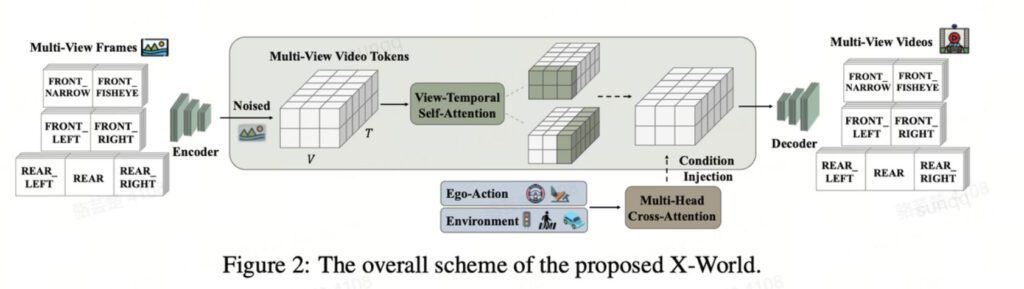
X-World 1.6 anchors generated scenes to recorded road geometry and cuts trajectory error 20.9% against version 1.0

Overview

Updated 4 minutes ago

A pedestrian steps off a curb once. The car brakes, or it doesn't, and the moment is gone. Engineers can never rebuild that exact intersection with that exact timing, so they cannot prove a revised driving model would handle it better.

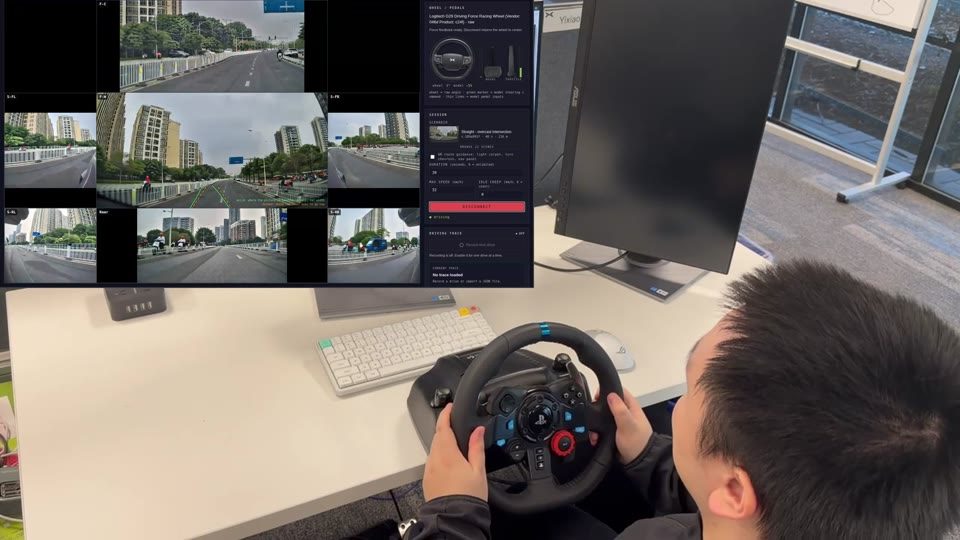
XPENG's answer is to reconstruct the street itself. X-World 1.6, announced November 23, 2026, keeps the recorded geometry of a real location (roads, buildings, bridge piers) and then varies what engineers want to test: traffic, weather, the timing of a light. XPENG says simulated vehicle paths now land 20.9% closer to reference trajectories than in version 1.0.

The point is repeatability, not prettier video. A model can take the same rare test a hundred times, and a team can compare two versions of its driving software against an identical street.

Why it matters

Self-driving systems learn most from rare, dangerous moments. Reusable simulations let a model retake those one-off tests a thousand times.

Questions about this story

Free account needed to ask — your question is kept and asked for you right after sign-up. Answers are public.

No questions yet — be the first to ask.

Key Indicators

20.9%
Reduction in average trajectory endpoint error
Compared with X-World 1.0 in XPENG's internal evaluations.
96.4%
Reviewed cases with improved or comparable failure reproduction
XPENG's own paired review; 3.6% of cases got worse.
19%
Cases where target-failure reproduction improved
Measured against version 1.0, not an absolute success rate.
30+ s
Length of multi-camera rollouts the model can generate
XPENG notes long rollouts still lose scene content behind occlusions.

Voices

Curated perspectives — historical figures and your fellow readers.

Sign up to generate historical perspectives on this story.

People Involved

Organizations Involved

Timeline

March 2026 November 2026

3 events Latest: Today
  1. X-World 1.6 launches with Virtual City

    Today Product

    XPENG announces reconstruction of recorded locations, interactive driving through generated scenes, and a 20.9% trajectory-error reduction versus 1.0.

  2. Technical paper on 1.6 submitted

    Research

    XPENG submits a preprint describing the upgraded model, its Virtual City pipeline and its evaluation tables.

  3. X-World 1.0 enters service

    Product

    XPENG's first generative driving simulator is described publicly and used to develop its VLA 2.0 driving model.

Scenarios

1

XPENG ships a successor that holds a scene together

Likely Resolves by Q2 2027

Discussed by: XPENG's own preprint, which names scene memory and control consistency as the next post-training targets

The 1.6 paper says long occlusions can still erase previously observed scene content, and that inconsistent control inputs produce discontinuities. A follow-up that keeps a street stable across a minute of driving would make Virtual City usable for long-horizon tests rather than short replays.

2

Outside researchers reproduce the consistency gains

Uncertain Resolves by End of 2027

Discussed by: Independent coverage that notes every figure comes from XPENG's preprint rather than third-party testing

Each number in the announcement is an internal comparison against X-World 1.0. If a university or rival lab runs the model on data XPENG did not supply and gets similar trajectory agreement, the simulator becomes a shared benchmark. If not, the claim stays a vendor figure.

3

Regulators start counting simulated miles

Unlikely Resolves by Q2 2028

Discussed by: XPENG's release, which frames simulation as complementing real-world testing rather than replacing it

XPENG's own material says simulation results are supporting evidence and that final validation still happens on real roads. If a regulator wrote simulated validation into type approval, demand for world models across the industry would widen. No regulator has said it will accept X-World output.

Historical Context

3 moments from history that rhyme with this story — and how they unfolded.

2010s

Waymo's Carcraft simulator (2010s)

Google's self-driving team built a virtual replica of the streets it tested on so engineers could replay real drives and insert variations a road test could not stage. The tool let the team run far more simulated miles than road miles, and it became the standard way to regression-test a software change before it reached a vehicle.

Then

Simulation became the default first filter for new driving software, catching regressions before road testing.

Now

It set the expectation that a self-driving program needs a virtual copy of its operating area, not just logged data.

Why this matters now

XPENG's Virtual City is the same idea applied to generative models: keep a recorded place, change the conditions, replay the test.

2023

Wayve's GAIA-1 world model (2023)

Wayve published a generative world model that produced driving video from prompts, generating plausible streets, vehicles and weather it had never filmed. It showed that a neural network could synthesize realistic driving scenes, but keeping a scene stable across repeated generations proved difficult.

Then

The work popularized generative world models as a training tool for driving AI.

Now

Controllability and consistency became the recognized bottlenecks, which is the problem grounded reconstruction tries to solve.

Why this matters now

XPENG's 1.0 model belonged to this purely generative wave, and the 1.6 upgrade is a direct response to its drift.

January 2025

NVIDIA Cosmos world foundation models (2025)

NVIDIA released a family of world foundation models trained on video and pitched them to robotics and autonomous vehicle developers as a source of synthetic training data. The release made world models a commercial product category rather than a research demo.

Then

Automakers and robotics firms gained off-the-shelf tools for generating training scenarios.

Now

The competitive question shifted from whether a company had a world model to whether its model could be controlled precisely enough to trust.

Why this matters now

XPENG's pitch for 1.6 is control and repeatability, the same axis on which general-purpose world models are judged.

Sources

(8)