


Pull to refresh
Logo
Zhejiang University team claims deterministic subexponential discrete logarithm algorithm

Zhejiang University team claims deterministic subexponential discrete logarithm algorithm

New Capabilities

The preprint breaks a square-root time barrier in theory, but depends on an unproven OpenAI construction and applies only to enormous keys.

Overview

Updated 46 minutes ago

For 55 years, the fastest known deterministic method for the discrete logarithm problem needed about the square root of the group size in time. A preprint posted 23 November 2026 by three researchers at Zhejiang University claims a deterministic algorithm that runs in p^o(1), a subexponential bound that grows slower than any fixed power of the prime.

The catch is scale and dependence. The new exponent only falls below one-half for keys far larger than any deployed today, and the proof leans on a Boolean tensor contraction construction from an OpenAI preprint published in October 2026. No standardized elliptic curve becomes easier to break.

Why it matters

The result makes no deployed cipher easier to break, but it ends a 55-year assumption that deterministic discrete logarithms could not beat square-root time.

Questions about this story

Free account needed to ask — your question is kept and asked for you right after sign-up. Answers are public.

No questions yet — be the first to ask.

Key Indicators

p^o(1)
Worst-case deterministic running time
Subexponential in the bit length of the prime, with zero random bits and no smoothness heuristics.
55
Years the square-root bound held
Shanks' 1971 baby-step giant-step method set the p^(1/2+o(1)) benchmark for deterministic algorithms.
2^(2^17)
Estimated key size where the method could overtake classical attacks
One commentator's estimate puts the crossover far beyond any deployed key.
0
Random bits required
The algorithm is fully deterministic, unlike the Las Vegas predecessors from October 2026.

Voices

Curated perspectives — historical figures and your fellow readers.

Sign up to generate historical perspectives on this story.

People Involved

Organizations Involved

Timeline

October 2026 November 2026

3 events Latest: 4 days ago
  1. Liu, Zhang and Ren post a deterministic subexponential DLP preprint

    Latest Research

    The paper claims p^o(1) worst-case time for prime-field and prime-order elliptic-curve discrete logarithms, conditional on OpenAI's tensor contraction scheme.

  2. OpenAI and Anthropic postprints claim to refute the Exponential Time Hypothesis

    Research

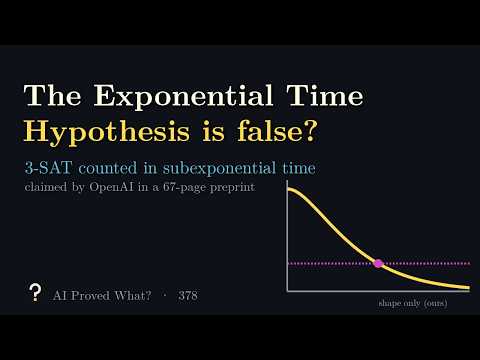
    Deterministic subexponential algorithms for sparse Boolean tensor networks and 3-SAT undermine a long-standing complexity assumption.

  3. Akshima et al. and Kaarelson publish Las Vegas subexponential elliptic-curve DLP algorithms

    Research

    Both rely on randomness for factor-base coverage, leaving deterministic p^o(1) discrete logarithms open.

Scenarios

1

Peer review accepts the result with its conditional premise intact

Possible Resolves by End of 2027

Discussed by: The paper's own authors, who flag the OpenAI Cauchy–Hermite construction as their sole unrefereed premise

If the OpenAI tensor-contraction construction holds up and the Zhejiang proof survives checking, a refereed venue publishes a deterministic p^o(1) discrete logarithm algorithm. That would make the complexity-theory claim durable even though it changes nothing for deployed cryptography.

2

No standardized cryptography is weakened

Likely Resolves by End of 2027

Discussed by: Hacker News commenters and cryptographer Lukasz Olejnik, who note the bound says nothing concrete for 256-bit curves

The bound only undercuts square-root attacks at key sizes far beyond any deployed curve, so P-256, P-521, secp256k1 and other standards keep their status. This is the most likely near-term outcome and the easiest to verify.

3

The OpenAI tensor-contraction premise is found flawed

Uncertain Resolves by End of 2027

Discussed by: Independent cryptanalysts and complexity theorists checking the October 2026 OpenAI preprint

Because the DLP proof rests entirely on OpenAI's Appendix D construction, an error there would collapse the result. Any retraction or independent refutation of the Cauchy–Hermite scheme would send the paper back to the drawing board.

Historical Context

3 moments from history that rhyme with this story — and how they unfolded.

1971

Shanks' baby-step giant-step method (1971)

Daniel Shanks published a method for solving discrete logarithms in roughly the square root of the group order. Nechaev and Shoup later showed that no generic algorithm could do better in the black-box model.

Then

The square-root method became the benchmark for prime-order groups.

Now

It set the p^(1/2+o(1)) wall that deterministic algorithms failed to breach for 55 years.

Why this matters now

The Zhejiang preprint claims to break that wall deterministically, the first such claim in the problem's history.

1979

Adleman's index calculus (1979)

Leonard Adleman gave a randomized subexponential algorithm for discrete logarithms in prime fields. Later work by Coppersmith, Gordon and the number field sieve improved the exponent to roughly one-third, but always with randomness or heuristic assumptions.

Then

Subexponential attacks on finite-field discrete logs became practical for some sizes.

Now

Deterministic subexponential time for discrete logarithms stayed open, and elliptic curves had no subexponential method at all.

Why this matters now

The new paper targets exactly the gap Adleman's line of work left open: subexponential time with zero random bits and no smoothness heuristics.

October 2026

The October 2026 ETH refutations

OpenAI and Anthropic preprints claimed deterministic subexponential algorithms for sparse Boolean tensor networks and 3-SAT, refuting the Exponential Time Hypothesis. Rudich and Rousseau applied the approach to integer factoring.

Then

Akshima et al. and Kaarelson built Las Vegas subexponential algorithms for elliptic-curve discrete logarithms.

Now

Deterministic p^o(1) discrete logarithms in prime fields remained the open case that Kaarelson explicitly flagged.

Why this matters now

The Zhejiang paper is a direct follow-on that takes the OpenAI construction and pushes the discrete logarithm case from randomized to deterministic.

Sources

(7)