

Pull to refresh
Logo
All regions near Paris warming limits, study finds

All regions near Paris warming limits, study finds

New Capabilities

Global land has warmed 1.9°C since preindustrial times; northwestern North America is at 3°C.

Overview

Updated 1 hour ago

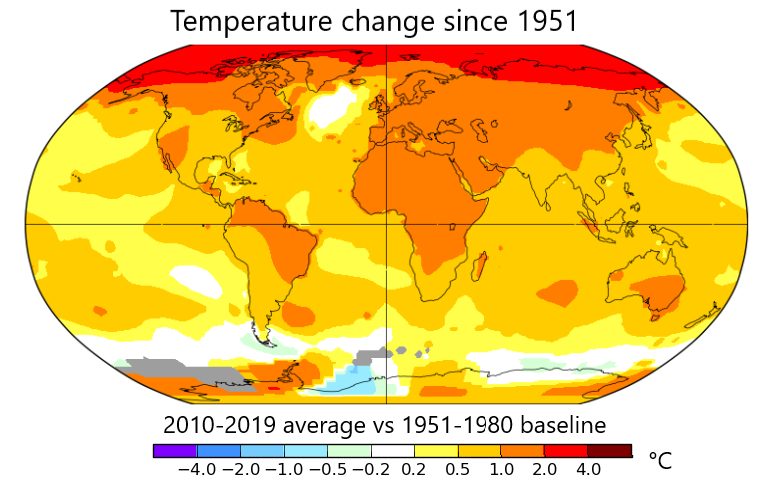
In northwestern North America, the past decade averaged about 3°C warmer than the late 1800s. A study published in Nature Climate Change finds that is roughly twice the global land average, which has already reached 1.9°C above preindustrial levels.

The study uses a Bayesian method that combines climate models with sparse observations to estimate human-caused warming in all 46 IPCC regions. It finds every region has already experienced 90–94% of the warming expected in a world where the global average reaches 1.5°C. The uncertainty ranges include 100%, meaning current regional warming is statistically indistinguishable from a 1.5°C world.

Why it matters

Every region has already banked most of the warming expected at 1.5°C, so adaptation plans must catch up with a climate already here.

Questions about this story

Free account needed to ask — your question is kept and asked for you right after sign-up. Answers are public.

No questions yet — be the first to ask.

Key Indicators

1.9°C
Global land warming
Average land surface temperature above 1850–1900 for 2016–2025.
3.0°C
Northwestern North America warming
Regional warming above preindustrial, about twice the global land average.
90–94%
Share of 1.5°C regional warming already realized
Best estimate across IPCC regions by 2025.
65–76%
Share of 2°C regional warming already realized
Best estimate across IPCC regions by 2025.
1.4°C
Global mean warming in 2025
Attributable global average above 1850–1900.
46
IPCC AR6 regions assessed
All regions covered by the study.
2029
Projected 1.5°C threshold
Under SSP5-8.5, the study projects the global mean reaches 1.5°C around 2029.

Voices

Curated perspectives — historical figures and your fellow readers.

Sign up to generate historical perspectives on this story.

Organizations Involved

Timeline

December 2015 November 2026

4 events Latest: Today
Tap a bar to jump to that date
  1. University of Victoria announces findings

    Today Statement

    News release highlights 1.9°C land warming and 3°C in northwestern North America.

  2. Study published in Nature Climate Change

    Research

    Bayesian analysis estimates attributable warming for all IPCC regions.

  3. IPCC AR6 defines regional framework

    Report

    The Sixth Assessment Report sets the 46 reference regions used in the study.

  4. Paris Agreement adopted

    Treaty

    Countries agree to keep warming well below 2°C and pursue 1.5°C.

Scenarios

1

Global annual temperature reaches 1.5°C by 2029

Likely Resolves by End of 2030

Discussed by: Study authors and WMO climate reports

The study projects the 1.5°C global threshold around 2029 under SSP5-8.5. A single year at 1.5°C would not mean the Paris target is permanently breached, but it would mark the first annual crossing in major datasets.

2

2°C threshold reached by 2042 under high-emissions path

Possible Resolves by End of 2043

Discussed by: Study authors

Under SSP5-8.5, the study projects the 2°C global threshold around 2042. That path assumes high emissions continue, so slower emissions growth would push the date later.

3

IPCC AR7 cites regional attribution method

Uncertain Resolves by End of 2029

Discussed by: Climate attribution researchers

The study's Bayesian method fills observation gaps in Africa, South America and the polar regions. If the next IPCC assessment adopts it, regional warming estimates could become standard in adaptation planning.

Historical Context

2 moments from history that rhyme with this story — and how they unfolded.

December 2015

Paris Agreement (2015)

At COP21, 195 countries agreed to hold global warming well below 2°C and pursue efforts to limit it to 1.5°C. The deal relied on national pledges rather than binding emissions caps.

Then

Countries submitted initial pledges that fell short of the temperature goals.

Now

The 1.5°C target became a benchmark for climate policy, adaptation finance and loss-and-damage talks.

Why this matters now

The new study measures how much of that 1.5°C-equivalent warming each region has already experienced.

August 2021

IPCC Sixth Assessment Report (2021)

The IPCC's Working Group I report concluded human influence had warmed the atmosphere, ocean and land. It also defined the AR6 reference regions used in the new study.

Then

It became the standard scientific reference for regional climate impacts.

Now

Its regional framework allowed later attribution studies to compare warming across all inhabited continents.

Why this matters now

The new study fills the regional observation gaps that AR6 flagged, especially in Africa and South America.

Sources

(5)